Movie Review: Carol
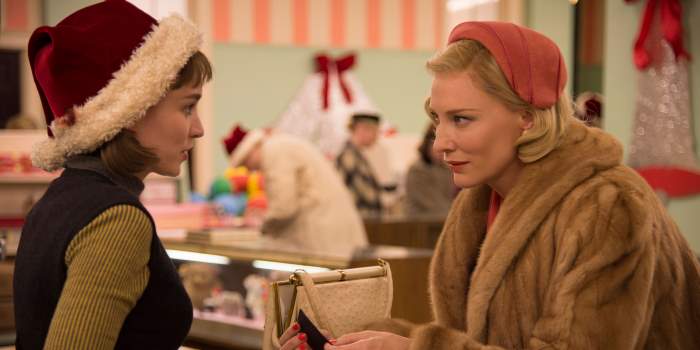
Chilly? Icy? Distant? Not even close.
Ever since Carol debuted at the Cannes Film Festival midway through 2015, a coded kind-of language has punctuated otherwise rave reviews.
Having finally seen Todd Haynes’ aesthetically immaculate and emotionally resonant 1950s romance, I have to paraphrase Inigo Montoya and evoke one of the Internet’s favourite memes: "You keep using those words. I do not think they mean what you think they mean."
A slight chill is to be expected in a picture about a clandestine lesbian relationship, particularly one set in an era where such a thing becoming public could be ruinous for all involved. (It also takes place in the winter, so... you know: cold.)
There are longing looks; the nervous anticipation of touch; much feeling, withheld. Just as he did with Far From Heaven, director Haynes relays a story that, once upon a time, simply wasn’t allowed on screens. When Patricia Highsmith wrote the book upon which Carol is based—titled The Price of Salt, published in 1952 under the pseudonym Claire Morgan—the Hays Code censored American flicks from featuring anything remotely explicit (chiefly: sex and homosexuality).
In period-specific detail, aided by warm Super 16mm cinematography, Haynes has made something that wouldn’t have looked out of place in the golden era of moviemaking, except it contains that which was once deemed questionable by Hollywood’s morality guardians. How can you call Carol chilly when it’s literally the thawing of cinema’s inglorious past?
The film begins with young New York shopgirl Therese Belivet (a delicate Rooney Mara, deserving winner of the Best Actress prize at Cannes) recalling the origins of her affair with refined society lady Carole Aird (Cate Blanchett, in a role you’d swear was written for her, if it hadn’t been published in a book seventeen years before her birth).

One Christmas, Therese spies Carol from across the department store, and an immediate crush is born. The older woman invites the ingénue to lunch, and later, to her home. Therese’s nice-guy boyfriend Richard (Jake Lacy) is puzzled by the sudden friendship, to say the least. It’s at Carol’s that Therese runs into her soon-to-be ex-husband Harge (Kyle Chandler); he’s much wiser than Richard as to Carol’s intentions, based on previous experience.
Embarrassed and emasculated, Harge begins to seek sole custody of their young daughter Rindy. Wanting badly to leave the city (and her problems) behind, Carol brings Therese along for a friendly road trip to Chicago. Of course, it becomes much more.
The discovery of a gun in Carol’s luggage and the looming threat of the heartbroken Harge suggests we’re rollicking towards a violent, tragic end. Highsmith’s body of work, comprising The Talented Mr. Ripley and other such grisly mysteries, indicates the same. Carol takes a detour by focusing on the flowering relationship of its two leads; women from different walks of life, and generations, and two very different 'coming out' experiences.
Through Haynes’ sensitive, slow-cook direction, the luminous performances by the impeccable Blanchett and Mara, and the personal investment of the author in the original text (Highsmith had a similar romance in her youth), Carol exceeds the constraints of regular cinematic romances, where charismatic leads are drawn to one another solely by attraction and relative proximity. Not salacious in the slightest, this feels like love.
The feature—adapted by Phyllis Nagy, photographed by Edward Lachman and scored by Carter Burwell—indeed builds to a satisfying climax, though not an explosive one. In recent decades, unburdened by the Hays Code, queer cinema has nonetheless rested on tragic endings (not unreasonably, given the persecution that has continued of LGBTQI individuals to this day). And yet, Carol gives its subjects an opportunity to find happiness with one another despite massive consequences in a world that would encourage them to remain closeted for decades to come. The beautiful final shot opens the door for a new way to tell these stories in cinema.
Snow paints the streets throughout Carol. By the closing credits, it was I who had melted.
4/5
In Australian cinemas January 14, 2016. Rated M for mature themes, sex scenes, nudity and coarse language.
Topics
Ref: 59fcc3eb-1cb0-454d-a831-a562002dbd4b





Comments & Feedback
Share your opinion
Emoji cheatsheet Formatting Comment guidelines