Movie Review: Bridge of Spies
Steven Spielberg is still big. It’s his pictures that got small.
The enfant terrible of the New Hollywood movement is now a 68-year-old man. Is it any surprise he’s moved away from the popcorn-pushing fare of Jaws and Jurassic Park to direct serious political dramas like Lincoln and Bridge of Spies? The man has a legacy to consider.
When he announced that he would cede direction of Jurassic World to newcomer Colin Trevorrow, and abandoned plans to make the dumb-sounding Robopocalypse, it appeared as if the era of the “marquee” (aka, "fun") Spielberg movie was over. It would now be self-serious Amistads, from here to eternity.
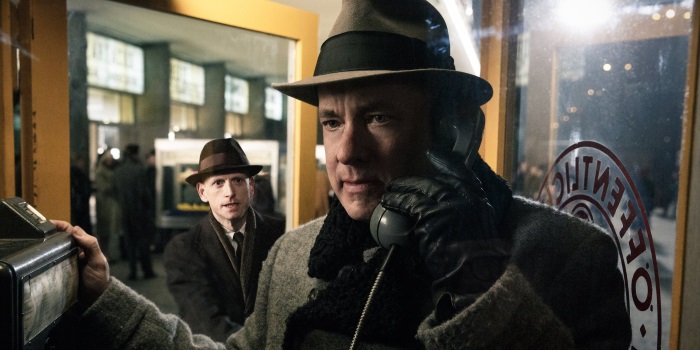
However, it takes only five minutes for him to put his indelible signature on Bridge of Spies, a true cold war tale that opens with a wordless manhunt across New York. Later, one of the last remaining big screen stars, Tom Hanks, is given ample opportunity to speechify with the gusto of James Stewart in a Frank Capra classic. Here is a picture about a lengthy geopolitical negotiation, told compellingly and with great skill. Fun has not yet been taken off the table.

Hanks portrays James B. Donovan, an insurance lawyer specially selected to represent alleged KGB spy Rudolph Abel (Mark Rylance) following his uncovering in Brooklyn. An unquestionably good man – the likes of which only Hanks can convincingly play – Donovan ignores instruction to represent Abel with minimal enthusiasm and instead seeks to spare him from the electric chair. His family (wife, Amy Ryan, daughter, Eve Hewson) pays the price, targeted by vandals and angry neighbours who can’t fathom why the Donovan family would side with the Russians at a time in which a nuclear showdown seems guaranteed.
Donovan’s foresight is only appreciated by the Feds when an American spy is eventually captured in Soviet territory. Suddenly, the United States wants to trade Abel for the return of its own son. The thing is, the Government can’t be seen to make such compromises with a Communist nation. So, Donovan is sent to East Berlin (officially representing “no one”) where he attempts to negotiate the trade in secret; a trade made more complicated when Donovan starts bartering for the release of another imprisoned American student too. He does it all while battling the sniffles; here, a staggering obstacle. Spielberg finds thrills where other directors find only snot.
Just as with Lincoln, where he partnered with the Pulitzer Prize-winning playwright Tony Kushner, on Bridge of Spies, Spielberg works from a Coen brothers’ screenplay (featuring more of their conversational idiosyncrasies and strange character touches – like that cold - than was weeded out of their Unbroken screenplay). Hanks, who has had bad luck with the Coens in the past, is a marvellous match for their stylised, old-Hollywood banter. Mark Rylance, a well-regarded English theatre actor, is gifted one memorable monologue, despite playing a character of resolute quiet. Amy Ryan, on the other hand, is given nothing. If we’re ranking crimes depicted in Bridge of Spies, her underuse goes hand in hand with treason.
Most of the movie takes place in stuffy rooms, but cinematographer Janusz Kamiński lets the natural light seep through the windows, distorting and blurring the frame. You keep waiting for the Tripods from War of the Worlds to storm in. Our director only knows how to make blockbusters, even when the subject wouldn’t seem to befit such a treatment.
For much of its running time, Bridge of Spies, unearthed from the volumes of memorable spycraft anecdotes of the era, does seem deserving of the Spielberg touch. It’s a potent parable about patience, translated as a thriller. Who can keep quiet the longest, or maintain their mettle, is a running theme, as it was throughout much of the Cold War. Men waiting by the phone can result in nail-biting sequences, perhaps only under Spielberg’s direction.
However, another guarantee of a Spielberg production is an epilogue that runs ten minutes too long. Just when you thought Bridge of Spies would be a little pricklier than your typical mainstream flick, it collapses into a heap of saccharine sentimentality. You want it to end on the titular bridge, but the film just keeps on going. That’s Spielberg for you though: he’s not changing his ways now, for better or worse.
3.5/5
In cinemas now. Rated M for mature themes, violence and coarse language.
Topics
Ref: d6fe351e-982b-4650-af6c-a539000fc1b0



Comments & Feedback
Share your opinion
Emoji cheatsheet Formatting Comment guidelines