Is There Too Much Technology Being Used In the Classroom?
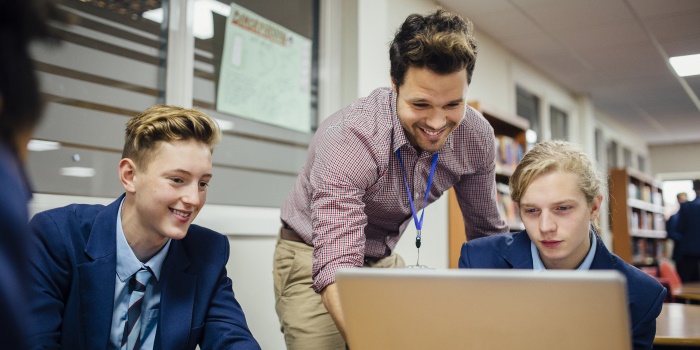
We don’t want to lose touch with our textbooks. For the sake of our education, let’s find a way to seek a balance with technology.
As technology constantly changes, so should the ways in which we learn, but that does not mean traditional methods are ineffective.
I grew up in the era when technology was starting to gain control—smart phones were brick-sized, computers were running on Windows 97 and touch screen technology was still in development. Today, kids dive feet-first into this digital era, where technology is integral in how we live.
We can’t detach ourselves from ringing notifications and updates anymore; technology has without a doubt become addictive. As a result, students are now handed devices in the classroom.
It’s easy to forget that textbooks and whiteboards are still effective ways of teaching. New computer-based games and programs can make learning fun, and certainly exposing kids to new technologies will help kids keep up to date, but why can’t we seek a balance with these tools?
To make the way we learn the best it can be, we cannot just hand devices on a silver platter to students without guidance. The education system needs to train and make certain that teachers are in control, and can switch between both methods of learning for greater effectiveness.
Computers will soon outnumber the students!

In Victoria, the overall ratio of students to computers has reduced steadily. The average has fallen from 4.17:1 in 2003 to 1.18:1 in 2016.
To keep up with the demand for computers, the federal government has chosen to embrace technology within the walls of the classroom, rolling out initiatives such as the BYOD (Bring Your Own Device) policy, which encourages greater access to online resources and allows students to have access to smart devices.
The $2.1 billion Digital Education Revolution (DER) also aims to innovate all aspects of technology, specifically by handing out devices to students across Australia. A report released by ACER in 2010 estimated there would be more than one million computers in secondary schools by 2012 through the DER scheme.
“Hyperadoption” is here.

Over the past decade, students have been in more control of how they learn, adopting their own methods to learning, choosing to engage with either their teachers or their technologies.
Our libraries, textbooks and resources are constantly transforming into digitised files and placed into the ubiquitous networks of 0s and 1s.
However, providing students with devices to access their own ‘spheres’ inside the classroom has caused the onset of the “hyperadoption” phenomena, which reduces the sense of caution that people once felt in the face of new and untested things.
I believe giving students textbooks and applying computer games, activities and programs to enhance their learning as a secondary feature is the way to go.
Separating social lives from the learning environment.
The internet brings potentially harmful content closer to young people. Students can also cross in and out of their own realities, thanks to social media.
Is this really healthy for students to be potentially exposed to at a young age?
An ACMA study showed that 88 per cent of teen internet users go on the internet more than once a day. It is more than fair to question if their access to the net in schools is actually beneficial.
Of course, if teachers can take the advantages of technology and integrate those tools with the curriculum, students could in fact be more stimulated to learn.
Is a balance possible with technology and education?
It certainly is possible to create a positive balance between technology and learning. There is no doubt that technology opens bigger opportunities to learn in a fun and enhanced way. Teachers simply need to look a step ahead and think of the best ways to move alongside this digital era without losing touch with their traditional roots.
Andrea Au is one of Student Edge’s student contributors. See more student contributions here.
Photo: iStock



Most Popular



Comments & Feedback
Share your opinion
Emoji cheatsheet Formatting Comment guidelines
Students should have way less technology in class! I know this makes me sound like someone who grew up in the 60s, but technology is taking over our lives. Nowadays, we aren't even learning how to spell because of spell check. This is my opinion. I'm not angry. I'm just disappointed in my species.
I was in a computer only class for a year. It was a lot less stressful because, with paper, you never know if you lose an important sheet. It also puts a lot less stress on your back since most classes require you to take textbooks for homework. In that class, almost everything is online. I believe technology should be used in the classroom but for maximum half the class
:)