Here's Why We Need More Young Women in STEM
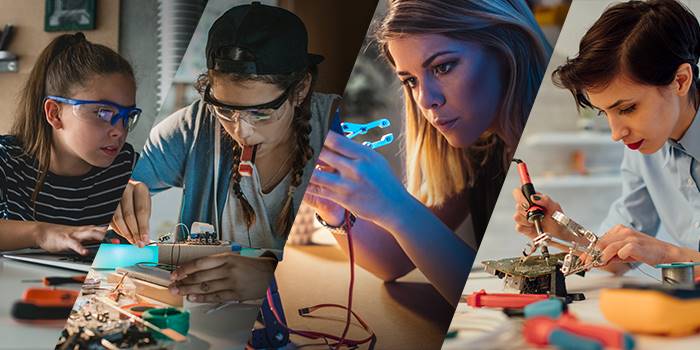
Sixty years ago, this world was a drastically different place for women.
Girls were destined to be mothers and housewives, and if they dared to have a career, it rarely went beyond nursing or teaching.
Thankfully, things have changed since the 1950s. Women are venturing out of the house and are branching out into other careers. Women are doctors and dentists; they’re managers and salespersons; they’re CEOs and CFOs. Women are everywhere, in every sector of every business in every industry. However, there is one field that is desperately lacking women: STEM.
STEM is the acronym given to Science, Technology, Engineering and Mathematics. It covers a range of topics, from physics to biology, computer science to maths, and robotics to chemistry. STEM subjects require critical thinking, creativity and innovation that many people—male and female alike—possess.
It is becoming increasingly important in our rapidly advancing technological world that as many people as possible pursue careers in STEM. As the pervasiveness of science increases, so does the demand for science and technology-related jobs. And let’s be real: the only way to avoid seeing your job taken over by robots is the be the one who makes the robots.

The STEM industry is dominated by men, with 84 per cent of those holding a STEM qualification in the workforce being male. Why is this gap so large, and what can we do to close it?
It starts with a false stereotype that we are all aware of, and perhaps have been our entire lives: boys are apparently 'better' at maths and science. Girls are being told this as soon as they enter school, and they subsequently lose hope. They feel incapable of fulfilling these roles, when that simply isn’t true. There is absolutely no evidence to suggest girls would perform worse than boys in STEM subjects; however, gaps in scientific achievement emerge as early as kindergarten, often driven by many other factors like inequality and availability of resources.
It is for this reason we must start young if we want to close this broadening gap. By exposing girls to science before they start school, they begin with a sparked interest and are free of this stereotype. Get them to embrace curiosity, encourage questions and educate them on how the world works. Plus, what little kid isn’t fascinated by robots?
The onus isn’t just on parents and caregivers here; it also falls upon the manufacturers of children’s products. Have you ever noticed the stark difference between the packaging of “boys Lego” and “girls Lego”? How the “boys Lego” is blue in colour, and features airplanes, cars, robots and other forms of technology, whereas the “girls Lego” is pink and purple, and features families, houses and shopping?
Children could look at this packaging and be immediately convinced that spaceships, robots and cars are for boys, while houses and shopping are for girls, whereas in actuality, there are no ‘girl things’ or ‘boy things’. This doesn’t only apply to print advertisements and packaging, but also videos. Just look at the drastic differences, between this advert for Lego Friends and Lego City.
Companies that manufacture products for young children need to change how they advertise and cease gendering activities and occupations.
The lack of female interest in STEM extends into the latter years of high school. Last year, 936 Western Australian year 12 girls took Physics; a dismal figure in comparison to the 2,418 boys. Males significantly outnumber females in other STEM subjects too, such as Computer Science, Engineering Studies and Mathematics Specialist, which begs the question: Is advertising of these subjects gender-orientated? Are girls even being encouraged to take these courses?
Unfortunately, this bias against women continues into the workforce, where there is significant marginalisation. In America, for instance, women make up just 26 per cent of STEM professionals, but earn approximately eight per cent less than their male counterparts. Unfortunately, the proportion of Australian women working in the STEM industry is even more dismal—only 16 per cent. In addition to pay gaps, women in STEM face less funding and lower grants. They are also commonly ostracised in the workplace, and despite their successes, typically have to fight to be taken seriously.
It is essential we, as a society, warp our attitudes towards women in STEM. It needs to be known that girls don’t have a lack of aptitude; rather, a lack of encouragement, fair treatment and confidence.
No one should be limited because of their gender; everyone should be able to do what they want to do and be what they want to be. Just remember: STEM—it’s not just for men.
Hannan Dempsey is one of Student Edge’s student contributors. See more student contributions here.
Photo: iStock.com/vgajic & Georgijevic & svetikd & StockRocket
Topics
Ref: d1383046-d9d6-40c6-878f-a89d005fe3b1



Most Popular



Comments & Feedback
Share your opinion
Emoji cheatsheet Formatting Comment guidelines
I completely agree that we need more young women in STEM fields. The historical gender biases that restricted women to certain roles have significantly improved, but there's still a long way to go in achieving gender equality, especially in STEM.
The stereotype that boys are better at math and science is not only outdated but harmful. It can discourage girls from pursuing STEM subjects and careers, despite their potential and interest in these fields. Research has consistently shown that there are no innate gender differences in abilities related to STEM subjects. So, it's crucial to challenge and dismantle these stereotypes from an early age.
You're absolutely right that starting young is essential. Encouraging girls to explore and embrace science, technology, engineering, and math from a young age can help break down these barriers. Schools, parents, and caregivers should provide equal opportunities and support for both boys and girls to develop an interest in STEM.
The point you made about the marketing and packaging of toys is also significant. Gendered marketing can reinforce stereotypes and limit children's choices and aspirations. It's essential for manufacturers to promote gender-neutral products and portray a diverse range of interests and activities in their marketing campaigns.
In conclusion, closing the gender gap in STEM requires a collective effort from educators, parents, caregivers, and society as a whole. We must encourage and empower young girls to pursue their interests in STEM without any biases or limitations. By doing so, we not only provide equal opportunities but also contribute to a more innovative and inclusive future.