"I’m Thinking of Ending Things" Explained (and Why It Makes Sense for Charlie Kaufman)
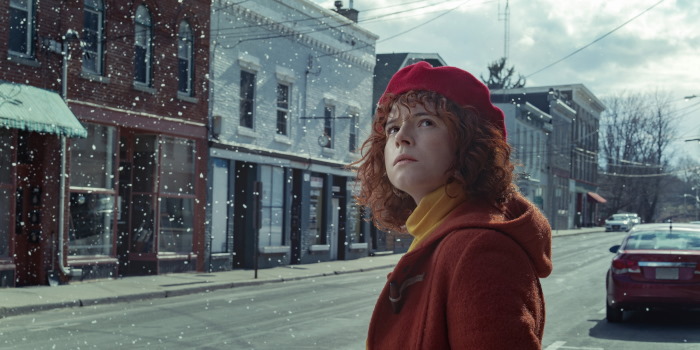
Welcome, weary traveller.
Please, remove your shoes, take a seat and enjoy some chocolate yule log. We know your journey has been exhausting, and your sense of self never closer to collapsing into a bundle of contradictions.
That’s because you just watched a Charlie Kaufman movie. Specifically, I’m Thinking of Ending Things on Netflix.
You’ve come here looking for an explanation to the film’s many mysteries, especially its bizarre and unsettling final act, what with its surprise dance scene, animated maggot-pig and big musical number.
Read More:
This Review of I’m Thinking of Ending Things Is An Eternal Nightmare of the Plotless Kind
I’m here to help, so long as you appreciate that I can only give you my interpretation, based, at least in part, on having read Iain Reid’s 2016 novel upon which the picture is (mostly) based. So, rest assured you can leave with at least an inkling as to what the hell you witnessed. But there’s another, more important question we need to resolve, even more pressing than "What. Is. Happening?'': Why did Charlie Kaufman, one of the most original screenwriters in Hollywood history, adapt a book? Let’s discuss.
There will be spoilers for I’m Thinking of Ending Things from here on out, so don’t go forward if you haven’t yet sat through all 134 minutes, or if you want the book to remain unspoiled too.
First, please, for the love of God, tell me what happened at the end.
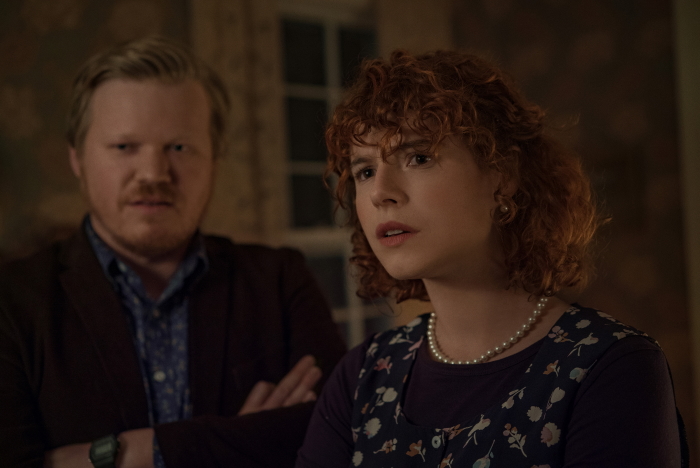
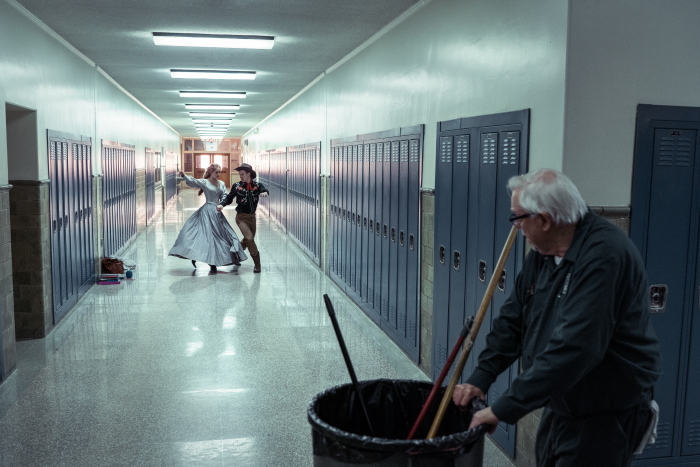
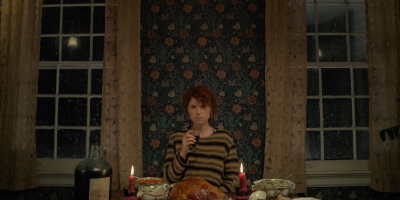
The flick hews pretty closely to the novel for its first two thirds, with a young woman (Jessie Buckley) going on a long drive with her new-ish boyfriend, Jake (Jesse Plemons), to meet his parents. They arrive at Jake’s family’s farmhouse, where his folks (Toni Collette, David Thewlis) appear to shapeshift in age during one seemingly endless, unnerving dinner. The young couple finally leaves, stopping at a nearby school to throw away some trash. Jake disappears inside, so the young woman (as she’s referred to by the subtitles, since the characters in the movie keep referring to her by different names) follows, where she meets a janitor (Guy Boyd) and admits, actually, she never dated Jake at all. The janitor finishes his shift at the school and heads to the carpark, only to have a fit, strip naked and imagine a talking animated pig—like the one that was eaten alive by maggots at his parents’ house—that guides him back inside. There we see Jake in skeletal old-age make-up accepting an award in an auditorium of everyone he’s ever known, before singing "Lonely Room" from Oklahoma.
Fade to blue. Fade back in to a still shot of the janitor’s car now covered in snow. Credits.
And I didn’t even mention the ballet.
The simplest explanation, if we go by the book.
What’s important to know about Reid’s novel is that it’s both a book and a suicide note; a novel within a novel "written" by the janitor to sum up his life and bid farewell to the world. There are clues dropped throughout Jake and the young woman’s car-ride conversations, especially when Jake, referring to the late David Foster Wallace, says, "Suicide becomes the story." Here, vice versa.
Reid teased out the mystery with interstitial chapters that indicate someone has died a gruesome death, though it’s not clear who or how or when, suggesting maybe a murder lies ahead for the young woman, or even Jake himself. Eventually, through dialogue between police officers, we learn that "the body" was "smart, well-read… He’d had an earlier career, some sort of academic work, PhD level," but ultimately lived alone and was never married: “No wife, no kids.”
It’s not until the very end of the book that you realise Jake and the janitor are one, that what we’ve read was all imagined by him, and that the suicide note left by his body was "some kind of diary, maybe, or story". It’s described as follows:
"He wrote about characters, or maybe they were people he knew. But then, he’s in the story, too, except he’s not the one telling it. Well, maybe he is. In a way, I don’t know. I’m not sure I follow it. I can’t tell what’s true and what’s not."
The final words give you a big clue into how to unlock the narrative: "You should read it. But maybe start at the end. Then circle back." This leads us to the young woman’s opening narration, now no longer sounding like she’s talking of a break-up, but of a more depressive ennui:
"I’m thinking of ending things. Once this thought arrives, it stays. It sticks. It lingers. It dominates. There’s not much I can do about it. Trust me. It doesn’t go away. It’s there whether I like it or not. It’s there when I eat. When I go to bed. It’s there when I sleep. It’s there when I wake up. It’s always there. Always."
To make it clear as mud: the young woman is Jake too. (There’s some synchronicity that both leads are played by actors called Jessie/Jesse.) At one point, she was her own person. What we're seeing is the remembrance of a woman Jake met in his youth who already had a boyfriend. So, in his last days, Jake writes a story in which she belonged to him instead, though even in fiction, she is looking for a way out. In the book, it culminates in a bloody encounter between the janitor and the couple. Kaufman realises this section with a wordless ballet, avoiding Reid’s decision to go gory.
Here’s why it makes sense in Charlie Kaufman’s filmography.
Kaufman’s script doesn’t include the janitor’s death, or even the suicide note/book. However, it manifests the idea of writing as an act of constant revision, making it of a piece with his previous flicks Adaptation and Synecdoche, New York. Even as an in-joke, it shares an uncanny similarity to The 3, a fictionalised script from within Adaptation in which a man with multiple personality disorder is revealed to be all three main characters ("all of them are him!"). Here, that’s the case too.
Kaufman visually draws a line between Jake and the janitor from the jump, and even if it doesn’t always make sense, you get the idea early on that the janitor is the older version of Jake, who is described as something of a polymath. As the tale unfolds, we see the janitor wandering school halls, presumably imagining how his life story should be shaped and in what form (dance? cartoon?), reworking it inside his head. This leads to countless do-overs and contradictions, with the young woman’s profession changing from physicist to poet to painter, and the ages of the characters winding forward and back without landing anywhere concrete.
It doesn’t matter that the janitor, in the movie, never actually writes his book. Kaufman’s version of the story allows us to see how writing can be an act that exists solely within our own mind, as a way to reframe our life and our history to be less tragic, as a form of therapy, and as a final will and testament.
But wait there’s more.
As if the above connection wasn’t enough, the film also shows a woman wanting to break free from a relationship because she knows she’s being used to simply justify her partner’s existence. She sees him taking credit for her poetry and her paintings, as if he’s subsuming her in real time. Though you could look at these as further hints that the characters are one and the same, it fits the template of previous Kaufman efforts, like Being John Malkovich and Eternal Sunshine of the Spotless Mind and Anomalisa, which explored relationships relying on one party giving themselves over to the other completely.
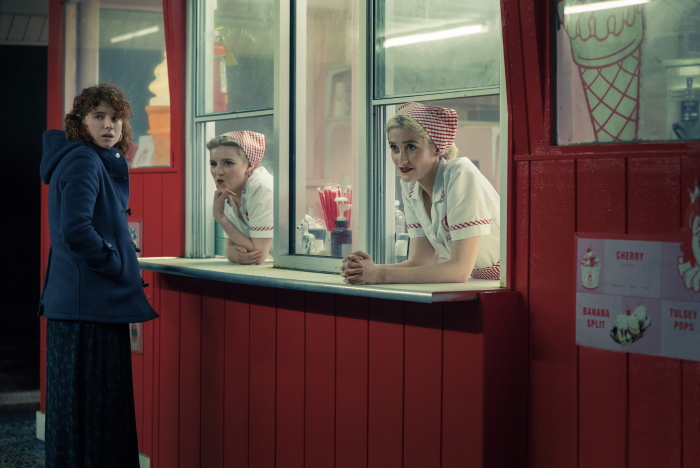
The way Jake depicts her, she's compliant and impressed with him, despite her inner monologue. In some scenes, Jake mansplains something, and she doesn't complain. Later, he pressures her into a sexual situation, and she complies after mild protestation. The young woman even occasionally takes the form of other women—presumably other crushes—including an actress the janitor sees in a movie during his lunchbreak (played by The Boys’ Colby Minifie) and then film critic Pauline Kael, as she recites one of her reviews (for A Woman Under the Influence) verbatim. Still, he can’t stop his invented dream woman from eventually pushing back. She develops agency and criticises Jake. Soon, the book—or the author, same—tries to protect the young woman by attempting to halt her in time. Or is it a trap? If so, it's a trap for Jake too. By trying to take ownership of her, she has become his Manic Pixie Nightmare Girl; confirmation of his loneliness, and not a solution to it.
Okay, so where does that leave us?
Kaufman has always been down with love. Anomalisa suggested everyone becomes the same after a while. Eternal Sunshine said the only way a relationship can work is if you both forget everything about one another (optimist’s take: it’s actually romantic to make the choice to forget). However, this is more like Synecdoche, New York—starring Philip Seymour Hoffman as a playwright certain of his impending death trying to write the perfect encapsulation of his life—which tried to contain the whole world and probably got nearer than anything else ever. In contrast, I’m Thinking of Ending Things is as insular as it gets, set within one’s imagination, but the both of them remind us that the greatest fiction we’ll ever write is whatever we tell ourselves about ourselves. And that's what I'm Thinking of Ending Things is about. Maybe.
Uh, so I hope this helped.
I’m Thinking of Ending Things is now available to stream on Netflix.
Are you experiencing suicidal thoughts, sexual assault or domestic and family violence? Seeking to support someone who is? Call Lifeline on 131 114 or Kids Helpline on 1800 551 800.
Visit ReachOut to get support to help you with everything from everyday issues through to tough times.
Header Image: Netflix
Topics
Ref: 5788b40b-2b43-474d-b391-ac2f005b9133




Comments & Feedback
Share your opinion
Emoji cheatsheet Formatting Comment guidelines