Movie Review: Anomalisa

A miracle movie.
It’s not quite accurate to say, "There’s never been anything quite like Anomalisa before." Animated movies, despite not featuring actual humans, have long been able to replicate human emotions and inspire us to feel more human as a result. (TL;DR: they make us cry and always have.)
Nor is Anomalisa the first to use stop-motion to depict a middle-aged man’s existential panic. See also: Mary and Max, The LEGO Movie and Fantastic Mr. Fox... except, in the latter instance, it was a middle-aged fox.
Weirdest of all, Charlie Kaufman and Duke Johnson’s flick isn’t even a pioneer in puppet intercourse, that particular trail having already been blazed by Team America: World Police, Bride of Chucky and Meet the Feebles (though, mercifully, not Muppets Take Manhattan).
And yet… there’s never been anything quite like Anomalisa before.
Anomalisa delves so honestly and effectively into so many significant human issues, with such elegant craft and impossible skill, 'miracle' seems like the only adjective that’ll fit when describing it. In 90 minutes, and with only three voice actors, it excavates the depths of our banal, primal fears. It’s about the terror of routine, the routine of monogamy, the bliss of new love and the inevitable curdling of bliss. It’s about the burden of mental illness, as well as the realisation that maybe you’re just not a good person. It’s also about realising that the phrase "hell is other people" should sometimes be taken literally.
It comes from the mind of Charlie Kaufman, the mad, soulful genius who wrote Being John Malkovich, Adaptation and Eternal Sunshine of the Spotless Mind. After penning the script for Anomalisa as a spoken-word play, he raised funds for a feature via Kickstarter, so certain was he that Hollywood would not help bring his vision to life. (Kaufman knows of what he speaks.) Here, he shares directing credit with Duke Johnson, a stop-motion specialist who has long toiled at Adult Swim and is responsible for Community’s famed Claymation episode. To complete the chain of creatives, Community Godhead Dan Harmon’s production company Starburns Industries ponied up the additional dough to bolster Anomalisa’s Kickstarter funds. A film for the weird people, by the weird people.
Set in 2005, over 24 hours, Anomalisa begins with author and customer relations expert Michael Stone (David Thewlis) arriving in Cincinnati for a conference, having left his wife and son home in LA. He reluctantly chats to a fellow passenger on the plane ride over. He barely abides an infuriating conversation with his taxi driver at the airport. The hotel’s concierge and lobby boy both speak to him with indistinguishable blandness. He calls his family, and they sound exactly the same. That’s because, with one exception, every character other than Michael is voiced by the soft, droning Tom Noonan (of Manhunter and Kaufman’s last directorial effort, Synecdoche, New York). There’s a suggestion that Michael, some time ago, lost his mind, and now hears everyone’s voice in an identical timbre. Everyone's faces, more disturbingly, are blurring together as well. Hair styles and colours may change, but the same facial features appear over and over again. The 3D-printed puppet designs of Anomalisa are gorgeous and, at times, almost photorealistic. No doubt using the same mould for everyone other than Michael would have saved some of that Kickstarter cash too.
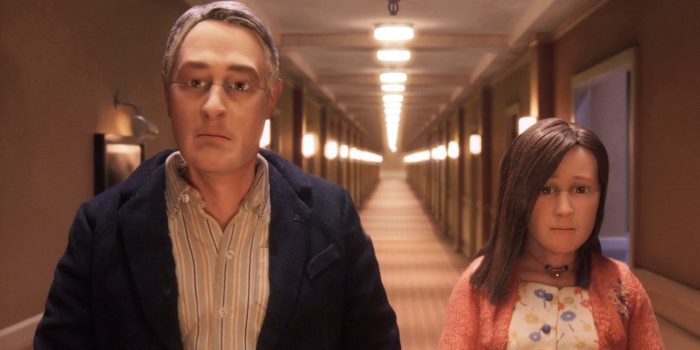
No man is an island, except for maybe Michael Stone. That night in the hotel, however, Michael meets an anomaly: Lisa. Anomaly. Lisa. You’ll get there.
She has the singular voice of Jennifer Jason Leigh. A shy, small-town phone-room operator in town to see Michael’s keynote speech, he can’t believe that someone has penetrated his crushing mental malady. (It reminded me of this quote from Being John Malkovich: "I’ve been very lonely in my isolated tower of indecipherable speech.") He swoons over her perfect, unique ordinariness. It’s a touching approximation of falling in love with someone for their imperfections, rather than in spite of them.
Had it ended there, Anomalisa would have been one of the most beautiful metaphor movies ever made. Instead, it continues. And Kaufman’s vision of soulmates finding one another in a sea of strangers takes a dark turn. Anomalisa remains a beautiful metaphor; now, it’s just a profound, blisteringly dark take on self-imposed segregation.
Thewlis does heart-breaking, complex work as a relatively unsympathetic lead, while Leigh continues her incredible resurgence as the lovely, uncomplicated Lisa. (Her rendition of "Girls Just Want To Have Fun" is a contender for scene of the year.) It’s Tom Noonan who truly deserves appreciation for his work though, populating the rest of Michael’s hellish universe with unnerving calm and other-worldly range. He is the hero of this picture and many others.
Or is the secret hero Carter Burwell, the composer who gives Anomalisa its haunting tone? Or cinematographer Joe Passarelli, who mixes dreamlike reverie with intricate compositions (and whose patience with all those puppets is unthinkable)? Or is it Kaufman, finally telling the purest version of the unhappily-ever-after love story that has appeared in all of his projects to date?
Anomalisa has its ancestors and, on account of its power and innovative designs, will have it descendants. But never forget: This was one in a million.
5/5
In cinemas February 4, 2016.
Rated MA15+ for a strong sex scene.
Topics
Ref: e053777f-c99c-472f-826c-a5a0001b1e00

Most Popular



Comments & Feedback
Share your opinion
Emoji cheatsheet Formatting Comment guidelines
When I saw the making of the film, it just shows how much work goes into it.