How to Spot COVID-19 Misinformation and Find Accurate Health Advice
Trigger warning: this article discusses violence and racism.
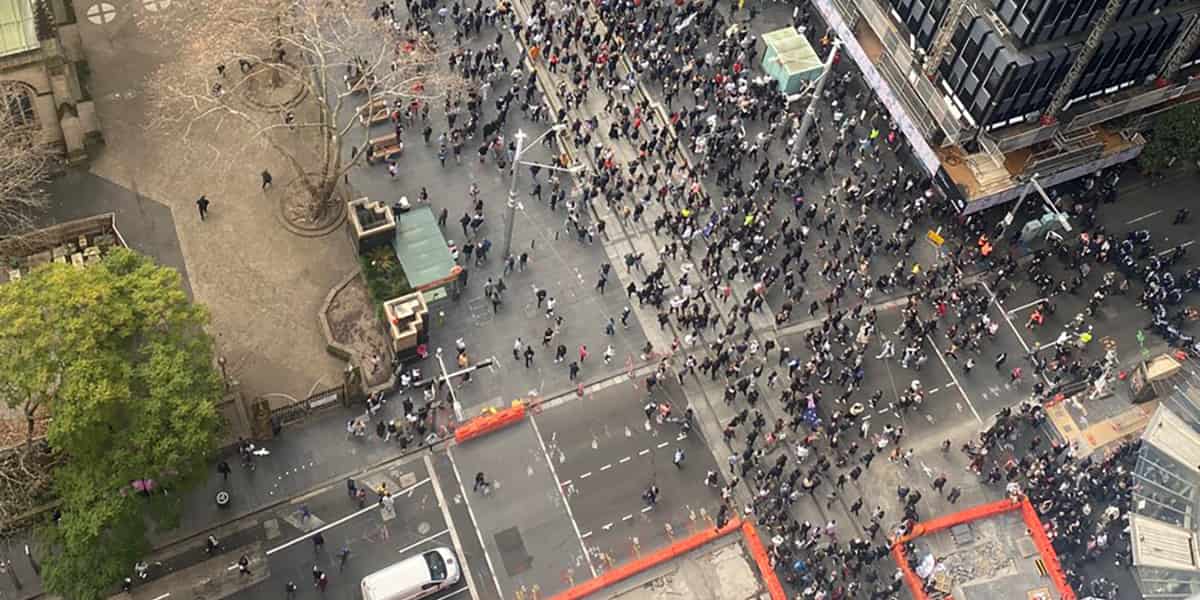
Over the weekend, Australia watched as frustrated Sydneysiders—as well as Melbourne and Brisbane citizens—took to the city streets to protest the extended coronavirus lockdowns they've been experiencing over the past few weeks.
Angry at the government and health advisory bodies, most people gathered in their thousands to march down the streets of Sydney’s Inner-West, unmasked, unvaccinated and risking the health of hundreds of other people in the CBD by attending this potential ‘super-spreader’ event.
Calling it the “Freedom Rally,” attendees were demanding an immediate end to lockdown, with some claiming misinformed theories about COVID-19, the available vaccines, and the effectiveness of masks.
The images from Saturday’s protests are distressing to say the least, as many protesters clashed with police and events became violent.
So, it’s understandable if as a young Aussie you’re feeling a bit worried or confused about what to think about the whole situation. To help put your mind at ease, we’re going to break down exactly what happened in Sydney on Saturday and how you can find accurate and reliable COVID-19 information.
The Sydney anti-lockdown protest is a superspreader event in the making. If the sheer number of people wasn't enough, everyone is also screaming at the top of their lungs (without masks) and potentially spreading droplets all over the damn place pic.twitter.com/WI2R5Ql4kE
— Zac Crellin (@zacrellin) July 24, 2021
What happened in Sydney on Saturday?
On Saturday morning, thousands of protesters gathered in Sydney’s Inner-West to demand an end to the Greater Sydney lockdown. At the time, it was NSW’s worst day of coronavirus numbers, with 163 locally acquired cases recorded—45 of which were infectious in the community—as well as two deaths the following day.
At the same time, demonstrators in Melbourne and Brisbane also erupted in protest, all completely unauthorised by police and state governments.
For context, parts of NSW have been in lockdown for about four weeks now, as the state government tries to control a community outbreak of the Delta COVID-19 variant. It’s now the second time Sydney has gone into a full lockdown since the initial outbreak in March 2020.
People at the protests marched with signs condemning both state and federal governments, health advice, and even the validity of COVID-19 and its seriousness.
Protestors clashed with police during anti-lockdown protests in Sydney, Australia in defiance of public-health orders amid a growing COVID-19 outbreak https://t.co/ofqHtQTZMg pic.twitter.com/d5vhV096wo
— Reuters (@Reuters) July 24, 2021
NSW police reported that at least 3,500 people were in attendance and since the event, over 57 people have been charged and more than 90 people have been issued infringement notices for breaching public health orders.
"What we saw today was 3,500 very selfish boofheads—people that thought the law didn’t apply to them,” NSW Police Minister David Elliott said.
"There is no doubt in my mind that at least one individual there today had COVID, it is statistically impossible for us not to consider that.
"I'm appealing to all 3,500 people to get tested tomorrow, if not for themselves for the sake of their family and friends."
Meanwhile, in Sydney, crowds of people are attending a large and unauthorised anti-lockdown protest. pic.twitter.com/asW5K1tuIE
— Josh Bavas (@JoshBavas) July 24, 2021
Amongst the crowds of demonstrators was former professional boxer and rugby league footballer Anthony Mundine who openly told the Daily Telegraph that he supports the anti-lockdown movement as well as 5G conspiracy theories. He has since been issued a court attendance notice for appearing at the rally.
Just to be clear, there is zero evidence linking 5G to the coronavirus.
Also in attendance was Jon-Bernard Kairouz, better known as “the TikTok guy” for his videos leaking the NSW COVID-19 case numbers.
Kairouz was calling himself the “people’s premier” and addressed the full crowd at the protest. He was later arrested and charged for his attendance at the event.
#BREAKING: NSW Police have issued Jon-Bernard Kairouz (aka TikTok guy) with a penalty infringement notice after he uploaded (and then deleted) a video of himself speaking at yesterday's anti-lockdown protests in Sydney. pic.twitter.com/YXOdTEg9So
— Eden Gillespie (@edengillespie) July 25, 2021
Mr Kariouz has recently been under fire for appearing in a video with racist themes against Indigenous Australians and liking racist comments from his viewers.
NSW Premier Gladys Berejiklian issued a statement saying she was disgusted by the actions of the protesters.
"The protesters have shown utter contempt for their fellow citizens who are currently doing it tough," she said.
"This type of activity during lockdown will not be tolerated and the full force of the law will be brought against anyone who engages in this type of illegal activity."
What is COVID-19 misinformation and how can I spot it?
While many of the demonstrators at these protests over the weekend are angry about having to stay in lockdown and not being able to work, a lot of other attendees were there to share their message about distrust in the government and theories about COVID-19 that have little to no research or evidence backing them.
As seen by many of the placard boards held at these protests and the various media interviews, videos and photos that were captured throughout the weekend, many of the protesters in attendance were anti-vaccination, believed that COVID-19 was a hoax or that it is being transmitted via modes like 5G (all of which are considered to be conspiracy theories or misinformation).
The spread of misinformation or fake news about COVID-19 has been wide-spread since the pandemic began, and it can sometimes be difficult to spot, which is why so many people often believe what they read or watch online.
Began looking into the origins / organisers of todays Sydney and Melbourne anti-vax / anti-lockdown protests. This thread is the most interesting entrance to the very dubious rabbit hole - international well resourced Astro-turfing at its core, the question is for what purpose? https://t.co/Wr8ntmRNiq
— Dubrow (@chrisdubrow) July 24, 2021
Also the recent Sydney anti-lockdown/anti-vax protests have a Qanon presence there. That’s pretty bleak for Australia’s future
— Avery Wright (@av_oceanmoon) July 25, 2021
According to the Australian Government’s eSaftey Commissioner, fake news can be found on your social media, in online videos or even online chatting apps, and they’re designed to try and influence how people think, shop, act or even vote.
There are ways you can do your bit to prevent the spread of fake news and avoid being influenced by it.
Double check the news source.
The eSaftey Commissioner recommends that you should always check the information you might be reading or watching by doing your own online searches and questioning the trustworthiness of the publisher.
“If you think a story you are reading or watching could be untrue or misleading, check the information by doing your own web searches to see if anyone else has reported the same thing. Are the journalists or news outlets that are reporting it well known? Do they have a lot of followers? This might show they are a trusted source of information,” they explain.
”The main news outlets may occasionally be biased or get something wrong, but they are usually pretty careful, and you can make a complaint if the facts don’t stack up.”
Question what you watch, read or listen to online.
If you come across something online that you’re not sure about, you can ask yourself a series of questions to see if the article is extremely one-sided or potentially trying to influence your opinion.
The eSaftey commissioner recommends these questions:
- Is the article based on fact or opinion?
- If it’s an ‘opinion piece’, does the writer include the point of view of anyone who disagrees with them?
- Does the headline match the content of the article?
- Do the quotes make sense and match the rest of the story, or do they seem to be missing the wider context of what was said and done, and why?
- Does the article match the news source it was based on? Some people rewrite stories or change the facts to fit their point of view.
- Does the story attack a broad group—such as ‘the media’, ‘the government’, ‘people on welfare’ or ‘refugees’? Lots of fake news is written to make you think certain groups are your enemy.
- Does the story make you so angry or surprised that you don’t want to believe it? Listen to your doubts and do more research.
#LIVE: Dr Lucas de Toca, COVID-19 Primary Care Response First Assistant Secretary, answers the Top Three questions across our channels https://t.co/NFC1LblFyU
— Australian Government Department of Health (@healthgovau) July 22, 2021
Consider different opinions.
Essentially, just because a lot of people are sharing an opinion or idea doesn’t necessarily mean it’s true.
In this case, it’s best to consider all sides of the story, read perspectives from a variety of news sources and even chat with a friend or a trusted adult to help you come to a better understanding of a topic or situation.
You can find out more tips on what to do when you come across fake news on the eSafety Commissioner’s website.
Where can I get the correct info on COVID-19?
Okay, so you’ve avoided misinformation online but want to make sure you’re getting the most accurate info and advice available, where do you start?
Well, the best place to start when talking about COVID-19 is government websites and their resources.
Government and health advisory bodies are the most trustworthy and reliable sources of information you can find. Not only are they written, vetted and monitored by top professionals in each department, but they will always have yours and the rest of Australia's public health and wellbeing as a top priority.
In fact, the federal government has a webpage that breaks down what COVID-19 is, what the symptoms are, how it spreads, who is most at risk, how to protect yourself or seek medical attention and how to get tested.
If you have symptoms of cold or flu, it’s time to get tested for COVID-19 🦠
— Australian Government Department of Health (@healthgovau) July 24, 2021
For further advice and to find a testing clinic near you visit 🔎 https://t.co/nR7lIzSAKj#Gettested #Coronavirus #COVID19 pic.twitter.com/asNAFmmJrV
The World Health Organization (WHO) also has a similar webpage with common questions, myth busters, and research.
You can also find out all about the COVID-19 vaccines that are available in Australia and check your eligibility on the federal government’s Department of Health website. And you can read up on all the latest research and info on vaccines on the Department of Health’s Therapeutic Goods Administration (TGA) webpage.
To find out what restrictions or potential lockdowns your state might have in place and why, head to your state government’s website or check out their social media page to stay updated.
💬 We know that many of you may have questions about the #COVID19 restrictions across NSW.
— NSW Health (@NSWHealth) July 22, 2021
🔗 https://t.co/kkWLVjCdmX is the best place to find the latest information.
If you require further support, contact Service NSW on 13 77 88 for any non-health related COVID-19 questions. pic.twitter.com/4AzE0NdHhy
To keep updated on news about the coronavirus you can read or watch news media information from trusted sources but always make sure to double check the facts and consider that sometimes mistakes can be made.
If you’re still struggling with how to find the right info on COVID-19, head to the eSaftey Commissioner’s website to find out all the other ways you can stay safe online during the pandemic.
Are you experiencing suicidal thoughts, sexual assault or domestic and family violence? Seeking to support someone who is? Call Lifeline on 131 114 or Kids Helpline on 1800 551 800.
Visit ReachOut to get support to help you with everything from everyday issues through to tough times.
Header Image: Twitter (@alxndrwbb)
Topics
Ref: e6282436-a638-4a69-9dd6-ad7100785e58




Comments & Feedback
Share your opinion
Emoji cheatsheet Formatting Comment guidelines