How To Become An Agent Of Change In The World (Even If You’re Still At School)

“How do you get to the root causes of something and how do you bring about real, sustainable change to make the world a better place?”
Er… are you asking us?
Because, hey, if we knew, we swear we wouldn't keep it a secret.
At least Dr. Julie Roberts is working hard to find the answer. Fact is, she’s spent her entire career figuring it out; from her early days as a social worker, to even when she began lecturing in the history and theory of art and design, before focusing on policy and strategy within academia.
Now, as Social Innovation Project Manager at CQUniversity, she might finally be close to a solution, encouraging Australia’s youth to develop “social enterprise” opportunities and find innovative solutions for communities beset by unemployment, homelessness and poverty.
She recently took 13 CQUniversity students to Gladstone, Queensland; a “boom and bust” region that, as Dr. Roberts describes it, is trending downwards, economically.
Over two weeks, the students investigated the area, with a few of them developing projects that would potentially enfranchise the locals.
“They came up with the idea of a place called The Refinery, which would be a café/ hub area where people could come in and find out more about how to set up their own businesses,” she told Student Edge.
“They were looking at, particularly, women who were at home with small children who really wanted to get something happening.
“Mum-preneurs,” she added, catchily.
“Another one was an online game called Healthy Harbours, which was aimed at children and educating them on how to keep the harbours healthy, and looking at environmental things.”
A judging panel awarded these two projects $5000 in start-up money.
“One of the things that really excites me about this is I can see this as a way that students can really start to see themselves as agents of change,” she said.
“I really saw that during the Gladstone project and the feedback I’ve been getting is people saying, ‘I went back home to my own community and thought, I can do this, I can create change here.’
“That’s my goal. Just a little thing like that,” she laughed.
It seemed like Dr. Roberts was pretty on it when it came to bettering the planet, so we asked her to share five hacks for students who want to become “agents of change” in the real world. We’ll let her share the following tips in her own words.
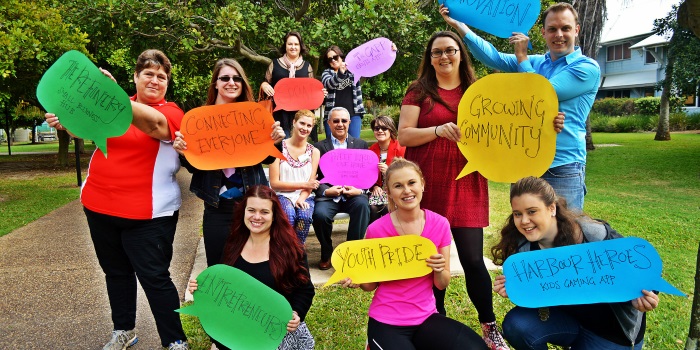
The CQUniversity team, taking part in the Gladstone Region Social Innovation Incubator.
1. Yes, embrace group work.
Most students hate group work. There’s always a slacker who doesn’t do any work. It’s really hard to get a high mark unless your team is exceptionally good – and that usually happens through luck rather than planning.
The reality is that when we start working professionally, most of us will spend a lot of time working in groups. Our ability to manage group work is one of the things that can set us apart. Research on employability skills tells us that most employers don’t really look at the applicant’s grade point average - they are more interested in identifying whether or not you will fit into their team.
Being able to demonstrate that you are a team player and can thrive in group work will put you ahead of the pack. In social innovation terms, collaboration – that is, being able to work “with” not “for” people - is a key step in identifying solutions that will work for everybody.
2. Challenge yourself – even argue with yourself.
Yes, the pressure is on to get good grades and that’s important, but don’t lose sight of the fact that study is ultimately about your learning. So, stretch and challenge yourself. In your next essay, try arguing for a position you don’t agree with – just to get a deep sense of an opposing view. Choose a topic for your assignment that doesn’t really interest you, just to see what you can discover that you may not have expected. Don’t just do the minimum to get through; challenge yourself to learn as much as you can. Continually ask the question: Why? And don’t assume that your lecturers know it all.
3. Step outside your comfort zone.
Studying Business? Why not take an elective in Humanities or Health? Studying Social Work? Take an elective in Business. Try to experience and learn about something outside of your normal range of interests. While you’re studying this unfamiliar area think about how it may relate to your core area of interest. What can you learn from this different area of study? Each discipline sees the world through a specific lens; innovation is stimulated by a capacity to see the world – or a problem – differently.
4. Volunteer, travel, do an internship, work on a project – do something.
Take whatever opportunities you can to learn outside of the classroom. Volunteering can take you all sorts of places, into worlds you didn’t know existed - and to countries you’ve always wanted to visit. An internship locally or internationally can give you a chance to experience life at a whole new level. Project work provides the challenge of team work, and the satisfaction of creating something that may live on, and make a real difference to the lives of others. These experiences can be challenging, but they really are the ones that make a whole lot of difference to who you are and what you’ve got to offer the world.5. Have fun out there.
Seriously, the most innovative, creative thinking comes when you’re having fun and you’re in the zone. Work hard, but don’t forget to enjoy yourself. Just because you’re trying to solve the world’s problems doesn’t mean you can’t have a laugh along the way.
Photos supplied by CQUniversity.
Open up your universe and consider a degree at CQUniversity. For more information, go to cqu.edu.au
Topics
Ref: b67e5e18-572e-43fa-965f-a502007c58eb






Comments & Feedback
Share your opinion
Emoji cheatsheet Formatting Comment guidelines