How Student Role Models Are Helping Improve School Attendance in Remote Communities
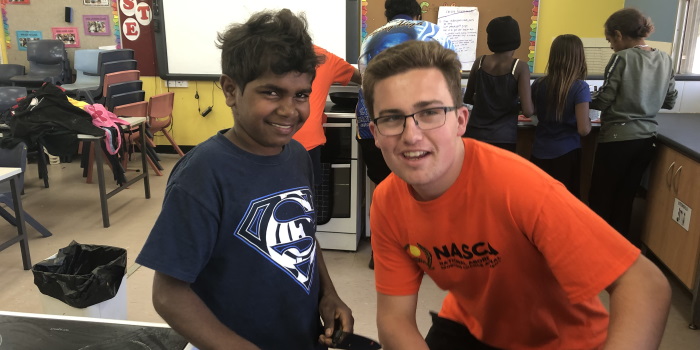
"I think you just don’t understand how isolated they really are."
Tim Wallis, a 19-year-old secondary teaching student, wants us to know that the way the media paints remote communities is pretty far from the reality, and often lacking in empathy.
"I think the lack of services and support that they have is quite a struggle for communities, and that’s not really focused on heavily enough," he tells Student Edge.
"I think you just don’t understand how isolated they really are."
Tim’s seen it first-hand, originally as a volunteer with St Vincent de Paul Society, and again this September as part of the National Aboriginal Sporting Chance Academy’s (NASCA) tour of Wiluna in regional WA (nearly 1,000km north-east of Perth).
"My dad used to work up in [remote] communities as a school principal, so I was quite enthusiastic to get out there myself and experience and see what it’s all about," he says.
But even given his background, there were surprises in store for Tim and his fellow 'vollies'.
"We were told to drop our expectations," he says.
"Every community is different. Some communities are majority Indigenous population. Wiluna was quite a diverse one due to the local mining. You have many different types of cultures there which was quite interesting to see how they interacted with each other."
Keen to become a secondary teacher in remote communities, Tim was enthusiastic about volunteering with NASCA, who only expanded to WA this year after two decades in NSW and the NT.
Read More:
What a Young Indigenous Woman Wants You to Know About Her Culture
How a Student Learnt About His Aboriginal Heritage and Wound Up in Tokyo
"I think there was definitely a bit of apprehension [from the community] because they weren’t sure what out place was," Tim says.
"But near the end of our program, you could see how much they opened up to us, and they really valued us being there."
As their name suggests, NASCA is all about bringing sport and recreation to Aboriginal communities, but as Tim explains, that’s just the jumping-off point for their team.
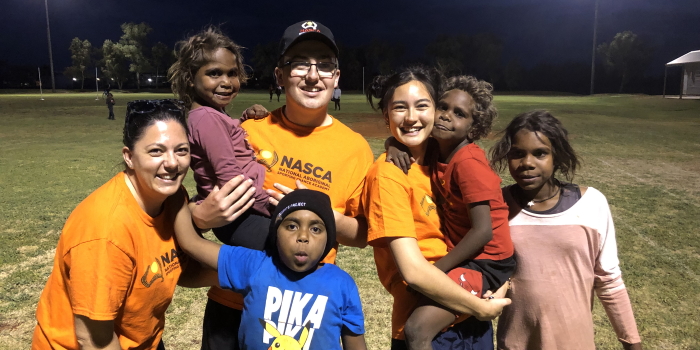
"Our main objective when we’re in the community is to provide role models, and model healthy behaviours," he says.
"We try to increase school engagement and think that’s something NASCA is really good at," he adds, pointing to research that shows students who work with NASCA are more likely to stay at school (they call this number 'retention rate').
"I think by modelling behaviour it helps to increase the self-esteem of the students, which really encourages them to attend school and just participate in the local community," he adds.
"Sport is a great way to bring them in to have a bit of fun and let them engage with other people who they might not necessarily engage with."
You can learn more about NASCA and their programs and mentorship of Aboriginal and Torres Strait Islander young people here.
Header Image: Supplied
Topics
Ref: f2d9721a-aa33-42b5-a627-aaff0078b9ee



Comments & Feedback
Share your opinion
Emoji cheatsheet Formatting Comment guidelines