Greece's Choice: What You Need To Know About The Referendum That Could Change Europe Forever
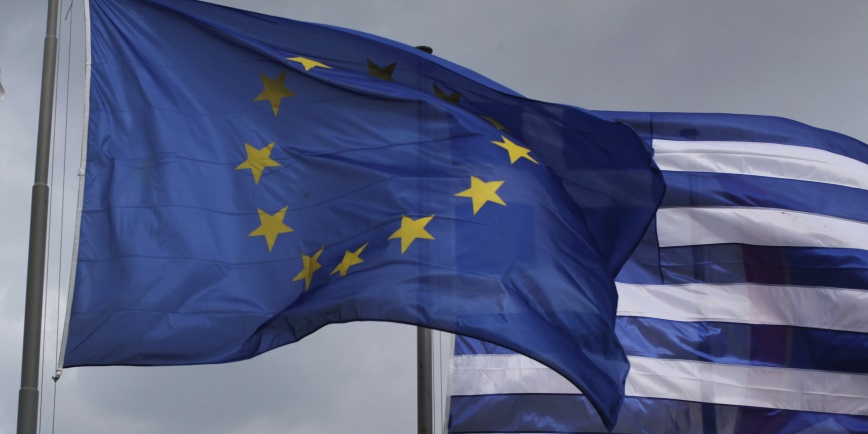
Europe is facing a transformational moment.
Following years of financial struggle, Greek leaders are putting a referendum to the people that could reshape the very idea of a unified Europe.
On July 5, Greece will vote on whether or not the nation should accept a bailout by its creditors (comprised of other European governments and the International Monetary Fund).
If they vote against the bailout, Greece may abandon the euro and be forced to form a new currency (they’ve got to pay back the banks somehow); the nation will likely be struck by high inflation and life will – at least temporarily – be devastatingly difficult for locals and their businesses. The New York Times believes this will create “financial chaos in the near term” but could lead to a “rebound in the medium term.”
If they vote for the bailout, the austerity measures that have crippled the nation for years will likely only be stretched out further. (Also, it's likely the government that initially rejected the bailout before giving the vote to the people will be ushered out post haste.)
Sound like a rock and a hard place? This is the choice being faced by ordinary Greeks right now; citizens who have suffered through high unemployment and halved wages, and who have spent much of the weekend withdrawing money from ATMs in a panic.
(For this very reason, the banks have been closed until July 6, with a limit of 60 euros a day imposed on all ATMs, announced via official decree.)
With such a world-shaking referendum on the horizon, it’s important to know how we got here, what it all means and where we’re likely headed. (Yes, Australia is affected by how this all shakes out too.)
How we got here:
Greece, battered by the global financial crisis, has borrowed a lot of money in recent years. Reuters calculates they owe lenders about 242.8 billion euros.
Some of these loans won’t need to be repaid for decades.
However, the loan by the IMF of 1.6 billion euros is due at the end of the month, which is notably a whole lot sooner. A further 3.5 billion is due to the European Central Bank on July 20, to be followed by another 3.2 billion payment in August.
(There are 8 billion euros worth of short-term bills also due in this time.)
Greece is pooling money for its debts from cash reserves and public bodies like schools and hospitals, but still does not have enough to pay back the sums. They have refused to use pensions and public wages as a source for repayments.
That’s why Greek leaders, like Prime Minister Alexis Tsipras, tried negotiating a bailout with creditors, though that didn't keep them from walking away from negotiations on Friday, believing the proposition by the IMF and their European creditors to be unsatisfactory. (They required further cuts to pensions and more tax increases.)
What happens if Greece makes a new currency?
The ‘drachma’ was the currency used in Greece prior to the introduction of the euro. If the nation creates a ‘new drachma’ to repay their loans, it is believed the value of their sort-of-new currency would drop by half almost immediately.
With everything in the nation suddenly worth only half its original price, inflation would kick into effect and imports would suddenly become extra expensive.
Yet, given that austerity measures under the euro have been exceedingly difficult for ordinary Greeks these past few years, there is a good chance many will welcome an alternative approach, even given the massive risks (as outlined by the Huffington Post).
What’s at risk for Australia?
When world events of this magnitude occur, the Australian stock market will always feel the aftershocks. This is what it means to be part of a global economy.
Case in point: the Aussie dollar has fallen by around three quarters of a US cent since Friday, becoming one of the first stock markets to react to the shaky situation in Europe.
According to News.com.au, more than $35 billion has been wiped from the Australian share market, with IG market strategist Evan Lucas warning that this could become “our worst day in two or three years.”
Okay, so what’s at risk for Europe?
Much more, and not just financially speaking. The so-called "Grexit" could inspire an entire cultural schism in the EU.
It is believed by some analysts that an exit by Greece from the euro could inspire other debt-laden countries like Italy and Spain to follow suit. (That’s not mentioning the cultural groundswell for an EU exit by popular nationalistic parties in France and the UK.)
What effect this could have on the global economy is difficult to predict, which in itself is terrifying to many economists.
Still, let's not freak out entirely. There are no other immediate euro exits on the horizon right now. Even Greece's (widely expected exit) is yet to be made official.
Let’s just deal with one massive world crisis at a time.
The people of Greece will make their decision on July 5.
More news as it develops.
Topics
Ref: 65dc1224-33df-41db-8328-a4c6004d5ee8



Comments & Feedback
Share your opinion
Emoji cheatsheet Formatting Comment guidelines