Here's Why Australians With Invisible Illnesses Need ‘Please Offer Me A Seat' Badges
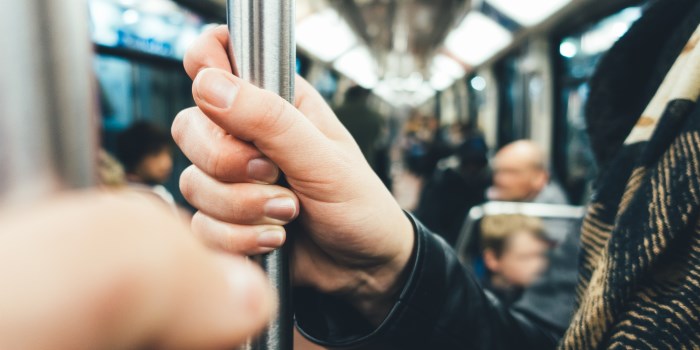
In June 2011, I became a sixteen-year-old who couldn't walk.
I had just undergone a knee reconstruction, and it would be six months before I could confidently take my first steps without crutches. And while I knew that facing mobility issues, even temporarily, would affect how easily I could move around in both public and private spaces, it didn’t occur to me that it would change the way I did something as simple as catching a bus.
Those suffering with invisible illnesses, including young people who 'appear' healthy, are among those who would benefit from a 'please offer me a seat' badge system, as the UK has trialled. The badges signal to other passengers that a person may need to sit more than others, and follows the success of the ‘baby on board’ badges that Transport for London introduced for pregnant women.
I think of what a ‘please offer me a seat' badge would do for me, and I wish that state governments across Australia would consider such a trial in our transport systems.
I moved to Sydney three years ago to start university, which meant relying on public transport for the first time. When I moved, it had been two years since my surgery.
Since then, I have encountered many public transport nightmares. Think drunken people causing a ruckus on the ride home, unhappy passengers screaming at bus drivers and, occasionally, unhappy bus drivers screaming at passengers.
But no experience of leering men or rowdy teenagers or grumpy drivers has come close to the discomfort and pain that my knee has caused.
My morning commute means standing on the bus for at least forty minutes. My surgery means that my right leg is ill-equipped to hold all or most of my weight, so standing on the bus means shifting constantly and trying to prepare for the often-unpredictable braking and acceleration.
If you’ve been on a bus in Sydney (or anywhere else, for that matter), you’ll know what I’m talking about: the driver suddenly slams on the brakes and everyone flies forward, scrambling for balance. Even those seated slide around, or grab the seat in front of them for support. Now imagine dealing with that multiple times per trip when you have one leg that doesn’t cooperate, and muscles that are still rebuilding.
My leg also has a long metal rod in it, and a number of large metal screws. This metal is incredibly good at conducting temperature, both hot and cold. This means that in the summer, my leg can heat up until it feels like it’s on fire. And in the winter, the iciness can spread until my whole leg seizes up and it becomes painful to move. This makes it very difficult to stand for an extended time, especially on a moving bus or a packed and claustrophobic train.
The times that I am lucky enough to score a seat, I feel incredibly guilty. Almost everyone standing will be older than me, and I worry that people will think me rude or ill-mannered for not offering up my seat. The guilt of sitting while others stand—others who ‘look’ like they deserve to sit more than a young, healthy-looking student—is something I still struggle with.
And then I think of the many Australians who suffer illnesses far worse than my own. Illnesses that others cannot see, yet illnesses that can make catching public transport impossible.
One in five Australians have some type of disability, and of those disabilities, almost 90 per cent are invisible. Yet, although invisible illnesses account for a huge proportion of disabilities, I found it difficult to find detailed information or statistics on invisible illnesses in Australia and invisible illnesses experienced by young people.
The reality is, you can never be guaranteed a seat every time you step onto a bus, train, tram, light rail or ferry. And that risk is something many Australians with invisible illnesses cannot afford to take.
Public transport should be accessible for everyone. And sadly, that’s just not the case for many people we share our commute with. Badges could be the first step.
Invisible illnesses might be invisible. The people who suffer from them shouldn’t be.
Brittney Rigby is one of Student Edge’s student contributors. Learn more about the contributor program.
Photo: iStock
Topics
Ref: f58a3ac6-7ffe-4a92-bac5-a6ce007787ca


Most Popular



Comments & Feedback
Share your opinion
Emoji cheatsheet Formatting Comment guidelines
I completely agree. I think they should at least trial it. I'm 17 and I have chronic nerve pain and fatigue (I've had it since i was 13) and struggle to stand for too long. I recently got a wheelchair but I do not use it all the time. A few times on the train I've had to sit on the floor as there was no seats and i couldn't stand any longer after being out all day. Other times I've gotten looks from people older than me when I haven't gotten up to give my seat to an elderly person when i physically could not stand any longer. (which really they could of given them their seat so they are being a bit hypocritical) I would love to trial the badges. I think especially for young people you're expected to do things like give up your seat but with a chronic/invisible illness sometimes you just can't.