Album Review: Lana Del Rey Smiles Like She Means It on “Lust for Life”
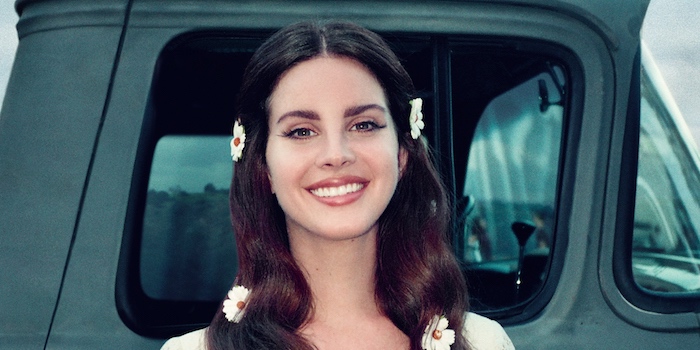
Lana Del Rey goes to space and finds something to smile about on fifth album Lust for Life.
Lana Del Rey, the patron saint of women who have to abide men telling them to “smile, beautiful”, waited five albums to bare her teeth.
The message being, she’ll smile when she’s good and ready, thanks.
Her rarely spotted grin was even given a slow promotional rollout, to ensure fans didn’t fall into convulsive fits at the sight of it.
Del Rey premiered it in the video for her retro space-lullaby “Love”, the first single off Lust for Life (its title being another giveaway for her sudden shift in mood).
In many ways, “Love” is the defining Lana Del Rey song; a dreamy, grandiose anthem about being beautiful and having nothing to do: “It’s enough to be young and in love.” However, the smile in the music video indicated ‘love’, formerly a burdensome passenger on her previous records, was now welcome in her drop-top road trips across Los Angeles (or the cosmos; wherever it is she really resides).
Though much of the album is still fed by her ‘white witch’ reputation, the vision of her beaming on Lust for Life’s artwork and the buoyant chorus of “Love” set a surprising new mood: What if Lana Del Rey but happy?
She’s joined by spiritual soulmate The Weeknd on the doo-woppy title tune (not a cover of Iggy Pop, or Girls), where they play carefree lovers dancing on the H of the Hollywood sign. Yes: Lana Del Rey and The Weeknd, carefree. Of all the people to shake Abél Tesfaye from his gloomy slumber… Lana?
Then again, she’s not entirely content. On “13 Beaches”, a sort-of sequel to “High by the Beach”, she runs from paparazzi for a private splash in the water. On one of two A$AP Rocky collabs, “Summer Bummer” (okay, that is the defining Lana Del Rey song title), she mewls “white lies and black beaches and blood red sangrias”, reminding there’s no party she can’t ruin. And on “Coachella—Woodstock On My Mind”, she admires a married singer, shadily confiding in his wife, “critics can be so mean”.
In her most on-brand moment, the wavy “Heroin”, she evokes the worst of L.A. (“I’d be lying if I said I wasn’t sick of it”), name-checking Charlie Manson (“writing in blood on my walls”) and Mötley Crüe. “I want to leave; I’ll probably stay another year,” she equivocates. Funny. That’s how she used to feel about relationships, too.
Still, the old complaints and concerns roll off her back more easily. The singing husband doesn’t run off with Lana in “Coachella”, as he might have on albums past; she seems more interested in the friendship with his wife, anyway, and the star-children in the audience absorbing his musical message. And amid the grinding groove of “In My Feelings”, she kisses-off an ex by asking him, “Who's doper than this b****? Who's freer than me?”
It’d be wrong-headed to look at her personal life for an understanding of why she’s so cheery (or, at least, cheerier). As an artist, Lana Del Rey’s known for sarcastically fetishising Americana, singing with sultry detachment, and anachronistically twisting her pop-pastiches and baroque orchestrations with twitchy editing tools. Yet as a person, she’s not “known” at all; we just see her characters, be they a boho hippie (“Brooklyn Baby”) or a self-destructive Jessica Rabbit (“Born to Die”).
Given that she turns over songs on a yearly basis—and that she was recently involved in a magical binding ritual against Donald Trump, because of course—it’s not unreasonable to think Lana’s new persona was forged by the current American government. And like her heroes of the ‘60s, she’s been activated by political unease and oppression to produce something (wait for it) optimistic.
“God Bless America—And All the Beautiful Women In It” is her acoustic shot at Beyoncé’s “Run the World”, and the determined, Dusty Springfieldien “When the World Was at War We Kept Dancing” brushes off a Trump presidency (and “the end of America”) with the message to girls, “throw your hands up and get loose/ cut a rug, lean into the f***ing youth”.
The silver linings don’t end there: “If we hold on to hope, we’ll have a happy ending”.
She even invites Stevie Nicks to harmonise on “Beautiful People Beautiful Problems”, on which they glimpse their miniscule romantic issues from the vantage of space, and agree to get over them, and themselves. (I wonder if Stevie got in on that binding ritual as well? I’m kidding. She definitely did.)
Fear not: The breathy, Black Dahlia version of Lana is never far away on Lust for Life, even if she’s working to better herself and her disposition. She aims to be “honest, capable” on the reflective me-and-a-piano ballad “Change”, and on the beautiful closing track “Get Free”, she recites her “modern manifesto”, to move “out of the black, into the blue”. Miley Cyrus and Lady Gaga went country in the age of Trump; Lana went to space, and came back with a lot more clarity, for her and us.
3.5/5
Lust for Life is now available.
Photo: Interscope
Topics
Ref: ca175617-998c-40ce-8200-a7ba0079cfe3



Comments & Feedback
Share your opinion
Emoji cheatsheet Formatting Comment guidelines