Album Review: To Pimp A Butterfly, By Kendrick Lamar
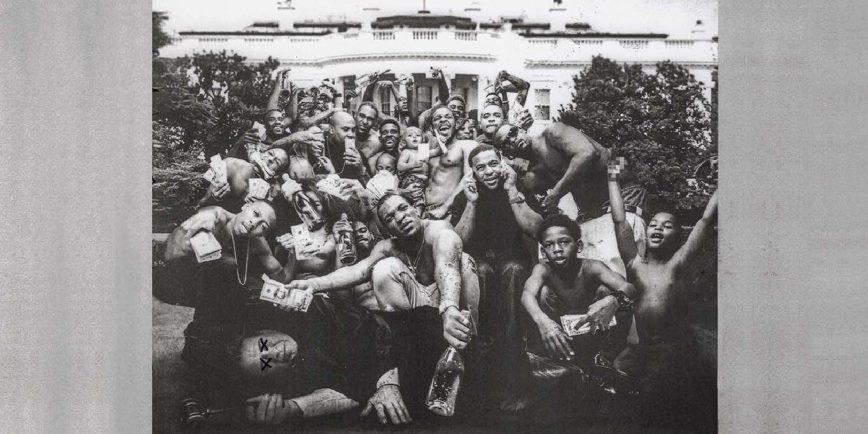
Early on To Pimp a Butterfly, Kendrick Lamar says he's mad, but he ain't stressin’.
An hour of listening later, you’d be surprised to learn the first part of that was the understatement.
The line comes from his “Theme from Shaft”-echoing “King Kunta”; an anthem designed for strutting that offers Kendrick's second major-label album its lone moment of jubilance.
To Pimp a Butterfly’s other 15 tracks see the Compton rapper regularly enraged though never unfocused; taking a break from naming and shaming lesser contemporaries (as he notoriously did, as if by flamethrower, on Big Sean’s “Control”) to address white America, black America, and himself with startling bluntness. The flamethrower has been given a hunting scope.
It’s a challenging and troubling listen, to say the least. It’s also funny, moving, sensitive and violent. This is an album written from the perspective of an entire community, by a figure happy to play the part of both prophet and villain. As he sings on “The Blacker the Berry”, his most aggressive cut to date, he’s the “biggest hypocrite of 2015” for decrying racism but boasting about black-on-black violence.
Yet, as we learn, when Kendrick says “i” what he really means is “we.” Following the shooting and strangling deaths of young black men Michael Brown and Eric Garner by white authority figures, To Pimp a Butterfly has the nerve to point the finger of blame at the mirror. Like I said: troubling.
Throughout the album, Lamar flirts with repeating the same plea for “black respectability” that was once the controversial catchcry of ruined icon Bill Cosby. If To Pimp a Butterfly had been all self-loathing, maybe we'd have to call it culturally poisonous. Mercifully, there’s a lot of self-love in there too.
Last year’s once-celebratory ode to the ego “i” has been rebooted for this record, re-performed with a live band in a rowdy club and re-contextualised too. This time around, the atmos of the crowd eventually overwhelms the song entirely, forcing Kendrick to stop singing and broker peace amongst the warring audience; as glaring a metaphor for the album’s intentions that you’re ever gonna get. Now, the chorus of “I love myself” feels more powerful, less selfish, and suddenly To Pimp a Butterfly isn’t a lecture to a people; it’s a prayer for them.
The record is a perfect companion piece, sonically and thematically, to Black Messiah, the long-awaited D'Angelo comeback released at the end of 2014 as racial tensions hit fever pitch in the States (but that nonetheless put its jazzy foot first). Butterfly also sounds like James Brown at times, Prince at others, and Radiohead – specifically, their haunting “Pyramid Song” – during “How Much a Dollar Cost.”
To Pimp a Butterfly isn’t as consistently excellent as its cinematic predecessor good kid. m.A.A.d city. Still, it’s home to some of the best musical moments of recent memory. On first listen, the slow fade-in of opener “Wesley’s Theory”, the riot that destroys “i” and the interview with 2Pac’s ghost during twelve-minute closer “Mortal Man” sent shivers down my spine. Many listens in, they’re still doing it.
4.5/5
To Pimp a Butterfly is now available.
The following video has explicit language.
Topics
Ref: 604067da-9a1e-4c51-9778-a46800350899

Most Popular


Comments & Feedback
Share your opinion
Emoji cheatsheet Formatting Comment guidelines
This is a great review!