Afraid of Automation? A Bachelor of Arts Will Help You Survive the Rise of the Machines
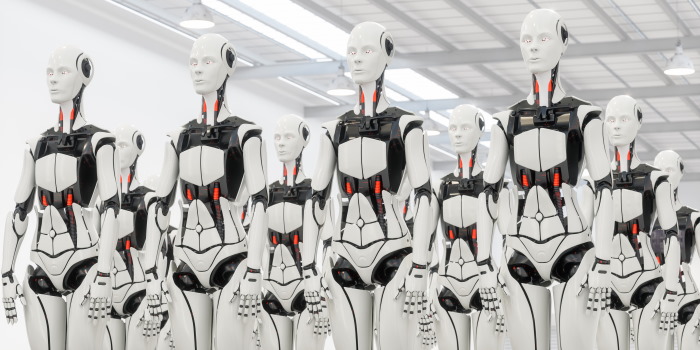
You can run, but you can’t hide. The robots are coming.
This post is presented in partnership with Monash University.
You can run, but you can’t hide. The robots are coming.

We’re talking about the automation of the workforce, which has altered the employment landscape for those training up for (or already skilled at) jobs that can now be done entirely by machines.
But the robots need not be your enemy. Instead, there’s a way for you to maintain a mutual respect—perhaps even a friendship—with the machines, and still find a satisfying career that won’t be at risk of falling to tech advancements.

How? By honing the human skills that robots just can't replicate.
What’s that now?
Top employers globally are now prioritising staff who can demonstrate skills gained from a Bachelor of Arts, such as critical thinking, creative problem solving, empathy, people skills, cognitive agility, insight, strong communication and listening. Arts grads have the expertise, skills and humanity that employers are looking for, across professional fields and sectors.
According to a recent report completed by the Centre for Future Work at the Australia Institute, "industry leaders are now calling for more Arts graduates in their workforce… given their training in abstract, critical methods of inquiry."
They add that many Australian employers in digital fields "now prefer employing humanities and social sciences graduates (rather than programmers) because they 'know how to learn'".
In fact, Humanities, Arts and Social Sciences graduates’ power two thirds of Australia’s workforce. Over 65 per cent of CEOs in Australia’s biggest public companies and 44 per cent of world leaders have a background in the Arts.
Over 88 per cent of Arts graduates are in full-time employment or further study just six months after graduation, so you can be confident that your skills are in high demand.
Okay, but how does this help me compete with robots?
Fact is, Australia is facing a shortage of employees with verbal, reasoning and memory abilities, while there’s a surplus of those demonstrating physical abilities like control movement and strength.
It’s the latter skills that are easily automated. But try as they might, robots haven’t quite mastered the human skills gained via an Arts degree.
Because of that, jobs requiring the human skills gained from a Bachelor of Arts are considered at low risk of automation. If you don’t believe us, you can check the handily titled website Will Robots Take My Job, which believes there’s a smaller than five per cent chance of careers such as directing, curating, marketing, scriptwriting and social science being automated.

If anything, those with a Bachelor of Arts will be able to use technology to help realise their dreams. Think of being a journalist working across podcasts, social media and digital news platforms (which you could learn via a major in Journalism), cracking cybercrime cases as part of an elite investigative squad (using skills learnt from Criminology units), or taking a leaf from Yacht and Holly Herndon by working with AI on a groundbreaking album (which you could experiment with in a Music major, especially now Monash boasts a state-of-the-art Digital Hub for music students).
With a Bachelor of Arts, you’ll gain the skills you need to both beat the machines in the job market, and create a positive change in our world.
There’s just no denying it: You can fear what’s coming, or use it to suit you.

There’s never been a greater need to make change. Whether you want to change your life, your career, your community, or the future, it starts at Monash. Find out more about an Arts degree at Monash University. Read more from Monash Arts.
Header Image: onurdongel/E+ via Getty Images
Topics
Ref: f0ade034-abaa-4543-9b12-ab0c00443b37



Most Popular



Comments & Feedback
Share your opinion
Emoji cheatsheet Formatting Comment guidelines
Thank you for this article. This is very interesting & informative. Didn't know the effects of acquiring a bachelor of arts degree/interests from employers.