Here’s Why University Of Melbourne Students Protested (Sometimes Starkers) This Week
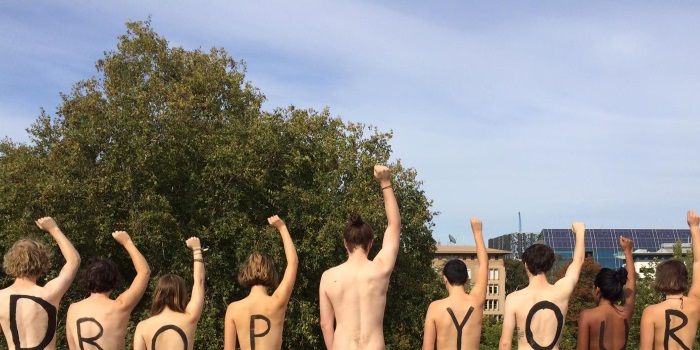
This week, students at the University of Melbourne protested in a variety of eye-catching ways.
They made a mini tent city, complete with a drum kit and coffee-sipping hipsters. They got naked on a rooftop. Then they poured concrete into barrels to block the doors of the university’s Administration Building. They managed to get Adam Bandt’s attention and trended on Facebook for a whole day. Even international media got its hands on the story. So, what are they campaigning for? The cause is very straightforward; they want the university to divest from fossil fuels.Fossil Free Melbourne University - one of many university groups with a similar agenda - has been active for three years as a student-staff collective, placing constant pressure on the university to divest (basically, end their investment in fossil fuels), with little return. As a site promoting nationwide campus disruption of the fossil fuel industry says: “They’ve ignored us. They’ve tried to distract us with so-called consultation. We’ve been patient, but we’re running out of time if we want a healthy world where we can actually use our degrees.” Despite being able to mobilise a large number of people over the years (gathering more than four thousand signatures in a single petition and signatures of support from one hundred academics in a single letter) the group has become increasingly frustrated with the lack of action taken by the university. FFMU is now demanding that the University of Melbourne take steps similar to that of Swinburne University, which, in 2015, announced a Responsible Investment Charter that identifies “companies that generate significant revenues from fossil fuel extraction” and which commits the university to “full divestment”. While Vice-Chancellor Glyn Davis of the University of Melbourne acknowledges that “sustainability is a key problem”, he emphasises that the “likely lower returns of… [excluding]… companies… with direct or indirect interests in fossil fuels” will be too costly for the university and the future of its students. Even the university’s Sustainability Charter sends mixed signals: its promise to make environmentally conscious investments is paired with a commitment to its “financial and legal responsibilities”. Those unclear policies have made these student activists restless. Professor Robyn Eckersley has said that students are “entitled to expect the University of Melbourne to lead in the divestment movement, and they are entitled to be impatient. This is their future.” This impatience is evident in many Australian universities, prompting 350.org (with affiliated university groups) to set a deadline. They pledged to take “bold action” should the universities fail to respond. The deadline was April 15th. It was met with silence. So, on behalf of every student who’s had five per cent taken off their mark daily for a late assignment, the students, in an ironic reversal of roles, punished the university for failing to meet their deadline. They definitely delivered on their promise of “bold action”. It’s pretty hard to ignore people when they’re naked, or chained to each other and a barrel of concrete. The university was forced to promise to negotiate transparently with FFMU in exchange for ending the blockade. The conversation will involve two members of the University Council, Robert Johanson and Allan Tait, who the FFMU have described as “key financial decision makers.”
FFMU have now resigned themselves to a small, and completely benign, stall. Only time will tell if the university will make a commitment to divest or if these talks will end in more ambiguously phrased charters.
Susan Alfayadh is one of Student Edge’s student contributors. Learn more about the contributors program.
Photo: FossilFreeCampusMU / Facebook.Topics
Ref: 11ce4e24-238b-451c-a756-a5f00020630a





Comments & Feedback
Share your opinion
Emoji cheatsheet Formatting Comment guidelines