So, What’s Up With HECS-HELP, FEE-HELP, and Census Dates?

Why so many acronyms 🥵
This article generally refers to loans which are eligible to domestic students.
Whether you’re going to be applying for tertiary education or have been at university for several years and have no clue what’s going on in your myGov account – you can’t be shamed! For some reason, no one ever told us what HECS was all about…
We want to empower students to understand their finances and university experience. Our new Real Money Talk and Ready. Set. Uni. pathways on Student Edge Plus have been designed to get you feeling savvy and confident about your future.
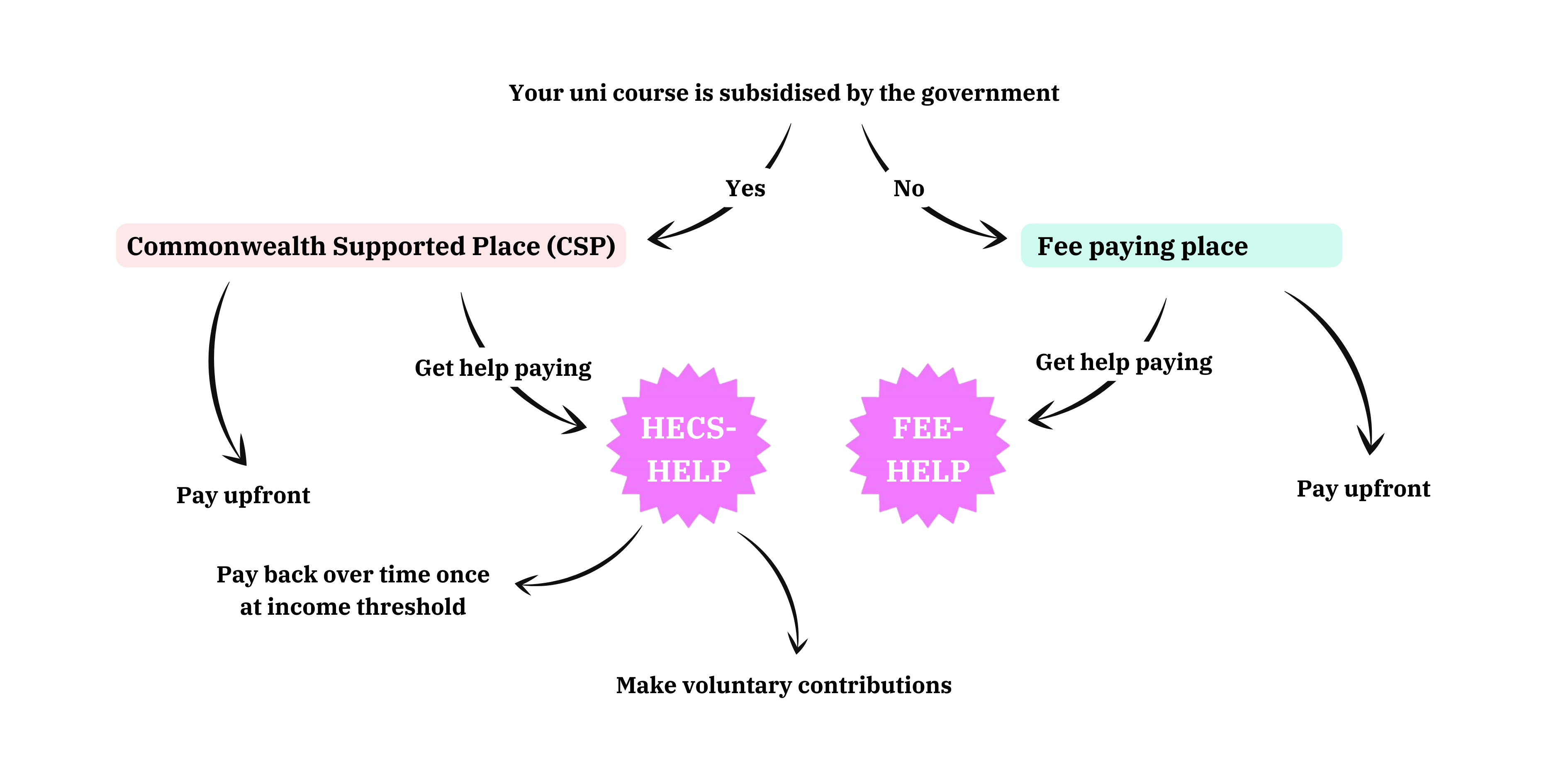
And we’re here to get you prepped (or retrospectively knowledgeable) about all things HECS-HELP, FEE-HELP and census dates. Here’s a quick flowchart to get your head sorted before we dive into the nitty-gritty.
Let’s start at the beginning, which is a very good place to start.
First things first: find out if you’ve got a Commonwealth Supported Place (CSP) or a fee paying place.

If you’re offered a Commonwealth Supported Place (CSP), it means part of your higher education will be subsidised by the Australian government. They are much cheaper than fee paying places.
CSPs are available at all public universities and some private providers, and the majority are at the undergraduate level. You can find a list at www.studyassist.gov.au. It is up to you to check if you have been offered a CSP before you enrol.
If you are eligible, you will automatically be allocated a CSP offer. To accept it, you need to submit a valid Request for a Commonwealth supported place and a HECS-HELP loan form by the census date. Your institution will provide instructions on this.
Note that:
- CSPs are only available to domestic students.
- It is not a loan, and you will not have to pay it back. However, you will still need to contribute towards the rest of your tuition fees (which we’ll talk about in a sec).
A fee paying place means that your tuition is not subsidised by the Commonwealth. This is usually applicable to postgraduate courses, or private universities. We’ll talk more about how you can get help paying for a fee paying place later.
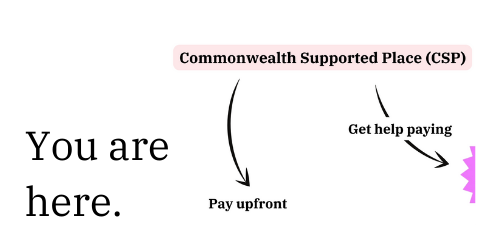
Okay, say you’ve got a CSP. What are your options to pay off the rest of your fees?
You have two options.
- Pay your fees for the units you've enrolled in that semester, upfront. If you do this, you have until the census date to finalise your payment arrangements (more on that later). To clarify - you don't pay for your full degree upfront, only the units you've enrolled in.
- Use a HECS-HELP loan (if you’re eligible).
What is HECS-HELP?

FYI, HECS stands for the Higher Education Contribution Scheme.
Imagine someone pays for your entire university degree, and you only have to pay them back once you can afford to. And there’s no interest. That’s HECS in a nutshell!

Each subject or unit you take is added to your HECS loan, and you don’t need to pay anything upfront. This is eligible for:
- Australian citizens undertaking at least one unit of course study in Australia.
- A New Zealand Special Category Visa holder.
- A permanent humanitarian visa holder.
How much can you borrow?
As of this year, you can borrow up to $109,206, with some exceptions for other courses. That’s a lot of money – so if you change degrees like you change your underwear, you’ve got some wriggle room!
Are you charged interest?
No! However, after your debt is more than 11 months old it will be indexed. This means it will be adjusted in line with changes in the cost of living as measured by the Consumer Price Index. These are published on the ATO website.
When do you start paying back your loan?
Once your income is above the compulsory repayment threshold. Then, your repayment will increase as your income increases – aka, the more you earn, the higher your repayment will be.
The threshold is adjusted each year. For the 2021-22 income year it’s at $47,014.
These payments will continue until you have repaid your whole debt, and is managed through the Australian taxation system.
How do you keep track of your loan?
A wonderful website called myhelpbalance has an itemised list of every HELP loan you receive. You’ll be allocated a Commonwealth Higher Education Student Support Number (CHESSN) when you first apply for admission, which can be used to access the site.
You can also visit myGov and go to the Australian Taxation Office to see your loans.
How do you apply for HECS-HELP?
- Submit a valid Request for a Commonwealth supported place and a HECS-HELP loan form to your provider by the census date.
- You must also meet the TFN (Tax File Number) requirements because repayments on your HELP debt are made through the Australian taxation system.
Can you make voluntary repayments?
Yes! If you want to reduce the balance of your account at a faster rate, you can make additional repayments through ATO online services via BPAY and credit card.
Alright, back to fee paying places. What is FEE-HELP?

As we said before, if you don’t have a Commonwealth Supported Place you will have a fee paying place, which is not subsidised by the Commonwealth government.
It also means you do not have access to HECS-HELP. But if eligible, you can use a FEE-HELP loan to help pay for your tuition fees.
Unlike HECS-HELP, there are loan fees for FEE-HELP. It is 25% of the tuition fee for each unit you pay for with FEE-HELP.
So, if for example you take a unit which costs $1,000 and you use a FEE-HELP loan for the entire amount, the loan fee is $250.
What’s all this about census dates?
The census date is pretty much a big fat legal deadline for applying for or withdrawing any loan you want to get.

It’s the last day you can:
- Submit your request for a CSP and a HECS-HELP or FEE-HELP loan form.
- Finalise your payment arrangements if you’re paying upfront.
- Withdraw from your enrolment without incurring the cost or debt for that unit.
For example, if you withdraw from a unit before the census date then you will not have to pay the student contribution or incur a debt for that unit (even if you’re a couple of weeks into the unit!)
If you withdraw afterwards, you won’t get a refund. There are exceptions in special circumstances, such as if you become seriously ill. So scribble that date down in your diary or put it on a post-it note to save on the late fees!

Okay, phew. We’ve reached the end of this little explainer on the wide world of uni fees, loans and legal stuff.
If you’re in the process of applying for a HELP loan or need any further information, check out the following resources that the government recommends (can’t get more official than that).
- StudyAssist website studyassist.gov.au
- Course Seeker website courseseeker.edu.au
- ComparED website comparED.edu.au
- myHELPbalance portal myHELPbalance.gov.au
If this has scratched your itch for financial empowerment, be sure to check out our Student Edge Plus pathways. And for more guidance on starting university, we'll get you prepped with Ready. Set. Uni. It feels good to be in the know, you know.
Topics
Ref: 7c9c0be5-179f-4b50-bee7-ae5200875de2






Comments & Feedback
Share your opinion
Emoji cheatsheet Formatting Comment guidelines