What Is the Government’s COVIDSafe App and How Does It Work?
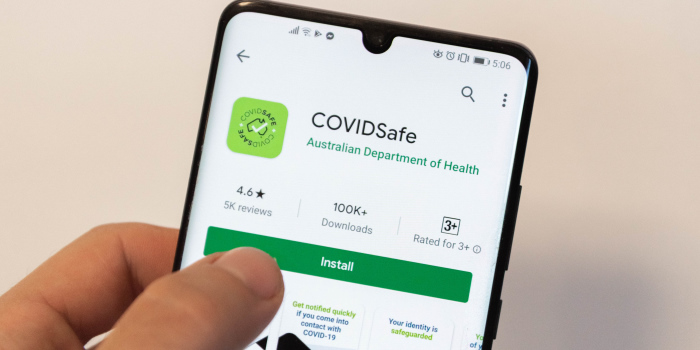
It hit two million downloads in 24 hours.
Over the past few months, the Australian government has implemented a number of restrictions to help stop the spread of coronavirus. We’ve seen restaurants and pubs close, cinemas shut their doors and strict quarantine measures enacted.
Now, the government has launched COVIDSafe, a new coronavirus tracing app designed to track every person you’ve come into contact with. Basically, if one user tests positive for COVID-19, it will help trace other users who could have potentially caught the virus from them.
It sounds a tad confusing, so let’s break it down.

How does the app work?
Based on a Singaporean app called TraceTogether, COVIDSafe uses Bluetooth to detect other app users and exchange anonymised IDs, which are stored encrypted on phones and deleted after 21 days.
It sounds complex, but it's the same kind of technology that's used for things like AirDrop on iPhones.
If you are diagnosed with coronavirus, you can allow the app to upload the list of anonymised IDs you've collected for the past 14 days of contact tracing. From there, health authorities can decrypt the data and get in touch with the app users you have come into contact with during that period of time.
The app can be downloaded from the Aussie Apple App store for iPhones or the Google Play store for Android phones.
Since registrations began on Sunday 26 April, the app has been downloaded 5.1 million times (as of 6 May 2020). Around two million of those signed up just a day after the app had launched.
Is it mandatory to download it?
No, you do not have to download COVIDSafe if you don’t want to. However, Health Minister Greg Hunt has previously said that about 40 per cent of the population would need to use the app for it to be effective.
In saying that, you cannot be penalised for refusing to use the app. Plus, nobody can force you to download it or upload your data if you’ve tested positive.
Okay, so why has the government introduced it?
Good question.
Well, the whole point of the COVIDSafe app is to make contact tracing easier. When people catch coronavirus from unknown sources, it makes it far more difficult for health authorities to contain the spread.
Instead of having to rely on surveillance footage or the person’s memory to determine who they might have infected, the app will be able to identify other app users they’ve seen over the past couple of weeks. Then, those people can be contacted accordingly.
Should I be concerned about my privacy?
It's only natural to have concerns about how your personal data will be handled.
When you download COVIDSafe, you'll need to provide your name, age range, postcode and phone number. If you're under 16, your parent or guardian will have to consent to the collection of your information and contact data.
According to the app's privacy policy, COVIDSafe will only record your encrypted user ID, the data and time of contact, and the Bluetooth signal strength of other app users with which you came into contact.
However, you don't need to worry about the app tracking your location. No location data will be collected, and any contact data stored on your device will be deleted after 21 days.
In the event you test positive for coronavirus, you'll have the option to share your contact data with health officials to enable contact tracing. Once you've consented to your contact data being uploaded, your information will be held by the federal government on an Amazon Web Services server in Australia. Only state health authorities responsible for contact tracing will be able to access it.
Additionally, you can delete the app from your phone at any time, or request that your personal data is deleted.
As reported by The Guardian, the government has also released draft legislation to diminish privacy concerns.
According to the draft legislation, the collection, use or disclosure of information collected by the app—except by public health authorities—would be punishable by up to five years in prison.
All data will be deleted after the COVID-19 pandemic has ended.
This article was updated on 6 May to reflect that the government has drafted legislation to allay privacy concerns.
Header Image: SOPA Images / Contributor / LightRocket via Getty Images
Topics
Ref: 6a069e9b-f724-4e15-9e87-abab006c7110


Most Popular



Comments & Feedback
Share your opinion
Emoji cheatsheet Formatting Comment guidelines
Awesome app