Three Ways to Stay Savvy and Safe Online

Scams are getting clever, so here's a few ways to make sure you don’t get caught out.
This article is presented in partnership with Circles Life.
Over time we’ve become pretty familiar with the usual looks of spam posts, messages and emails.
While we might not be falling for the Nigerian Prince scam quite so much anymore, but there’s still a host of scams, gambits and hoodwinks that you need to be looking out for.
Online scams are everywhere these days. Last year, Australians lost more than $3 billion to online scams, and young people are no exception.
From 2021-2022 two thirds of Australians aged 15 years and over were exposed to a scam, according to the Australian Bureau of Statistics.
So, we’ve partnered with Circles Life Australia to share info on how you can stay safe online.

Protecting yourself from catfishing.
If you’ve ever come across a person pretending to be someone else online, you’ve encountered a catfish.
In short, catfishing is when someone uses social media to create a false identity, usually to defraud or scam someone.

These are particularly common on dating apps, so be careful in that space.
You can spot a catfish by a few different behaviours:
- They won’t share social media accounts or rarely use their accounts.
- They’re actions and conversations don’t match their profile.
- They know a lot about you already, or ask you for lots of personal information.
- They encourage you to send photos of yourself without sending any of themselves.
If you’ve encountered any of these behaviours, be careful. You can act by either stopping the conversation, or you can do things like reverse image searching their profile picture.
Protecting your identity.
A big scam these days is identity theft. As we live our lives online, it can be easy for a scammer to collect information and pretend to be you, and access things like social media accounts, bank accounts and more.
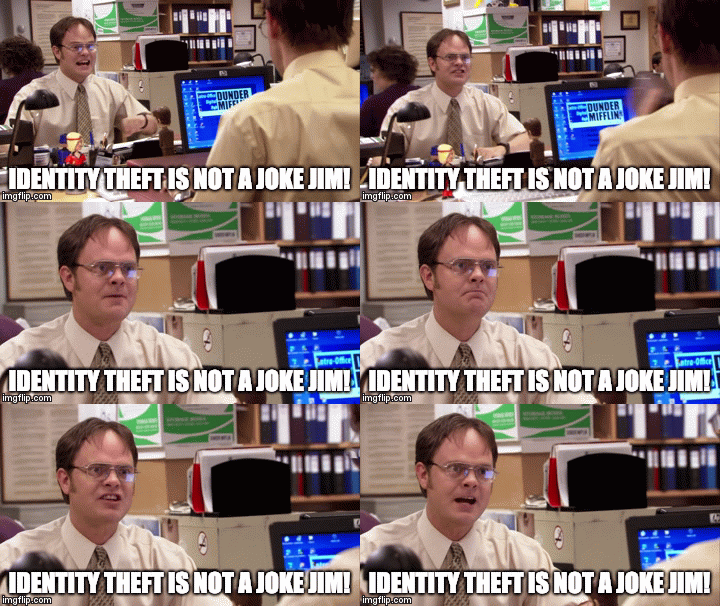
You can protect your identity in a number of ways.
- Not making personal information public (i.e. full name, date of birth, home address, work).
- Set up multi-factor authentication and strong passwords.
- Don’t ever share passwords.
- Connect to secure wi-fi networks.
Once your identifying information has been stolen, it can be really hard to get it back, so be sure to protect yourself.
Protecting your digital footprint.
A ‘digital footprint’ is essentially the trail of data you leave when you use the internet.
This might be posts, photos, videos and any tagged information that can be traced back to you.
A downside of the internet is that data can live forever, so protecting your digital footprint is pretty important these days.

You can manage your footprint by:
- Googling yourself and understanding what your footprint looks like currently.
- Taking down old posts/videos/images.
- Checking privacy settings on social media.
- Change your tagging settings.
Staying safe online is important for everyone these days – especially young people.
Luckily, Circles Life is a telco that is committed to helping protect your online presence.
Plus, you can get up to $15 a month off on 12 month mobile plans thanks to our limited-time offer.
Topics
Ref: 71361370-eabf-45e9-a467-b03f00392915






Comments & Feedback
Share your opinion
Emoji cheatsheet Formatting Comment guidelines