Solve This Puzzle and You’re Basically Among the Smartest 1% of Maths Students

Earn bragging rights for life (well, until next year anyway).
Select Year 8 students in the UK recently braved the Junior Mathematical Olympiad (JMO), which The Guardian says is for those who "score in roughly the top half per cent of mathematical ability".
Basically: fancy British maths whizzes.

About 1,200 students get to take part in the JMO each year, though in 2019, only 995 (the top 0.37 per cent of suitable UK students) qualified to sit the test.
Those students faced a paper made up of 16 questions, which they were given two hours to complete. It has since been posted online and bleeding hell, this thing is rough. stuff.
If you want to prove to the world that you’re an equivalent brainiac to that top tier of UK maths students, see if you can solve one of the JMO’s 16 questions below, which we helpfully rewrote for you (or check out the whole paper here).
Solutions will be posted on the JMO’s site after 24 June. So, clock’s ticking to outsmart those Brits!
Question: "In this word-sum, each letter stands for one of the digits 0 – 9, and stands for the same digit each time it appears. Different letters stand for different digits. No number starts with 0. Find all the possible solutions of the word-sum shown [in the comments section below]."
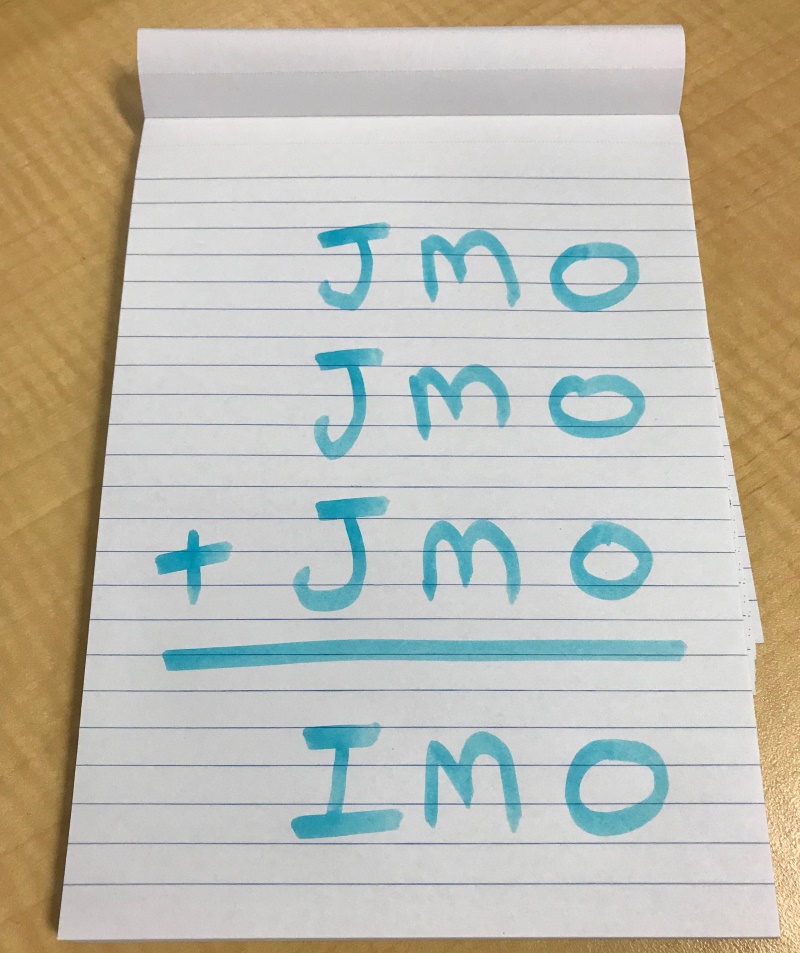
NB: "Give full written solutions, including mathematical reasons as to why your method is correct. Just stating an answer, even a correct one, will earn you very few marks." [Don't blame us, we took that straight from the paper!]
Header Image: Fox
Topics
Ref: ec681221-9692-407e-b8fb-aa720061faeb



Most Popular



Comments & Feedback
Share your opinion
Emoji cheatsheet Formatting Comment guidelines
I'm gonna try this one. I may or may not be right. I'm sorry if I can't explain this in a way that you can't understand.
I will first focus on the ones column.
O+O+O=O Only 0 and 5's one digit will remain the same when tripled, but since 5*3 is 15, the extra ten will carry over to the M+M+M=M and therefore not work, because M+M+M+1 can't equal M. So it has to be 0.
M+M+M=M. Again, 0 and 5 only satisfy the sum, but here, we can't use 0, as the digits have to be different. So we have to use 5. 5*3 is 15, so in the J column, we have to add an extra one.
J+J+J=I. J cannot, when tripled, and added one (because in the M's column, 5*3 is 15) be more than 9. 1 and 2 both satisfy this.
In the end, we have 2 options: 150 and 250.
I'm thinking JMO would have to be either 150 or 250.
No number added up 3 times produces itself (in the units column at least) except for '0' or '5'
"But maybe 'O' added up 3 times produces something big that it carries over to the 'tens' column - that way 'M' added up 3 times would not need to produce itself (in the units column) - it could produce something just below itself, which is then made up by the carrying over from adding up the 'O'."
Good point - but O would still need to add up to something that produces itself (in the units column), meaning that at this point O could be '0' or '5.' If O were 5, then it would produce a sum of 15, with 1 being carried over to the ten's column. M + M + M + 1 would therefore need to equal something with M in the units column. And i don't think there is a number between 0-9 that fulfills this requirement - the units column seems to be separated by increasing units of 2 as you ascend...
This leaves 'O' as equaling 0, while 'M' must equal 5. Finally, J + J + J + 1 (from the 5 in the ten's column) must be equal to a single digit (I) - this leaves either 1 or 2 as possibilities - leaving the possible answers as being
150 + 150 + 150 = 450 250 + 250 + 250 = 750
Thank you for coming to my TED talk