Why a Career in Eye Therapy (aka Orthoptics) Is Getting Popular Among Uni Students
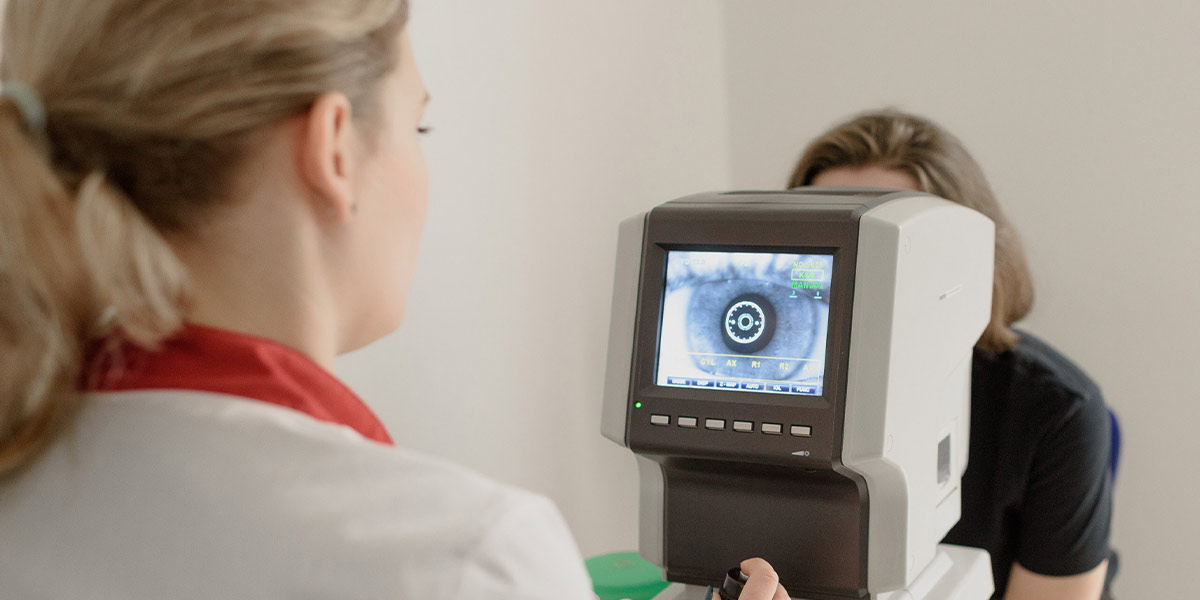
Open your eyes to the world of orthoptics.
This article is in partnership with UTS.
Despite what your parents may say, studying health and medicine at university doesn't just mean you become a doctor or a nurse.
A health profession that is drawing the attention of more and more uni students is orthoptics and eye therapy! But what the heck is that?
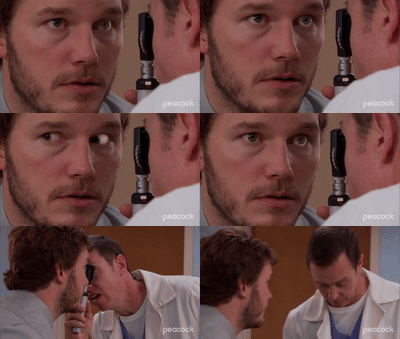
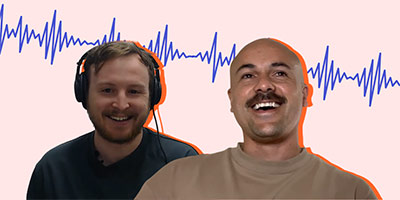
We chat with Aida, who has a Masters of Orthoptics from UTS and works in paediatric orthoptics, and Prem, who has a PhD in Orthoptics from UTS and works in opto-diagnostics.
They spill all the tea on their studies, careers, and why you should consider orthoptics, too!
Lots of orthoptists had no idea what orthoptics was when they started their studies.
Most people have an inkling that they might want to go into something health related. Prem says his favourite subjects were always science ones, which led him to study medical science as his undergrad.
But there often comes a roadblock at the end of undergrad, where students have no clue where to go next.
“I got to the end of my undergrad and I actually had no idea what I wanted to do,” says Prem.
Both Prem and Aida stumbled across orthoptics by pure chance and a bit of desperate Googling.

“I think the majority of people in orthoptics never knew what orthoptics was prior,” Aida says, “it came to the point where I think I was Googling so many things that eventually Google started picking out my ads…I was just on YouTube and the ad said ‘study a Master of Orthoptics at UTS’.
“It was Google stalking me.”
The Master of Orthoptics at UTS was so darn good that Prem went and got his PhD.
After serendipitously stumbling across the course in a UTS guide, Prem ended up absolutely loving it.
“I loved the way the course was run, the way I was taught, and the hands-on application of it. I had a really good time and towards the end I realised I wanted to do further study in orthoptics, so ended up doing a PhD.”
At the same time, he was working as an orthoptist at a clinic, which gave him great practical experience.
The day-to-day work of an orthoptist is always different.
Aida performs screening services for children to check the vision and alignment of their eyes. She gives a glowing review of what it’s like working with children.
“They’re quirky and brighten my day, and it kind of puts life into perspective when you see some kids that are quite unwell. It makes me thankful for what I have.”
She assures us she has a big jar of jellybeans and a huge book of stickers for the kids. What a queen.
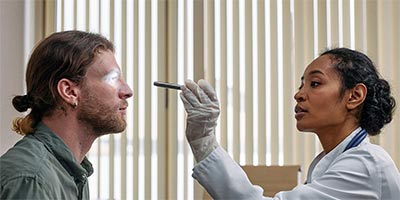
Prem’s job focuses on the installation and use of medical devices in clinics. “I’ll show the surgeon, optometrist or orthoptist how to use the product… I might be going through different analyses or interpreting data from the technology.
“Sometimes I travel off to regional areas. In the last few weeks, I’ve been to Wagga, Forster, and Taree… Everywhere really! My office is everywhere. I think my office is the road. I love it.”
There’s some crazy perks and highlights of studying orthoptics.
For Aida, the best part of her studies was going to Oxford University. Yeah—Oxford. The real-life Hogwarts over in England, innit.

“I was able to work at Oxford Eye Hospital and that was a highlight, just seeing how orthoptics is internationally and how even though it’s very similar to what we do here in Australia, it has its little differences,” Aida says.
For Prem, his biggest moment was submitting his PhD. “When I found out I passed and everything it was amazing.”
Aida and Prem both reckon you should give it a shot, and you’ll learn a tonne of useful skills.
“I’d strongly recommend the course especially if someone has a passion for healthcare and they love to continuously learn and upskill themselves—orthoptics is a great profession,” says Prem.
Aida says that if you don’t want to work in a clinic, for example, there are plenty of pathways where you can transfer your skillset in orthoptics including rehabilitation and low vision services.
“A lot of graduates have gone into being practice managers of large private clinics with day surgeries… There’s also a lot of professionals who went into clinical research and there are lots of jobs out constantly from laboratories,” she says.
Studying orthoptics will give you plenty of gnarly facts about eyeballs.
Prem’s a fan of showing his patients photos of their optic nerves and seeing them freak out. The optic nerve is the only nerve attached to the brain that you can see without having to dissect someone or cut them open.

On a lighter note, Aida says that the eye continues to grow up until your middle to late 20’s. “It starts off quite small and as you grow it also grows with you.”
Who knew?
You can find out more about eye therapy and the Master of Orthoptics at University of Technology Sydney here!
Topics
Ref: 33f86786-5387-455d-8243-ae00007aaee9




Comments & Feedback
Share your opinion
Emoji cheatsheet Formatting Comment guidelines