Movie Review: “War for the Planet of the Apes” Gives Us Caesar’s Last Stand
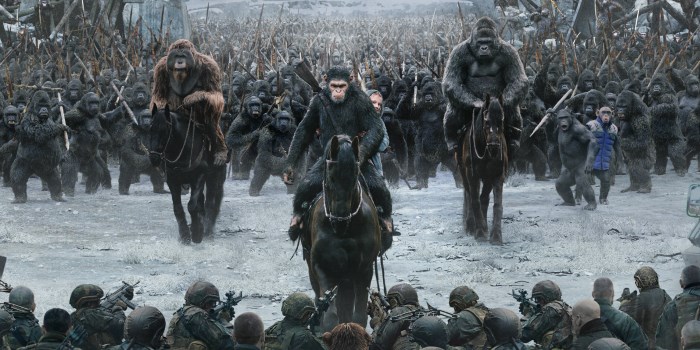
Don’t understate the achievements of the rebooted Planet of the Apes franchise. It got us to actively root against the survival of the human race.
Matt Reeves’ trilogy-closing War for the Planet of the Apes is certainly a step up from his inert Dawn of the Planet of the Apes, even if it doesn’t quite deliver on the title’s promise of all-out carnage between man and chimp—if that’s the kind of thing you go to the cinema for, and why wouldn’t you?
Yet that too is meant to convey the true humanity and morality at the heart of picture’s super-intelligent, speaking ape tribe, led by Caesar (a CGI creation, once again performed by a motion-captured, stocking-suited Andy Serkis). The war is entirely one-sided: Not only is it solely the humans who are fighting to reclaim the planet, they’re doing so in denial of a rabid virus that is quickly exterminating them.
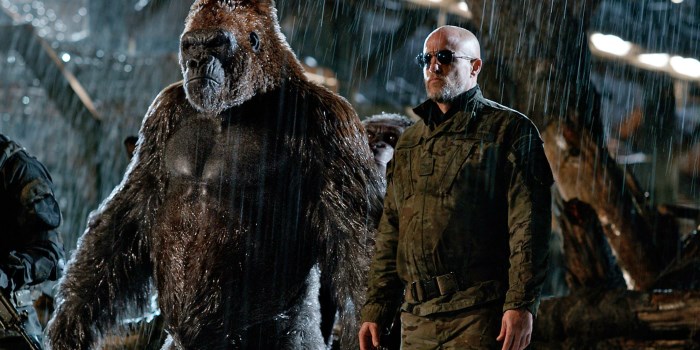
When the feature begins, a troop of soldiers—and some turncoat apes—sneak up on Caesar’s forested enclave, killing dozens of his community, including several members close to his heart. It’s the last gasp for the remaining humans alive, led by a mad, Kurtz-esque Colonel (Woody Harrelson). To emphasise the Apocalypse Now comparisons, we’re introduced to him in the rain, with war-paint strewn across his face. Later, we’ll see him rubbing his shaved head in dimly-lit quarters. Eventually, a few of Caesar’s emissaries will sneak into a tunnel beneath the Colonel’s barracks, and see “Ape-pocalypse Now” graffitied on the wall. Okay, now Reeves is just stealing perfectly good/bad puns from critics’ headlines.
Caesar, driven by rage, sets out to kill the Colonel, though the compassionate orangutan Maurice (Karin Konoval), bodyguard chimp Rocket (Terry Notary) and Luca (Michael Adamthwaite), the strong, silent type of gorilla, tag along. They pick up a young girl (wide-eyed Amiah Miller), who seems to be struck by the disease turning people mute and primitive, as they trek across the snow. Their crew is completed with the addition of Bad Ape (Steve Zahn), a self-deprecating chimp who adds some much-needed levity, raising the distinct possibility that Steve Zahn could get an Oscar nomination for a mo-capped performance before Andy Serkis, the actor who pioneered the form. Evolution doesn’t always work in your favour.
After Kong: Skull Island, War for the Planet of the Apes is 2017’s second Vietnam War-inspired simian revenge flick, which is a hell of a genre to accuse of dominating multiplexes. As impressively moody as Reeves’ movie is, it’s far more fun when it’s mimicking The Great Escape instead, with an exhilarating jail-break sequence orchestrated in the last act, as a final battle breaks out between two human armies.
War for the Planet of the Apes distinguishes itself from its hyper-narrow field by piling on the Christian allusions too. (Kong: Skull Island mashed a lot of elements together, but religious zealotry wasn’t one of them.) Caesar, the apes’ Christ-like saviour, winds up toying with self-sacrifice, and even ends up imprisoned, tied to a cross with his arms outstretched. Reeves and co-writer Mark Bomback do not shy away from the self-seriousness of their allegorical science fiction; they are blessed to have a performer as physical and emotive as Serkis to ground it, and a special effects team skilled enough to bring Caesar to life.
The apes’ appearance is uncanny, even compared against Rise of the Planet of the Apes from 2011. It now seems impossible to distinguish between actual animals and these computer-generated ones. Cinematographer Michael Seresin helps Caesar appear more human than human in one sequence, shadowing Harrelson’s seemingly-empty eye cavities during a face-to-face encounter. When you look in the eyes of the apes, all you can see are their personalities, and their pain.
With the latest trilogy ended, you have to wonder how this fifty-year-old saga will return, as it inevitably will. In the 1960s, it stood as a parallel to the civil rights movement, and the threat of nuclear annihilation. Does it speak worse of humanity that, fifty years later, the Planet of the Apes films are simply begging viewers to consider basic compassion for anyone else, suggesting we’re at risk of reverting to a subhuman state? Next time the apes return to our screens, we may not even need to wait three instalments before we start rooting for their takeover of Earth. We should cut the keys for them now.
3.5/5
In cinemas now. Rated M for mature themes and violence.
Photo: Fox
Topics
Ref: ef3eaccc-8f9c-434a-8281-a7bd00334d90





Comments & Feedback
Share your opinion
Emoji cheatsheet Formatting Comment guidelines