Movie Review: Straight Outta Compton
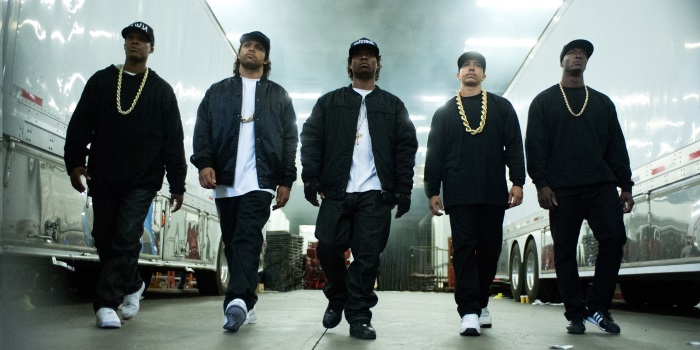
“You are now about to witness the strength of street knowledge.” No, really.
Just when you thought the biopic had nothing left to offer – besides refried rags-to-riches tales of redemption for baby boomer idols – 2015 comes with the one-two punch of Love and Mercy (a swirling, sonically-inventive distillation of Brian Wilson’s making of Pet Sounds) and Straight Outta Compton (a propulsive account of N.W.A.’s rise and eventual implosion).
What’s the trick? How do you make a Straight Outta Compton and not a Jersey Boys? Perhaps it’s all about casting Paul Giamatti as a manipulative Svengali, because he plays one in both Compton and Mercy. Hollywood executives will latch onto any trend in the hope of replicating success, so Giamatti should find a lifetime of employment ahead of him in just these kinds of roles. Heaven knows music history is littered with exploitative hangers-on.
Less superstitiously, you can chalk the success of Straight Outta Compton to director F. Gary Gray, whose long relationship with N.W.A.’s most lyrically dexterous mouthpiece, Ice Cube (dating back to his early videos and 1995’s Friday), pays off here. You can feel the history in the film, which begins in the late 1980s and crescendos with the LA riots of 1992. It’s during this period teenagers Cube, Dr. Dre, Eazy-E, MC Ren and DJ Yella decided to form a hip hop collective with a more “journalistic” intent: reporting on reality from within the powderkeg of one of Los Angeles’ most tumultuous areas. The album they produced - and from which the flick takes its title - is one of the best and most influential ever recorded.
It helps that O’Shea Jackson Jr. – aka Ice Cube’s son – plays his own father and is pretty convincing in the part. Corey Hawkins – a Juilliard grad - and Jason Mitchell are similarly ringers for Dre and Eazy, respectively. It makes the experience of watching Straight Outta Compton, where the original music is integrated seamlessly with the actors’ rapping, an uncanny one.

Their journey from obscurity to infamy begins when N.W.A.’s breakout song “Boyz n the Hood” catches the attention of producer Jerry Heller (Giamatti). He promises to bring them into the mainstream, so long as they sign some suspiciously-worded contracts. He succeeds. By the time the Rodney King beating by LAPD officers inspires near-revolution in Los Angeles five years later, the members of a now-splintered N.W.A. are secluded in the gated communities of affluent suburbs. The cosmic joke of the movie, however, is that even after reaching the heights of celebrity and wealth, the violence, persecution and marginalisation they knew in Compton is forever snapping at their heels.
Cube is driven to harass and threaten music execs just to collect his pay checks. Dre unwisely partners up with real-life Bond villain Suge Knight, a big time industry player with small-time hood instincts. (Suge is now on trial for murder, due to an altercation over this very project.). Eazy-E, on the other hand, finds himself fighting the less-discussed epidemic of impoverished America: AIDS. Without diminishing the struggles faced by black Americans who haven’t transcended to millionaire status, Straight Outta Compton is a fairly penetrating indictment of systemic racism in the United States, at all levels.
Sure, it falls into the same trap of many other music biopics, like relying on a chronological checklist of notable events and condensing history for brevity’s sake. (Founding member Arabian Prince is pretty much a no-show, though, mercifully, Lakeith Stanfield gets a decent berth as Dre’s pal, Snoop Dogg. Snoop and Dre seemingly inventing “Nothing But A G-Thang” on the spot – in one, woozy camera take - is a giddy highlight, and, again, not unlike Brian Wilson’s acoustic rendition of “God Only Knows” in Love and Mercy. Weird soulmates, these two.)
Also, certain prickly subjects are passed over entirely. For instance, Dre’s history of abuse towards women is entirely ignored; not that it helped people to forget. You can imagine the real-life Cube and Dre, as producers, influencing Jonathan Herman and Andrea Berloff’s script; they consistently appear as nice guys simply trying to do good. That’s why Eazy’s story leaves the most lasting mark. His tragic undoing, and the slow dissolution of his father-son relationship with Heller, is where the picture allows for much-needed complicated shading.

It’s in those moments - and during Gray’s staging of the live performances - that you’re convinced Straight Outta Compton has exceeded the genre’s limitations to truly achieve greatness. The showdowns between the band and the police (of “F*** Tha” fame) are stirringly effective too. The police, we discover, are just the first, most common barrier met by young black men in America. They are not the last. Nonetheless, in the wake of Ferguson, “I Can’t Breathe” and #BlackLivesMatter, these sequences of harassment by armed officials, sadly, ring truest of all.
Twenty five years have passed since the events of Straight Outta Compton. Ava DuVernay’s striking, essential Selma took place 60 years ago and dealt with similar issues. Today, the same racial schism remains. You have to wonder when ancient history will actually become ancient history. For Selma and Straight Outta Compton, the stories being told are still unfolding. At least Gray’s feature is fierce enough to honour the incendiary album that sought to bring attention to the matter.
4/5
In cinemas September 3, 2015. Rated MA15+ for strong coarse language.
Topics
Ref: 2b6d5371-8db5-4a68-88cb-a506004aea5f





Comments & Feedback
Share your opinion
Emoji cheatsheet Formatting Comment guidelines