Movie Review: Snowden

Is there any greater indication that you've successfully ignited a firestorm than hearing that Oliver Stone wants to tell your tale?
The rabble-rousing director returns in 2016 to share the story of NSA whistle-blower Edward Snowden in the drably-titled, wait for it, Snowden. (I guess Citzenfour was already taken.)
Joseph Gordon-Levitt, the hardest working man in showbiz (based on unnecessary effort, not filmographic breadth), takes on the title role, though towards the end of the feature, the real Edward Snowden is subbed in to deliver a lecture on why he exposed America’s illegal wiretapping of its own population. That’s one way to make us better appreciate JoGo’s acting chops.
Before then, the screenplay, by Stone and Kieran Fitzgerald, flits back and forth through time, contrasting Snowden’s decision to spill state secrets with the early circumstances of his career.
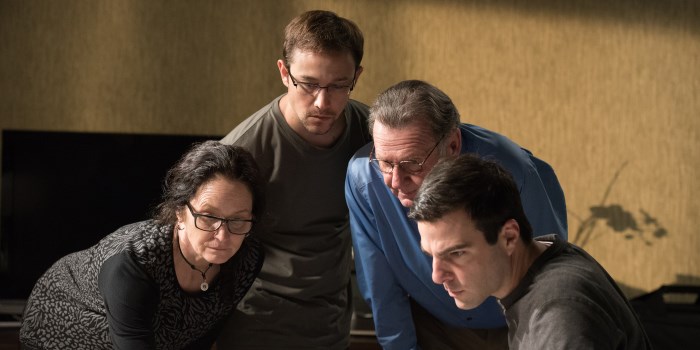
It begins in June of 2013, with Ed camped out in a Hong Kong hotel with journos Glenn Greenwald (Zachary Quinto) and Ewen MacAskill (Tom Wilkinson), along with documentarian Laura Poitras (Melissa Leo), who’s busy shooting what will become Oscar-winner Citizenfour. (Somehow, Hollywood has turned even the Snowden story into yet another ‘movie about making movies’.)
Like the biopic of a musician-who-must-reflect-on-their-entire-life-journey-before-going-onstage, Ed ponders how he got to this place while waiting on The Guardian to fact check his leaked documents before publishing far and wide. We see his memories – helpfully, in chronological order – including an expulsion from the Army Reserve for two broken legs to his training at the CIA as an analyst.
Eventually, after years of suspicion, his fears of the government’s invasive practices are confirmed while working as a contractor for the NSA. The film’s sole thrilling moment comes as he prepares to evacuate the damning data from a highly-guarded facility in Hawaii. First, however, he has to break the news all girlfriends dread hearing: “Gotta bounce; wanted for Espionage.” (I’m paraphrasing.)
In Ed’s case, his girlfriend is Lindsay Mills, an acrobat and (gasp) Democrat played by Shailene Woodley. In Citizenfour, the real Snowden seemed to approach his abandonment of Mills (and existence as he knew it) with near-detachment. Here, Stone reconfigures this as the most contentious aspect of his whistle-blowing. It’s one thing to run from an entity, like your government; it's another thing entirely to run from your loved ones.

Though he neatly condenses the larger bullet points of this scandal into an easily-digestible format, it’s a staid affair, lacking in energy, passion or necessity. Not even the sudden appearance of Nicolas Cage (as one of Ed’s oddball teachers) can introduce some fire to proceedings; just sniggering from the audience.
His main interest, clearly, is Ed and Lindsay.
You can’t blame Stone for seeing Snowden’s relationship with Mills as the general public’s “in” to the story. Citzenfour was the first picture to humanise Ed - particularly as he begins panicking over a potential raid of his hotel room - but it also painted him as a man totally comfortable with and certain of his choices. Oliver Stone instead goes the sentimental route, which is not a sentence you normally read.
Still, do we really want to turn to Oliver Stone for sentimentality?
Stone has made a cottage industry of commenting on America’s questionable exports (from international warfare to The Doors), and though he’s ultimately on the side of Ed Snowden here, he’s even-handed towards those doing the spying on U.S. citizens. (Rhys Ifans plays Ed’s imposing but reasonable mentor; Ben Schnetzer and LaKeith Stanfield are sympathetic surveillance artists.) The fairness is admirable. The ferocity is lacking.
Gordon-Levitt, mocked for his unnecessarily garbled ‘Snowden voice’ (which sounds like a teenager imitating their ‘very serious’ father), is otherwise suitably understated in the lead role, while Woodley is a suitable avatar for the average millennial, not super-concerned about their online privacy (much to her boyfriend’s annoyance).
Neither actor usually feels natural on screen, yet the director finds space for them to create some chemistry in Snowden. It’s not what we wanted – or needed – from an Oliver Stone movie about the shocking reveal of surveillance practices in the United States, but it’s what we’ve got.
3/5
In cinemas now. Rated M for coarse language and a sex scene.
Topics
Ref: baec6d14-5572-4826-a79d-a689002adba4



Most Popular



Comments & Feedback
Share your opinion
Emoji cheatsheet Formatting Comment guidelines
Cool