Movie Review – Red Dog: True Blue
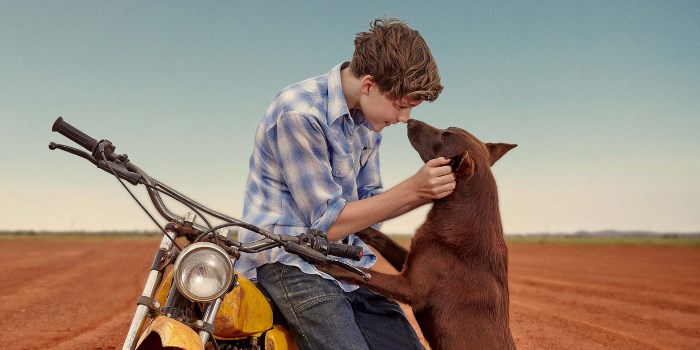
It will satisfy anyone who simply wants a film about a dog that’s red, and nothing else.
Wondering how they could possibly make a sequel to Red Dog, the hit 2011 weepie in which (spoiler alert) the dog died, followed shortly by the (life spoiler alert) actual death of the dog actor, Koko?
Here’s the twist in the tail: Red Dog: True Blue opens with a man watching the original Red Dog in cinemas, and being so moved by its story, he takes action in real life.
(I did not expect the Red Dog series to take its cues from The Human Centipede saga, which broke the fourth wall in the exact same manner with its second instalment, yet here we are.)
No fan of the original could have anticipated such meta experimentation. Perhaps director Kriv Stenders is taking inspiration from Hidden rather than Marley and Me this time around.
Or, maybe he’s hoping to coast on the goodwill generated by its predecessor? True Blue’s bonkers opening reminded me of that episode of The Office (from NBC), in which everyone just watched Glee (from Fox).
The aforementioned cinemagoer is overworked dad Michael Carter (Jason Isaacs, a Liverpudlian with a convincing Aussie accent). He reluctantly takes his kids to see Red Dog, only to discover that its subject was the very same dog he nurtured as a pup back when he was living in the Pilbara. He regales his son with the convenient story (manufactured by screenwriter Daniel Taplitz, fact-checkers), flashing back to 1969, where he, as a teen (Levi Miller), rescued ‘Bluey’ (dog actor Phoenix) from a storm.
(Normally, there’s an outcry when an older--or deceased—actor is replaced by a prettier, younger thing. Not so with dogs, I guess. Phoenix is the Alden Ehrenreich to Koko’s Harrison Ford.)
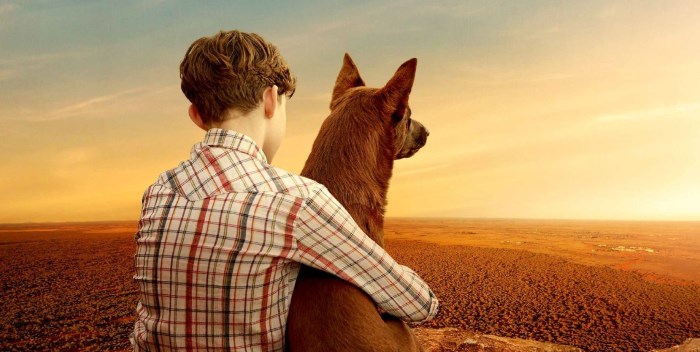
We learn Bluey was Mick’s only friend on the cattle station run by his grizzled granddad (Bryan Brown). Eventually, Mick develops a crush on fly-in teacher Betty (Hanna Mangan Lawrence) and a rivalry with her pilot boyfriend Stemple (Thomas Cocquerel), and even flirts with disturbing sacred Aboriginal land to win her affections. Ultimately though, these are distractions from the flick’s main concerns: a red-haired dog who loves getting up to mischief, being loyal to Mick and expelling potent gas. Fin.
There are some striking shots, captured by cinematographer Geoffrey Hall; of the vermilion-stained landscape, of a hellish bushfire, and of a lightning-struck steed rampaging through the night.
The cast too, is serviceable, with Brown especially in his element. But much is lacking here.
Should we congratulate Red Dog: True Blue for its few throwaway lines about Aboriginal land rights, being gay in the outback and the simmering culture schism between farmers and the city elite? Or should we bristle at its cursory, unsatisfactory references to these issues that still plague the bush?
The closest it gets to social commentary is the brief appearance of Lang Hancock (John Jarratt), though the most the movie can muster is simply having Bluey deny Lang a seat on the couch. Gina, don’t sue!
Kids and dog-lovers will probably get a kick out of Red Dog: True Blue’s frivolities, but it’s certainly lacking the emotional wallop of the original, or that effective, anecdotal structure. The first truly did feel like an apocryphal tall tale—or should that be shaggy dog story—spun by barflies. This is a hackneyed sequel spun, clearly, by screenwriters.
Often that can still result in something entertaining. Just don’t expect anything special this second time around.
3/5
In cinemas Boxing Day. Rated PG for mild themes and coarse language.
Photo: Roadshow
Topics
Ref: c076a51f-242c-47c2-a660-a6d300806d3f
Most Popular



Comments & Feedback
Share your opinion
Emoji cheatsheet Formatting Comment guidelines
It is a beautiful movie because the dog go to other people and i don't know what i have to say it's a lovely movie.