Movie Review: Prepare for Class War in the Brilliant "Parasite"
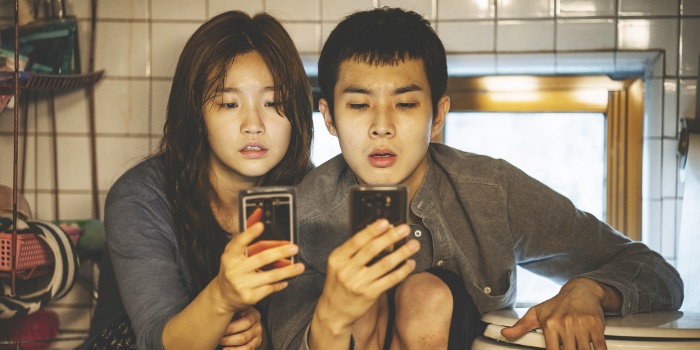
The director of The Host and Okja delivers a wild, searing and unforgettable black comedy.
It’s a weird but maybe era-appropriate coincidence that the two best films of the year so far—Us and now Bong Joon-ho’s Parasite—are searing black comedies about class, featuring two rival families whose differences in wealth are largely the result of chance. Understanding our current class divisions goes a long way to explaining where we find ourselves at this moment in time, and helps clarify otherwise inexplicable movements such as the rise of Trump, Brexit, and the revolt against climate action. Wrapping our heads around this divide doesn’t suddenly make those movements right. However, ignoring the issue was hardly helpful either.
So, Jordan Peele confronted audiences with his allegorical Us, and Bong tackles the schism with slapstick violence that crescendos at a hysterical pitch. He perfected this style of moviemaking with The Host, and though his English-language features—Snowpiercer and Okja—delivered diminishing results, Parasite sees him return to the top of his form. I’ll even go so far to say it’s his finest since 2003’s Memories of Murder. No wonder he nabbed the Palme d’Or at Cannes.
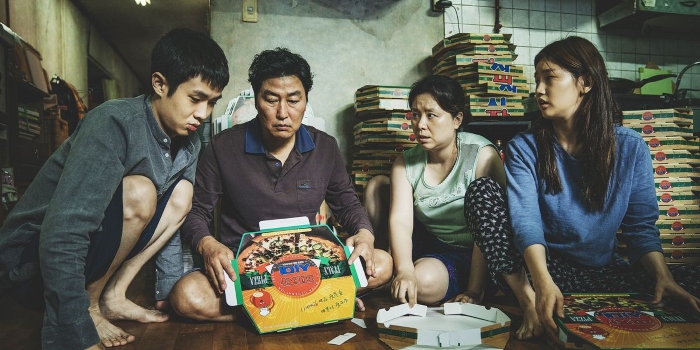
It opens with the Kim family in their below-ground South Korean apartment, welcoming the free blasts of pest-control poison from the street outside. Their social standing is so low, they have to look up from their hovel’s window to even see the road. Later, they’ll face rising, pungent sewage. Without ever spelling it out, Bong (who wrote the script with Han Jin-won) suggests it didn’t, or shouldn’t, have to be this way. The two semi-adult children, Ki-woo (Choi Woo-shik) and Ki-jung (Park So-dam), are silver-tongued grifters who can talk their way out of any situation, while mother Choong-sook (Jang Hye-jin) used to be an accomplished athlete. The gift of defeated patriarch Ki-taek (Bong regular Song Kang-ho) takes longer to emerge: turns out, dude can act.
Ki-woo gets a lucky break when his mate asks him to stand-in as a tutor for the Park family while he goes away on holiday. The Parks, situated literally and figuratively uphill from the Kims, need a university graduate to teach their teen daughter Da-hye (Jung Ji-so), and will pay richly for the right person. So Ki-woo forges his school documents, and smoothly convinces Mrs. Park (Cho Yeo-jeong) to also hire his sister Ki-jung as an art therapist for their supposedly prodigious son Da-song (Jung Hyun-joon), keeping their relation a secret. It’s not long before they’ve conspired to replace the Parks’ housekeeper with Choong-sook, and their driver with Ki-taek, and eventually, both families are practically living together. Throughout, the Kims pretend to be strangers to one another, feeling more and more entitled to the perks of the Parks’ mansion.
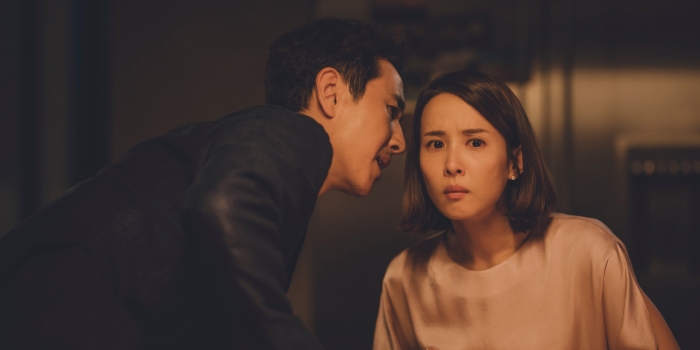
Parasite is a very specific inspection of South Korean social issues, but many of those will ring true to anyone in Australia, America or elsewhere. It cuts to the heart of a central modern question: Who deserves to earn? The Parks don’t seem to have any discernible talents, especially compared with the Kims, yet that doesn’t keep them from convincing themselves of what they’re worth: a lot. (In one biting recurring joke, their sole skill seems to be smelling the poor on people.) Mr. Park (Lee Sun-kyun) even repeatedly says during job interviews that he doesn’t want his staff "crossing the line", and though he never clarifies what he’s saying, we know exactly what he means.
Parasite doesn’t stop there. Just when you think you have the flick figured out, the Kims meet a new family, stationed even further down from themselves, and wind up at risk of overthrow. In Parasite’s most damning bit of commentary, it seems "eat the rich" is no longer a suitable catch-cry; it’s "eat whoever’s richer". Evaluating your sympathies for these characters, and the decisions they make in the wild final act, means confronting your pre-conceived notions of 'deserve'. You may not like it.
Or, if you’re down for a genre-warping romp that’s both a con-artist thriller and a class comedy, it's likely you’ll love Parasite. South Korean cinema has a taste for the melodramatic, and when coupled with Bong’s devious sense of humour (and composer Jung Jae-il’s cheeky score), it makes for a potent combo. The cast, especially the sardonic Park So-dam and the slow-roiling Song Kang-ho, chomp deliciously into the material, and the visual language, recalling Akira Kurosawa’s High and Low, expertly reminds you where the rich and underprivileged families are placed… or belong.
Still, Parasite is tinged with tragedy, both in its conclusion and the conclusions drawn by its characters. That’s what makes it so devastating in its final scenes, once the laughs subside. The upwardly mobile Ki-woo, who gets this snowball rolling, keeps insisting all one has to do is "walk up the stairs" to find success, as if it’s solely a matter of will rather than circumstance. Bong knows different.
5/5
In Australian cinemas 27 June. Rated MA15+ for strong violence.
Header Image: Madman Entertainment
Topics
Ref: 008094cb-42f2-428b-8726-aa7800226a77





Comments & Feedback
Share your opinion
Emoji cheatsheet Formatting Comment guidelines