Movie Review: "Phantom Thread" Is Dastardly, Devious and Delicious
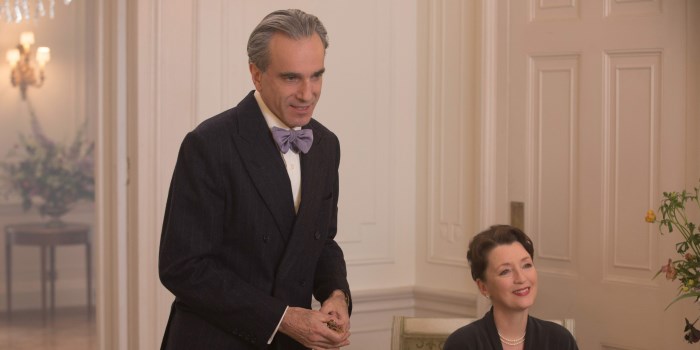
"New classic" is one of the dumbest oxymorons in our dictionary, but it fits Phantom Thread like a glove.
Paul Thomas Anderson’s latest appears torn out of time; a seeming refugee from the cinema of the 1950s. If you didn’t recognise its star Daniel Day-Lewis, you might have even mistaken it for an early film of Alfred Hitchcock’s, or an unreleased Powell & Pressburger flick.
Then again, it’s a rom-com-thriller as only PTA could make, which means there’s a semi-incestuous love triangle at its heart, a case of Munchausen syndrome by proxy and a piercing (though very lovely) Jonny Greenwood score. It’s kind of like when Michael Haneke made a movie called Amour and the most romantic thing he could think of was suffocating someone to death. Artists often fall back on old, devious habits.
That’s certainly true for Reynolds Woodcock, the dressmaker at the center of Phantom Thread, played by a refined—and apparently retiring—Day-Lewis. Woodcock (Day-Lewis picked the name himself, that scamp) is the toast of post-war London, fitting esteemed ladies of the era in the finest couture. His sister, Cyril (an icy Lesley Manville), keeps the House of Woodcock humming, also answering to any of Reynolds’ needs—usually before he has to ask. Alas, she’s no fan of how he conducts his love life, which involves spying some young woman, inviting her to board with them, growing tired of her and letting Cyril eventually show her the door. Actually, she doesn’t mind that last part.
It’s the arrival of Alma (Vicky Krieps) that throws their house out of its precise order. At first, the shy waitress feels lucky to be fawned over by Woodcock. However, when she notices him starting to pull away, she concocts a plan to install herself permanently in his bedroom, remaining by his side forever. Her means—and Reynolds’ response to it—will alienate viewers (who otherwise just wanted to swoon over Mark Bridges’ Oscar-nominated costumes). Phantom Thread’s love story is, umm, unconventional. Well, whatever works!
This marks a formal shift for Anderson, who’s working without a credited cinematographer (he reportedly collaborated on the filming with his crew). To satiate his passion for wide shots and tracking shots, he’s previously relied on spacious sets and vast landscapes, even shooting a climactic two-person sequence from The Master in the biggest office you’ve ever seen. In Phantom Thread, he challenges himself by placing the action almost entirely in the one location: Reynolds’ house, which wraps narrowly around a spiral staircase. Now, Anderson has us peeking around corners rather than gasping at empty expanses, and his depth of field only stretches across a few open doorways. When a hallucinated phantom arrives, it has to huddle in the corner of a cramped bedroom; the camera barely has space to pan from side to side and keep it in the frame.
It adds to Phantom Thread’s sinister sensation of claustrophobia, not to mention the intoxication of proximity with Reynolds, Alma and Cyril, each in competition to see who can deliver the most cutting comment under their breath, usually while buttering their breakfast in increasingly annoying fashion. (“I’m admiring my own gallantry for eating it the way you prepared it.”) Our romantic leads use food as a weapon throughout, and as the characters get too close to one another for comfort, so do we.
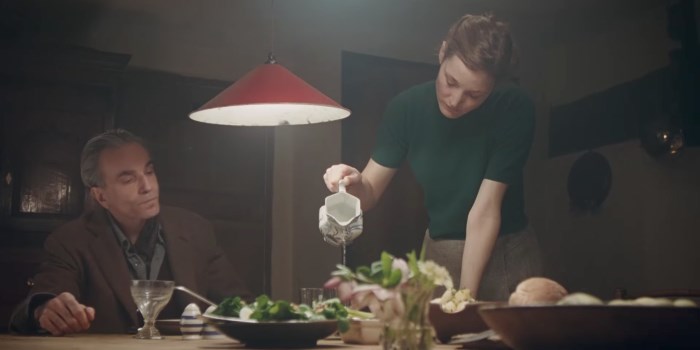
Did I mention it’s a comedy? Despite the threat of danger that lingers over proceedings, Phantom Thread remains really quite funny, in that catty, buttoned-up manner that was all the rage once upon a time. Day-Lewis, mimicking his writer-director’s soft cadence, lets his considerable body do much of the characterisation, wincing with comic precision at the breakfast table as Alma chews too-loudly on her oatmeal. Later, she pours tea as slowly as is humanly possible, from a great height, specifically to rile him up. Anderson winds the tension so expertly, he only needs to make his stars toy frustratingly with their meals to have us giggling in nervous anticipation.
Day-Lewis’ final line in Anderson's There Will Be Blood was “I’m finished”, and it’s bookended here by the declaration, “I’m hungry.” Some in the audience will be similarly left wanting more, wondering what Phantom Thread was even about. For an answer, look to PTA himself; an intricate artiste who changes things up a little, only to call-back to his previous works. The story of his new feature, and the way he's gone about making it, suggests people change, for a bit, before returning to where they began, like a needle pierced back and forth through fabric.
But routines can be changed, slightly, for the better. Only, as Phantom Thread argues, by force. And by food.
4/5
In cinemas now. Rated M for mature themes and coarse language.
Photo: Universal Pictures
Topics
Ref: 0e31ee42-b2f9-4c64-9024-a879008b78fb






Comments & Feedback
Share your opinion
Emoji cheatsheet Formatting Comment guidelines