Movie Review: "Once Upon a Time in Hollywood" Is Tarantino’s Strange, Sad Fairytale
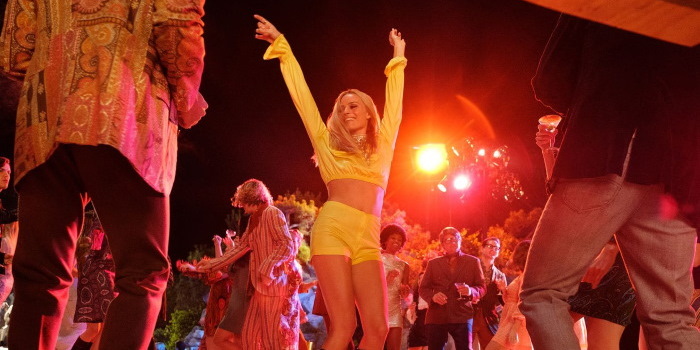
QT remixes history again in Once Upon a Time In Hollywood.
"Why did Quentin Tarantino make this?"
That's the question I asked myself after leaving Once Upon a Time in Hollywood, and it's not an ideal one. Admittedly, after seeing something like Hobbs and Shaw, we don't don the pose of Rodin's Thinker and wonder what exactly director David Leitch was trying to say through his art. And perhaps we should extend QT the same courtesy; to let him mix-and-match characters from history and his own imagination, just for s***s and giggles, without interrogating it any further. Once Upon a Time in Hollywood is, after all, very funny, with stunning production design and entertaining performances. That should be enough.
But c'mon. Tarantino is begging for interrogation, even more than he’s begging actors to kick off their shoes. He's pledged to only ever make 10 movies, and as the poster declares, this is his "9th", so QT’s certainly not doing this solely for s***s or giggles. It’s set in the months and hours leading up to the tragic slaughter of Sharon Tate and her friends at the hands of the Manson family in 1969; a writer-director must have a damn good motive with that climax on the horizon. Still, when the credits finally rolled, I couldn’t clearly see his reason why. However, as with any artist who makes a confronting and challenging work, you should meet them halfway before writing them off. I’ve taken my time with Once Upon a Time in Hollywood, just as it takes its time with us, and even though I'd place it last in a ranking of all his films, I'll concede there’s something of value here. What that is... uh, let's find out.
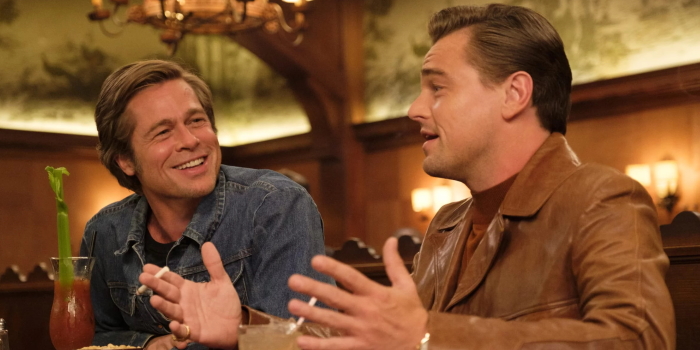
The story mostly focuses on Tarantino’s fictional inventions, who’ve been transplanted into the very real world of 1969 Hollywood, California. Leonardo DiCaprio, in his second collaboration with the auteur after Django Unchained, plays Rick Dalton, a former gunslinging TV actor who had the gall to reach for movie roles, and has dropped a few rungs on the ladder of fame as a result. He’s now stuck doing guest appearances on a bunch of westerns and cop shows, which means there’s not much work for his buddy and trusted stunt double Cliff Booth (Brad Pitt) either. Not that anyone would hire Cliff anyway; the industry turned their back on him after he seemingly got away with his wife’s murder. So, Cliff earns a living as Rick’s driver (and chief ego validator), hanging out at his swanky Cielo Drive home, just down the driveway from it-kids Roman Polanski and Sharon Tate. Imagine their luck.
Sharon Tate is played by Margot Robbie in the pic’s best turn. Tarantino gives Tate a new life, outside of the context of how she was murdered; in her key sequence, she goes to watch herself on the big-screen, in a supporting role of a Dean Martin vehicle called The Wrecking Crew. We see how a woman with a whole future ahead of her relished the big and small accomplishments of a career in acting; from her billing on the poster, to the audience’s laughter at her pratfalls. We know what becomes of Tate, so this scene carries a heavy weight; Robbie, airy and kind, keeps it light yet meaningful.
DiCaprio and Pitt are a fun double act, and it’s no surprise that Tarantino has stacked the cast with literally dozens of nifty day-players, including child actor Julia Butters as a precocious co-star of Rick’s. I particularly enjoyed Margaret Qualley as the nimble Pussycat, Cliff's escort to the ranch/former movie set where she and other hippie runaways have fallen under the spell of Charlie Manson (who, history tells us, later compels his followers to go on a killing spree). Mikey Madison is also a scream as the infamous, bloodlustful Sadie Atkins; no spoilers for how I mean.
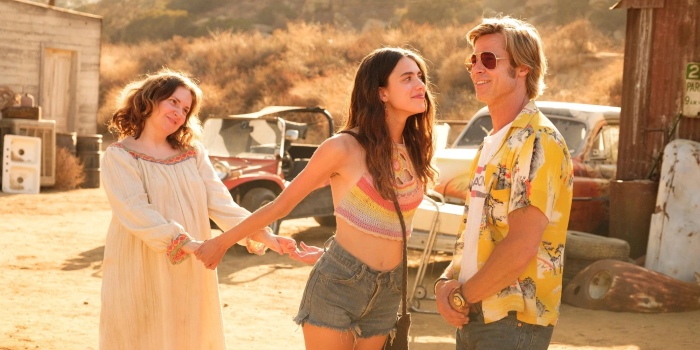
It won’t surprise you to learn that Quentin has his way with the historical record in Once Upon a Time in Hollywood. At the end of Inglourious Basterds, he altered WW2 by having Pitt’s titular Basterds kill Adolf Hitler. (Here, Rick Dalton gets to mimic that scene in one of his own war pictures.) But this time around, when Tarantino tinkers with history, he appears to acknowledge the impossibility of it all. Pussycat tells Cliff she hates the "phoniness" of actors and writers. Cut to Rick on his latest shoot, where QT and his longtime cinematographer Robert Richardson have restaged the "phoniness" and ingloriousness of moviemaking: the flubbed lines, the retakes, the emotional breakdowns; the multitudinous indignities a stuttering actor at the end of his career endures immediately before and after the director calls "action" and "cut". Audiences will never see how the sausage is made; only the idealised final product. Tarantino knows his movie is just a movie too, and embraces the veneer of phoniness. He knows we're looking out for shots of women's feet, so he puts them everywhere, for us to keep count. There’s also a winking mid-credits scene, where Rick Dalton throws a fit about a picture of himself with a double chin; a nod to the controversy around the promo shot for this very film that erased Leo's jowl. Tarantino clearly added this gag late in the game, as if to let us know TV and movies are fake and can always be restaged, remade and readjusted. History itself? Not so much.
Tarantino could never contrive a sequence more disturbing than the footage of Uma Thurman speeding off-road during the production of Kill Bill, which was shared in 2018 when Thurman spoke out against his former producer and alleged serial abuser Harvey Weinstein as well as the unsafe conditions on that picture’s set. It’s as if this #MeToo moment blew up the barrier between fantasy and reality for Tarantino. Once Upon a Time in Hollywood is the consequence. It’s a loving, affectionate tribute to those who give their life to cinema, and to old-school moviemaking, but it’s also a repudiation of the past, and how his town ignored the evil that flirted so closely to its fringes. Maybe that's why I struggled to see the sense in Once Upon a Time in Hollywood, which is lacking the full-throated confidence of all he's made before. It does not feel like the work of a settled man. So, what's he saying? There have been many unhappy endings in Hollywood. The irony, Quentin offers, is that only in Hollywood, can you write yourself a happy ending where there wasn't one before.
3.5/5
Once Upon a Time in Hollywood arrives in Australian cinemas 15 August. Rated MA15+ for strong violence and coarse language.
Header Image: Sony Pictures
Topics
Ref: 1f5c5893-eb3d-489d-94a7-aaa4003f0234



Comments & Feedback
Share your opinion
Emoji cheatsheet Formatting Comment guidelines