Movie Review: No Love Lost Between Emma Stone and Steve Carell in “Battle of the Sexes”
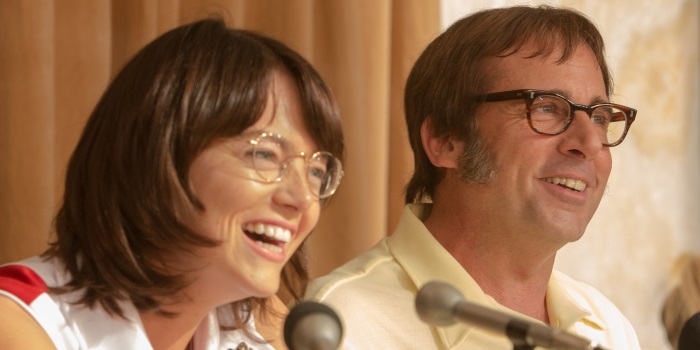
Tennis stars take the fight for equal pay to the court in a historical sports drama that couldn’t be timelier.
Imagine it: A retired men’s tennis great saying the current women’s number one can't hold a candle to the male competition.
Only in 1973, right? Wrong. Try June. Of 2017.
That’s what John McEnroe, professional blowhard, said of Serena Williams (*checks watch, looks at calendar, glances at position of the sun*) literally three months ago, soon after her triumph at the Australian Open, which she won while pregnant. Apparently playing tennis while a person grows inside of you is amateur stuff.
McEnroe’s serve makes Jonathan Dayton and Valerie Faris’ Battle of the Sexes depressing rather than inspiring, which probably wasn’t the intention. Focusing on the legendary 1973 match-up between 29-year-old Billie Jean King (then the women’s champ) and 55-year-old Bobby Riggs (the former world number one), it shows the absurd lengths King had to go to prove she and her female counterparts were worthy of equal pay and respect on the sporting field, and, by extension, everywhere else.
King endured Bobby Riggs’ circus with a smile, hoping each small, degrading step moved her towards equality. Gains were made so gradually, you’d have to examine her entire lifetime’s achievements to actually see the social shift. (Still in the closet at this time, King would have to save the fight for the LGBTQI community until after this barrier for female rights had been broken first.)
Emma Stone stars as King in this timely re-enactment, while Steve Carell—complete with big glasses and bigger fake teeth—joins her as Riggs. Screenwriter Simon Beaufoy is not so naïve as to depict Bobby as the big, bad face of Male Chauvinism; his script and Carell’s performance renders Bobby a harmless clown and hustler who’s just interested in putting on a show (and taking a tantalising bet—each of his proposed man vs. woman matches came with a big payday for the winner).
Instead, the movie mostly follows Stone’s Billie Jean as she rebels against Jack Kramer (Bill Pullman), a sexist gatekeeper of the sport, while beginning a taboo flirtation with Marilyn Barnett (Andrea Riseborough), despite her marriage to husband Larry (Austin Stowell) and the homophobia of the 1970s. On tour with her newly formed Women’s Tennis Association, Billie Jean finally begins exploring her previously-buried sexuality. Meanwhile, Riggs sees an opening to play the persona of “chauvinist pig” in this age of women's lib, challenging Australia’s own Margaret Court (a convincing Jessica McNamee) to a match. After winning, he declares himself the “women’s number one”. An infuriated Billie Jean takes on his $100,000 challenge to reclaim the title. She resents competing on his terms, but the savvy feminist in her recognises the importance of the optics, so game on.
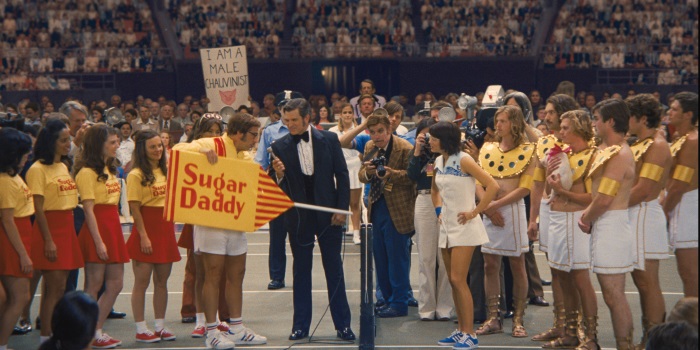
Battle of the Sexes is compelling and enjoyable to watch, thanks in large part to the performances, even if some of the outsized supporting characters, especially those portrayed by Sarah Silverman and Alan Cumming, are given the lamest lines.
Beaufoy condenses the timeline well enough, and fairly, though he does let the romanticism of the metaphorical battle get the best of him in the dialogue department. Perhaps he took the film’s title to heart, trying—and failing—to emulate the frothy rom-coms of the 1950s with his characters’ witty back-and-forth, when maybe he should have gone for the gritty realism of the period-appropriate 1970s. Directors Dayton and Faris at least try to visually mimic the grain of the era’s cinema and TV. Nonetheless, it results in a stylistic disconnect, like when Emma Stone played a Chinese woman that one time.
The picture's tension relies heavily on the buildup to the final match. However, Dayton and Faris (better known for character pieces Little Miss Sunshine and Ruby Sparks) don’t so much put you in the game as they make you watch it from above, with the same bird’s eye view of a regular tennis broadcast. If you’re going to justify a reimagining of historical events for the big screen, it’s not enough to condense the story into a more palatable and streamlined narrative. You've gotta offer a little more. Dayton and Faris might have considered a more immersive approach to their sporting set-pieces.
Thankfully, Stone and Carell do their part to illustrate their subjects’ inner life and motivations, which may have otherwise been lost in the lead-up to the real-life showdown. Carell is fun and somehow affecting, dentures and all. Stone—tasked with carrying Billie Jean King’s numerous, simultaneous burdens—deploys her incandescent smile and charm as if it were a mask, without losing her lust for righteousness, for Marilyn, and, above all, for tennis. She's phenomenal.
This is the reason Emma Stone is the highest paid actress in the world. And yet, she only made less than half of what the highest paid male actor managed in 2017. That actor? Mark Wahlberg. Acting's not a sport, but still, there's no question who'd win that particular acting-off.
3.5/5
In cinemas now. Rated PG for mild themes, sexual references and coarse language.
Photo: Fox Searchlight
Topics
Ref: 36916ec3-2b1a-4d7a-a7ec-a7fb0076a9be




Comments & Feedback
Share your opinion
Emoji cheatsheet Formatting Comment guidelines