Movie Review: Joaquin Phoenix Is the Best "Joker" Ever
As for the rest of the film: Why so serious?
In the old joke, a doctor tells an unhappy man to lighten up by seeing the famous clown Pagliacci.
I don’t think any medical professionals will be prescribing visits to Joker as a salve for depression.
It’s a good movie, but a totally dispiriting affair, and mostly an examination of mental illness and radicalisation. In fact, you may want to dial double-zero before heading into the theatre, and if any of the other patrons giggle with too much zeal at its gory, antisocial antics, dial the final zero.
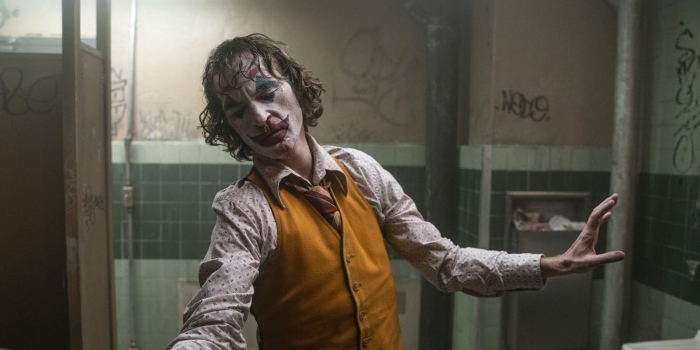
Joaquin Phoenix stars as Arthur Fleck, a dejected outcast and failing comic who dreams of one day cutting it up on a late-night talk show. (Yes, this is also the exact premise of Between Two Ferns: The Movie.) Not helping Fleck’s professional aspiration is his pathological laughter, which forces itself out of his throat at awkward times. And then there’s his non-stop stream of "negative thoughts", unquieted by medication or the positive reinforcement of his mother/roommate (Frances Conroy). At least he loves his job—a for-hire party clown—even if most gigs end in violent emasculation. In an opening scene, he’s left bloodied in an alley after a mugging, holding his crotch in pain. The title Joker then splashes across the screen. Oh yeah, this is a Batman flick, just without the Batman.
You’d be better off approaching this DC supervillain vehicle as a new entry in the MCU (Marty Cinematic Universe), seeing how its story is inspired by Martin Scorsese’s Taxi Driver and The King of Comedy. The star of those projects, Robert De Niro, even plays the fatherly talk show host Murray Franklin whom Arthur aspires to meet... with increasingly deranged intentions.
As far as pitches go, I kinda love it: a remixing of Scorsese’s strangest, grimmest black comedies, with an iconic, outsized literary baddie dropped into the lead role, and our finest working actor inhabiting his deep burgundy suit (or rather, barely inhabiting it, given how gaunt Phoenix got for the part).
Director and co-writer Todd Phillips is no Martin Scorsese though, no matter how much he wanted his last effort, War Dogs, to take on the mantle of Goodfellas. Joker doesn’t look much like a Scorsese picture either, even if its Gotham City resembles Taxi Driver’s '70s-era New York, with tensions running hot. Phillips and cinematographer Lawrence Sher nonetheless only make stunningly photographed features, and Joker is one the best-looking films of the year. But if you thought Joker would outdo Taxi Driver or The King of Comedy and make their same points but better, well, you’re having a laugh.
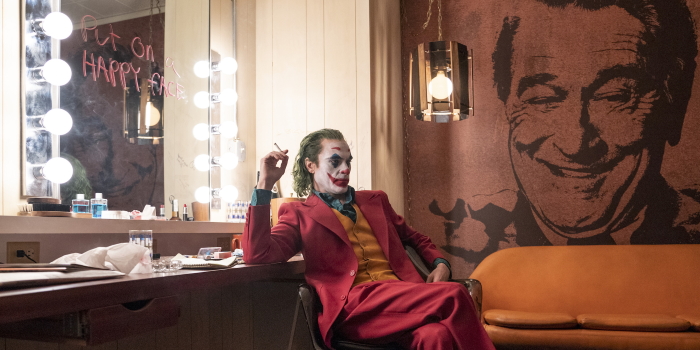
Still, this thing has a towering performance from Phoenix, who becomes the best to ever do it ('it' being the ultimate acting challenge of depicting the clown who fights Batman). He evolves from a wraithlike lonely ghost with a choked-out laugh to a smooth, sinewy, theatrical presence with a penchant for dancing and showmanship (and, weirdly, thrusting repeatedly like Ace Ventura). Believe the hype that Joker is primarily a character study, with a hell of a central character, played by a genius study.
It is also a provocation, because it asks us to empathise with the exact kind of terrorist or incel (involuntarily celibate) who commits shootings and acts of hate because of prejudices, perceived slights, or the sense that they’re not being heard. Like Gus Van Sant’s Elephant, it provides various potential triggers as explanations. Like the works of Antonio Campos, it worms inside an ill mind and asks us to look out their eyes. And, like those films of Scorsese, it suggests that under the most tempestuous social circumstances, a gun-wielding menace could become ironically celebrated as a hero.
The hand-wringing around Joker is probably warranted. Taxi Driver stirred up an attempted presidential assassination, after all. We have also seen the scale of violence by white nationalists in recent times, so any film that unintentionally gives them a figure to admire (even an apolitical anarchist clown) should be approached with suspicion. However, Phillips and co-writer Scott Silver don’t lionise Arthur when he kills as a means of quelling his inner demons. Throughout, the point is made that Arthur is an unwell man. The film also acknowledges how he’s being denied services that could genuinely help save him, and others, from harm. It also points out that he regularly makes excuses and blames others for his pitiable situation. When his first murders inspire "Kill the Rich" rallies in Gotham, parallels are drawn between the furious protesters and the Tiki torch-toting Nazis who stormed Charlottesville in 2017. Joker ponders how a person like Arthur turns to terror. It doesn’t celebrate it, and the finger of blame is never pointed at those who often experience the wrath in reality.
This may not make for a fun time at the cinema, and Joker suffers most when it’s too self-serious, but it’s the most challenging piece of mainstream art intended for mass audiences we’ve seen in some time, so that's something. And from the filmmaker who gave us The Hangover series. How’s that for a punchline?
4/5
In Australian cinemas now. Rated MA15+ for strong violence.
Header Image: Roadshow Films
Topics
Ref: 535ff957-5eba-4ee6-b5c4-aadb00954a9f

Most Popular


Comments & Feedback
Share your opinion
Emoji cheatsheet Formatting Comment guidelines
First just because someone laughs at some dark humour doesn't mean you should call the police on them regarding your first comment. Also I see you didn't like the sympathising with the main character because he's an 'incel' , hmmm well if you watched the movie (spoiler) you know that he is the product of an abusive childhood and his misfortune is a product of that. Also I don't see how people can't see that what Arthur does is not right? People aren't going to start shooting up the nearest public place after this movie, what you're saying is similar to what the media said about shooters (video games), the only people who will idolise him are mentally unwell and messed up people. I think you should stop trying to force this idea that violence in media will cause people to become terrorists and stop forcing your own political agenda in your reviews from now on. But if that was you aim you'll be perfect for buzzfeed.