Movie Review: “It Comes at Night” Is Scary for a While, Until Its Ending Ruins Everything
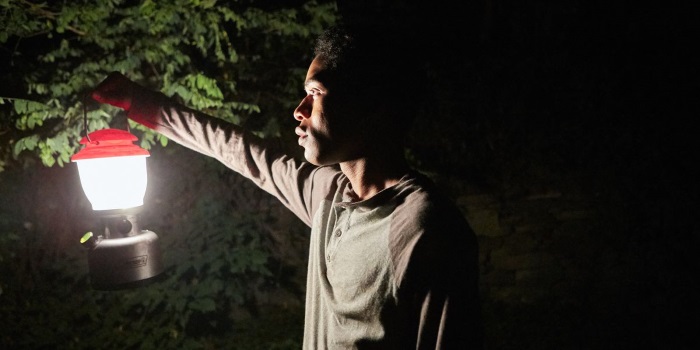
It Comes at Night answers the cinematic question: Do movies even need an ending? (Yes.)
Recommending a funny comedy is easy. Recommending a powerful drama (depending on the subject matter) is easy too.
But have you ever tried recommending an alienating, sometimes-abstract arthouse picture that is an absolute slog to sit through yet is ultimately rewarding? Woof. This is about as difficult as tasks get for critics (who, I’ll break the pact and admit, otherwise enjoy a pretty cushy job, what with the free movies and all).
Anyway, Trey Edward Shults’ It Comes at Night is like that, except without the ‘rewarding’ part. I saw it for free and felt ripped off. What will paying customers think? Shults’ psychological horror film is all slog, zero reward; a trial of emotional torture for viewers as much as it is for its characters, who are attempting to survive an outbreak of a deadly virus by hiding in the remoteness of the woods.
The flick raises thoughtful questions about the lengths one would go to protect their family in a crisis—and how much of their humanity they’d be willing to sacrifice—and demonstrates filmic skill to boot. But… for what? When the metaphorical ‘It’ of the title emerges, the director panics and punts, rushing to the end credits instead of stewing in the tension of his own making, rendering his film pointless. It’s cinematic seppuku.
Joel Edgerton stars as Paul, patriarch of a family living in forested seclusion as an unnamed epidemic ravages the cities. His family shrinks by one in the opening scene, when his sick father-in-low Bud (David Pendleton), riddled with sores, is taken out back, shot, and burned to a crisp. Paul’s wife Sarah (Carmen Ejogo) stays inside their home; their son, Travis (Kelvin Harrison Jr.), helps Paul destroy the body. We see the flames reflected in their gas masks, and cinematographer Drew Daniels makes it appear as if their teeth have been replaced with forked-tongues of fire. At this point, I’m in.
Still, where is this ‘It’ the title promises? Is ‘It’ Will (Christopher Abbott), a desperate young man who breaks into Paul and Sarah’s home? Turns out no. He begs them to let him take some water back to his wife (Riley Keough) and child (Griffin Robert Faulkner), in exchange for food. Paul, suspicious but desperate as well, proposes they move in together, giving them access to one another’s resources. They can also jointly defend the house from any outside threats who may be carrying the flesh-rotting disease. Twist: It’s the perceived threats coming from within the home that eat away at them quicker.
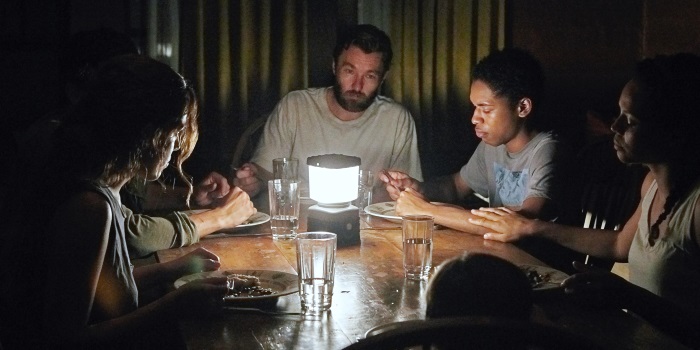
It Comes at Night follows in the footsteps of The Babadook, It Follows and The Witch, which all slow-crawl to horror, at a speed some viewers will describe as ‘unbearable’. Like It Comes at Night, those three use familiar tropes to tell larger, profound and deeply unsettling tales (about mental illness, sexual abuse and religious zealotry, respectively). And yet, those three managed to deliver the thrills (monsters, zombies, devil-goats) that make for an enjoyably terrifying experience.
It Comes at Night is familiar with what horror movies look and sound like. Its frights hinge on a spooky red door—the only entrance or exit to the house—at the end of a darkened hallway that remains an omnipresent threat. There are also Travis’ recurring nightmares—perhaps these are the ‘It’ that come at night—in which he imagines himself spitting up blackened blood. And they're effective! For a while.
Those escalating teases are meant to build towards something. What they build to here is a laughably misconceived ending that undoes much of the good work (especially from the actors) that precedes it. The Babadook, It Follows and The Witch are hard to recommend, but you do it because you know they’re worth the ride, and have their pleasures along the way. It Comes at Night isn’t, and doesn’t.
Writer-director Shults sows seeds of mistrust among the characters, and you anticipate some psychological warfare between the house-sharing families. This would be a mistake. You wait for them to manipulate one another, for the sake of their own survival. Nope again. Everyone acts exactly as they’ve acted from the start. The characters don’t change. They don’t do anything unexpected. They are not given an opportunity to take leaps of faith (fatal or otherwise). The moment conflict arrives, the film ends. Shults betrays the bedrock of storytelling that even Dude, Where's My Car understood: "And then?"
I’m all for leaving audiences with mentally-knotty homework after leaving the theatre, but the director is asking them to literally conceive of an entire third act. And to be honest, it’s not hard to think of multiple that would be more satisfying or intriguing than the one we have here. You don't walk away from It Comes at Night pondering its message about the ease with which we turn to cruelty. Instead, you play out the more interesting alternative endings in your head; you think how characters could have been given the opportunity to mutate (emotionally or physically), or how tension could have been drawn out further. Don’t mistake that for being food for thought. You’re just doing the work of the filmmaker at this point.
Good luck to the brave souls recommending It Comes at Night this weekend. It’s not a challenge I’m up to, or interested in.
2/5
In cinemas July 6. Rated MA15+ for strong themes and violence.
Photo: A24
Topics
Ref: b3be3379-7873-4353-92ca-a79b007b24f8





Comments & Feedback
Share your opinion
Emoji cheatsheet Formatting Comment guidelines