Movie Review: Good Boys Star in Wes Anderson's Good Movie "Isle of Dogs"
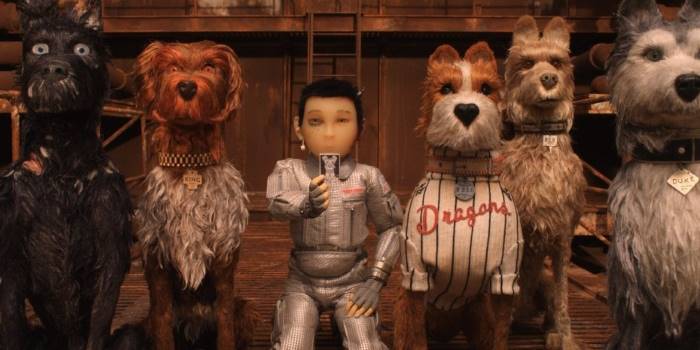
Wes Anderson takes a side-step on the stop-motion animal food chain, following Fantastic Mr. Fox with Isle of Dogs.
The joke, when Wes Anderson made Fantastic Mr. Fox in 2009, was that he got so sick of adjusting human actors in his precise dioramas, he decided it would just be easier to work with figurines instead.
(I didn’t say it was 'funny ha ha'.)
He went back to flesh-and-blood performers for Moonrise Kingdom and The Grand Budapest Hotel, but he’s now scampered back to sculptures and stop-motion (meaning the intricate, painstaking moving and lighting of puppets) for Isle of Dogs, as if returning a fetched stick.
The result is exactly what you expect and delightful because of it. I was enraptured by the handcrafted characters and how they moved, and swooned at the references to Seven Samurai. It’s stunning, absorbing and, if you’re into this sort of thing, actually 'funny ha ha' (a compliment the dry and deadpan Anderson doesn’t usually get). However, unlike his spectacular last three pictures, it’s open to nitpicking, which kinda suits, considering its flea-ridden stars.
Written by Anderson from a story by Anderson, Roman Coppola, Jason Schwartzman and Kunichi Nomura, Isle of Dogs takes place decades in the future, in Japan’s fictional Megasaki City. Dogs have been exiled to Trash Island, which truly is what it says on the tin, as ordered by Mayor Kobayashi (Nomura). There, the dogs both eat and talk trash, riddled with the seemingly incurable and mood-worsening 'dog flu' and 'snout fever' that initially got them banished. Mostly, it just makes them sneeze.
Human dog-lovers unite. Kobayashi’s nephew Atari (Koyu Rankin) crash-lands his light airplane on the island for a search-and-rescue mission, while a teen journalist/foreign exchange student (Greta Gerwig) is roused to investigate how the cat-affiliated Kobayashi might be conspiring to suppress the 'dog flu' cure. As far as propaganda goes, I can get behind the 'pro dog' kind.
As we’re informed in an early 'Note to Viewers', barks have been "rendered into English", meaning the canines speak for themselves, and they do so, often and wryly. Cranston voices Chief, an irascible stray, and one-fifth of a pack that includes Anderson mainstays (get it?) Edward Norton, Bill Murray, Jeff Goldblum and Bob Balaban. They are all good boys. Literally. The frequent complaint that Anderson unevenly stacks his massive ensembles with dudes can be applied here too. (At least Yoko Ono plays a scientist named 'Yoko Ono'. So there’s that.)
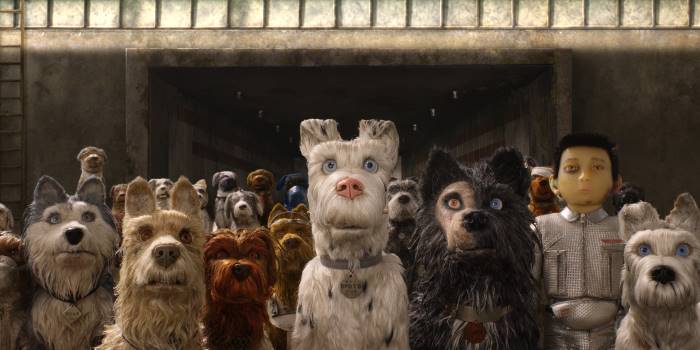
Claims of cultural appropriation have flown Anderson’s way, and they’re not unfair. Isle of Dogs is meant as a tribute to Japanese cinema, translated through Anderson’s idiosyncratic, flat lens. Meaning: He’s making Japanese cinema fit him, rather than the other way around. I don’t think he could possibly bend to any other filmmaking form, nor would we necessarily want him too. Still, should he have taken on this task? And could he have done so with greater sensitivity? (There's an uneasiness to some of his visual gags, which take aim at the physicality of certain Japanese people and customs.)
There are fair counter-questions too: Aren’t influences naturally absorbed and repurposed? Would a straight-up parody, in the style of Akira Kurosawa, be less offensive? And should artists be forced to limit their palette to the small scope of their own experiences? The first stage of Anderson’s career was all about his myopia; the past decade has seen him mature and go international.
I could go back and forth all day, and that’s before we even get to the debate over dialogue. Japanese actors in their native tongue, usually without subtitles, voice the Japanese characters. Is that empowering, or alienating? Meanwhile, the title, which sounds like "I love dogs", if slurred, is an example of Anderson’s language being playful for English-speakers, specifically, and perhaps exclusively. These competing points deserve to be pondered while watching, and afterwards. I personally came away thinking Isle of Dogs is a marvel and supreme technical accomplishment. But it comes with an asterisk.
Composer Alexandre Desplat’s sparse, like-clockwork percussion gives the flick a pulse, and Tristan Oliver’s empathetic cinematography warms the heart with its focus and patience; when the dogs’ eyes well with tears, or their hairs tangibly curl in the breeze, you want to reach out and pat them. Compositionally, we also get plenty of Anderson’s symmetrical top-down framing, though, without pesky human imperfections, he can now depict an elaborate sushi-preparation sequence, or a single-take surgery. It’s… it’s beautiful.
The plot, on the other hand, is perfectly predictable. Anderson ties a neat bow around many loose ends in the finale, to hilarious effect, yet strangely leaves a feud between the main gang of doggos open-ended. I don’t know why, but this continues to bother me, days later.
Isle of Dogs doesn’t provide the same satisfying conclusion as Fantastic Mr. Fox, which used Roald Dahl’s fantasy to tell a tale of mid-life crises in, well, foxes. In this, narrative takes a backseat to form, more so than in any of Anderson’s other heavily manicured movies, which is saying something. Because the man’s like a… you know… with a bone.
4/5
In Australian cinemas now. Rated PG for mild themes, animated violence and coarse language.
Correction: This review initially misrepresented Tristan Oliver's duties as a cinematographer. Student Edge regrets the error.
Photo: Fox
Topics
Ref: b5eccc39-5e6e-4972-a444-a8c00032214e






Comments & Feedback
Share your opinion
Emoji cheatsheet Formatting Comment guidelines