Movie Review: Get Out
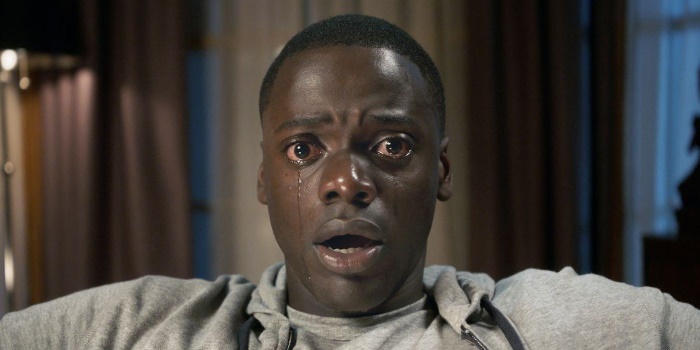
Jordan Peele’s Get Out plucks a raw nerve with skill and style. Strange, funny and confronting, it’s the horror satire of our age.
Guess Who’s Coming to Dinner. Dear White People. Movies about racial tension in America (or their titles, at least) invert the idea of polite cohabitation. They indicate an invitation gone awry.
Same goes for Get Out, though its title does away with the niceties entirely.
The directorial debut of comedian and Key and Peele star Jordan Peele, Get Out takes the generic template of an abduction thriller and mutilates it with unexpected comedy, unflinching satire and provocative images torn from reality.
Take the opening, where a limp, lifeless black body is dragged across a street. Putting the exaggerations of Get Out’s premise aside (we’ll get to that next), the film’s cruelty is all too real.
The engrossing Daniel Kaluuya plays Chris, a black photographer taken by his white girlfriend, Rose (Allison Williams), to meet her (perfectly cast) parents on their remote, plantation-sized estate. They seem like typical ‘East Coast Liberals’ at first. Dad (Bradley Whitford) calls Chris “My Man”, insisting he would’ve voted for Barack Obama again if he could’ve. Mum (Catherine Keener) is softly spoken under her wiry mess of boho hair; she runs a psychiatry practice out of a home office and dabbles in hypnosis.
As Titus Andromedon would say, it all seems like white nonsense. And it is, but not as Chris imagines.
The microaggressions turn macro when a throng of white houseguests arrive for a party, each grilling Chris about his genetic make-up and genital size. Rose is mortified; Chris has heard it all before. But stranger than his new Caucasian friends are the few black people he encounters over this weekend. There’s Georgina the maid (Betty Gabriel, a scene-stealer), a Stepfordian relic of another era, and Walter the groundskeeper (Marcus Henderson), whose night-time sprints unsettle Chris. And then there’s Logan (Lakeith Stanfield), whom we see kidnapped in the opening scene, and is now, for some reason, sporting an English accent and flirting comfortably among the whites. Chris calls his buddy Rod (Lil Rel Howery) about the weirdness. Then, the real weirdness occurs.
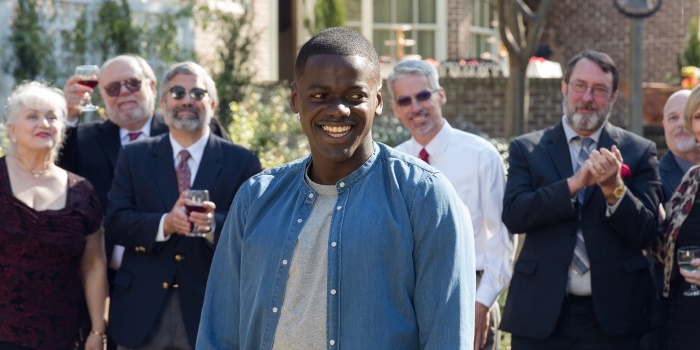
This is the maximum amount of information you’ll want to know about Get Out before seeing it, and see it you should. Australia is home to plenty of mixed-race relationships and friendships, and even well-meaning viewers will wince at the familiarity of the conversational missteps, or recognise the casual racism hidden beneath the veneer of so-called open-mindedness.
Peele and his comedy partner Keegan-Michael Key—sadly (and necessarily) absent here—crafted plenty of sketches on their show that turned benign encounters into social minefields. With a wicked sense of humour, they showed how a history of oppression, slavery and servitude had cast a pall over our modern, placid lives. Hell, the entire idea behind their most famous sketch, “Luther, the Anger Translator”, is that President Obama—America’s first black president—couldn’t be seen getting angry in public, because of the racial connotations.
Get Out obviously kicks this argument up a notch. Chris doesn’t get angry or take visible offence during his garden party interrogations. The movie argues that in this era of more veiled racism, black men and women need to remain vigilant. Peele similarly demands white men and women consider the cost of their cultural appropriation—in violent fashion. Get Out is funny, and it’s self-aware, yet it is also relentless and unforgiving.
As a director, Peele carries over Key and Peele’s cinematic flair. Many of the show’s sketches were pastiches of horror classics (from The Shining to, erm, Gremlins 2); this time, he’s just withholding the comic kickers. Instead of revealing a joke, his picture sinks deeper into the realm of the horrific. You can look to one of Key and Peele’s best ever sketches “Negrotown” as an audition for the scope of Get Out. That sketch, like this feature, had a defeatist attitude towards race relations in America.
So, it’s not an optimistic flick. And structurally, it’s not radical. However, it is bold, overall. Seen through the lens of cinema history (beginning with the original Birth of a Nation, in which the heroes—get this—are white supremacists), Get Out’s racial reversal of the “monstrous” villain is straight-up revolutionary.
The sparse soundtrack adds to its unnerving tonal shifts, only including songs that act as warnings: Childish Gambino’s “Redbone”, Flanagan & Allen’s “Run Rabbit Run” and a Swahili-language concoction by film score composer Michael Abels, which plays over the opening credits and warns a “brother” that “something’s coming, and it ain’t good.”
A movie can be funny and still be no joke.
4.5/5
In cinemas May 4. Rated MA15+ for strong violence and themes.
Photo: Universal
Topics
Ref: 48a4ae37-5bfb-44c4-bf58-a74e0058357b




Comments & Feedback
Share your opinion
Emoji cheatsheet Formatting Comment guidelines