Movie Review: Don’t Believe the Title of Michael Haneke’s Snapchat Flick "Happy End"
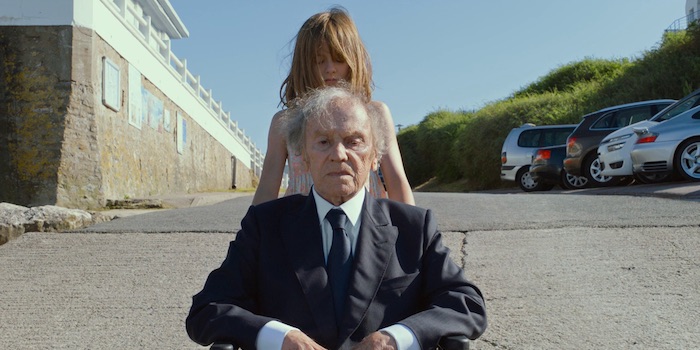
In Happy End, a Snapchat-obsessed girl forms a bond with her granddad, but this ain’t Little Miss Sunshine.
A few years ago, it was rumoured Austrian auteur Michael Haneke would follow-up his Oscar-winning Amour with a film about flashmobs.
When it was abruptly cancelled later down the track, we figured we’d all dodged a bullet.
We didn’t anticipate he’d go and make a movie about Snapchat instead. It’s like he’s exclusively seeking story ideas from his grandkids. Next up, maybe a Tide Pods flick?
If you bet the vampiric-looking, 75-year-old misanthrope would paint an ugly portrait of Snapchat and social media at large, you win absolutely zero prizes. But as he establishes in his absurdly titled Happy End, the cruel detachment of our camera phones may not be as worrisome as the lies we’re telling one another face-to-face. By the climax, the character slowly poisoning people/animals and uploading the videos to her social media account appears to be the most virtuous.
And to that profound point, one can only say: “Huh?” What is Haneke on about this time?
Happy End opens with some spooky Snapchat footage of a hamster being drugged by its owner, and later, of a depressive mother being spied on from afar. We can assume the footage belongs to 12-year-old Eve (the excellently morose Fantine Harduin), who is sent to live with her estranged father, Thomas Laurent (Mathieu Kassovitz), when her mum winds up in a coma due to an accidental overdose. She moves in with Thomas and his wealthy, extended family in Northern France. Of course, none in the Laurent clan have reason to suspect Eve of being behind the OD, nor do they notice her increasingly hopeless state. They also ignore the encroaching senility and despair of patriarch Georges (Jean-Louis Trintignant), given they're too busy with their own personal and professional morality-free dramas.
Needless to say, a pact eventually forms between outsiders Georges and Eve, and it's far from heart-warming.
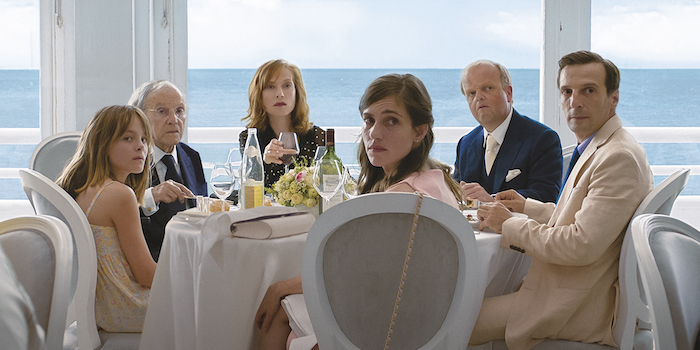
Completists of the writer-director will get a kick out of Happy End for the way it calls-back to old themes and deploys the reliably unblinking camera of reunited cinematographer Christian Berger. There are echoes of the self-destructive family from The Seventh Continent, the sociopathic documentarian from Benny’s Video, the evil children from The White Ribbon and the European social commentary of Code Unknown. (In Happy End, the refugee crisis only subtly rears its head, until it finally interrupts the Laurents' insular and privileged existence.)
Haneke doubles down on the themes of Amour too, casting Isabelle Huppert as Trintignant’s daughter once again. Yet it builds to zilch, except a greatest hits package that’s less than the sum of its parts. He’s made several masterpieces and a couple of duds previously, but never before has Haneke penned a thesis this muddled, and to a conclusion so empty. The performances are strong, and the staging is reliably tense. We're even shown a spirited karaoke rendition of Sia’s “Chandelier”, which furthers my theory Haneke's now writing for the yoof. Still, I’m looking back on the picture as a whole, and there’s very little here.
Haneke trains us to stare at his tableaus, rarely interrupted by an edit, and wait for something to happen. I felt that way watching the whole movie pass me by. It’s his least essential work since the remake of Funny Games, which was an English-language rehash of a condescending satire. He made it specifically to reach more people to tell off. Until recently, I thought that was his most misanthropic project to date. I hadn’t yet sat through his Instagram stories.
2.5/5
In Australian cinemas now. Rated M for mature themes, sexual references and coarse language.
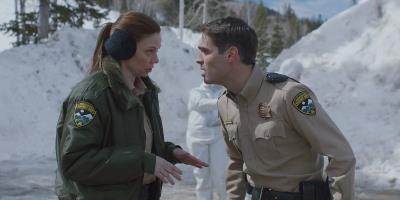
Photo: Transmission Films
Topics
Ref: 23751b4c-1751-4904-998a-a88100625162


Comments & Feedback
Share your opinion
Emoji cheatsheet Formatting Comment guidelines