Movie Review: “Detroit” Is Disturbing and Relevant, But Tough to Endure
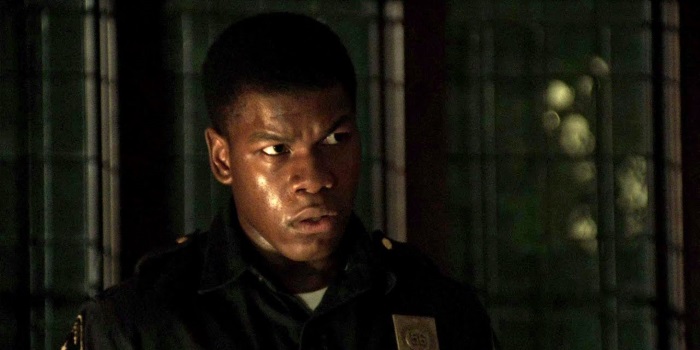
If the events of the day aren’t despairing enough for you, try spending 143 minutes in Detroit.
Those who cannot remember the past are condemned to repeat it. For that reason alone, Kathryn Bigelow’s Detroit—which dramatises the still-muddy events that led to the murder of three black men in the Algiers Motel during the Detroit riots of 1967—is essential viewing.
The problem, of course, is that we’re already at the ‘repeating it’ stage, and you couldn’t begrudge any viewer for opting-out of a film in which young black men are preyed upon by prejudiced police officers and rail-roaded by the criminal justice system. In America and Australia, this is far from old news.
Detroit begins with a stunning animation of Jacob Lawrence’s paintings of the “Great Migration”, explaining how tensions reached boiling point between black citizens and largely-white law enforcement in densely-populated Detroit, circa 1967. Looting and riots commence, but our eyes are turned to the Algiers, just beyond the melee, where a number of residents become subjected to a violent interrogation by white police officer Philip Krauss (Will Poulter), with only black security guard Melvin Dismukes (John Boyega) to protect them.
Barry Ackroyd, Bigelow's Hurt Locker cinematographer, once again puts us in the heart of a warzone. The final product depicts a nightmare, with aftershocks that continue to echo today.
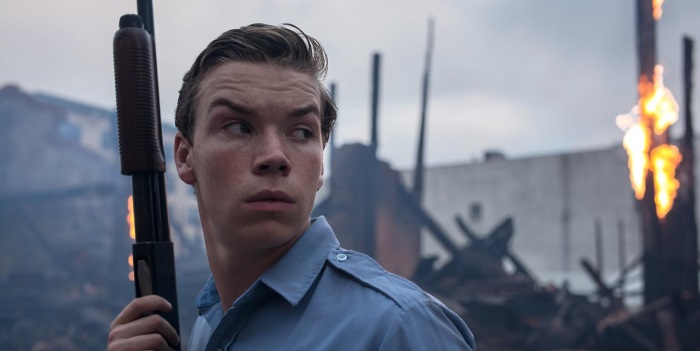
As a single, misshapen movie, Detroit struggles under the gargantuan weight of America’s bloody history. Zero Dark Thirty, Bigelow’s last feature, was a masterpiece in the way it challenged American foreign policy—and our bloodlust—despite pursuing a singularly despicable villain: Osama Bin Laden. This film—written by Mark Boal, based on extensive interviews, flavoured with creative licence—instead fixates on the grisly events at the Algiers, and the evil of three cartoonishly racist cops. The very viewers who might be in need of challenging here are unlikely to identify with these caricatures.
It’s a test of physical endurance, and Bigelow’s craft is on full display in the lengthy, tension-tightening Algiers centrepiece. She seemingly has less interest in the scenes that follow, in which blame gets shifted and institutions close ranks to protect their own. Yet, it’s in these moments, as the survivors of the Algiers attempt to resume life, that Detroit finds its grave purpose. It’s not in the racial violence that Bigelow and Boal recreate in gut-churning fashion; it’s in society’s utter failure to reckon with its perpetrators and accommodate and support its victims. That failure is what ultimately feeds the vicious cycle of riot-and-militarisation, though the picture never quite connects those dots.
As with previous Bigelow efforts, familiar faces flit by for a scene or two, and then disappear. As for the main cast: Poulter is vicious, and Boyega is virtuous. The characterisations are simplistic, but both actors are great. It’s distressing to watch Anthony Mackie, Algee Smith and Jacob Latimore, as just some of the Algiers’ hostages, break down; their commitment to Bigelow’s trials, and their honouring of the real subjects, is commendable. Gbenga Akinnagbe, playing the father of a slain young man, does much with his limited screen time, recalling the most affecting moment in Ava DuVernay’s (significantly better) Selma.
Detroit’s not a documentary. And though it’s enraging and emotionally exhausting, I’m not sure it’s entirely successful as a work of activism either. What it is, however, is something else that’s extremely rare: a showcase for dozens of excellent black actors, retelling an important moment in history.
I’m glad we have Detroit on the cinematic record, for future generations to revisit. I pray, by then, it will seem like a relic of the distant past.
3.5/5
In cinemas November 9. Rated MA15+ for strong themes and violence.
Photo: eOne
Topics
Ref: 9a38531d-7f64-463b-8537-a81f00813d35





Comments & Feedback
Share your opinion
Emoji cheatsheet Formatting Comment guidelines