Movie Review: Billy Lynn’s Long Halftime Walk
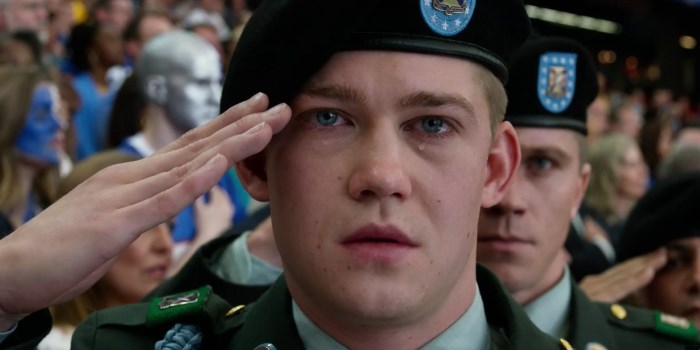
Finally, a war movie that combines the music of Destiny’s Child with experimental, confounding camera technology.
Billy Lynn’s Long Halftime Walk is audacious for the length and puzzling specificity of its title alone. (Who is Billy Lynn? What is a ‘halftime walk'? And what constitutes a long one?)
So, director Ang Lee’s decision to shoot said walk in 120 frames per second—five times more than the typical 24fps rate, and a new record—goes beyond audacity, inching towards folly.
The Hobbit flicks first experimented with high frame rate, and in just 48fps, they boggled human eyes with their hyperrealism and unnerving lack of motion blur (appearing strangely sped up).
Those of us in Australia may never get to experience Lee’s original vision, as only five theatres on the planet can project Billy Lynn in the way it was intended, and, quelle surprise, they ain’t here.
Still, to accommodate for his vision, the actors had to abandon the protective veneer of make-up (which the piercing 4K HD cameras would see right through) and cinematographer John Toll had to shoot many of the characters’ interactions in first person, and in close up, to theoretically enhance our immersion.
The result is truly bizarre. Movies don’t usually look like this. They’re not usually shaped like this either, building to a climactic crescendo (that titular walk) at the halfway point and then slowly winding down to its foregone conclusion.
We’ve never seen anything like Billy Lynn’s Long Halftime Walk before. As we come to realise by the end credits, there’s a reason why.
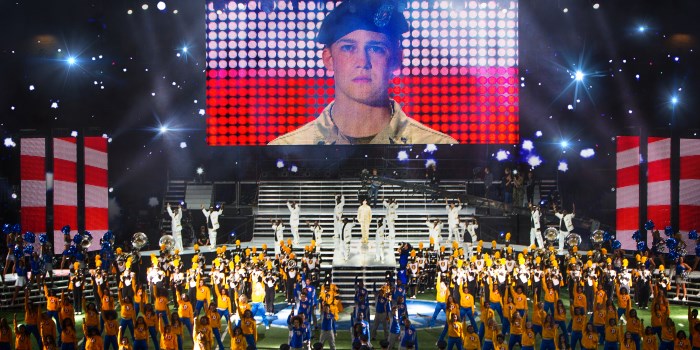
Newcomer Joe Alwyn plays Billy Lynn, a young soldier who returns to Texas in 2007 to be celebrated alongside his Bravo company for a feat of heroism captured on video during a skirmish in Iraq. Billionaire football team owner Norm Oglesby (Steve Martin) wants the Bravo boys (led by Garrett Hedlund’s Sgt. David Dime) to participate in the halftime entertainment of his big Thanksgiving game. What that means, the soldiers don’t know, though they’re told Destiny’s Child will be involved.
As we build towards the big show, Billy flashes back to Iraq, remembering the circumstances that have earned him this honour, questioning his heroism and mulling over desertion.
Adapted by Jean-Christophe Castelli from Ben Fountain’s book of the same, lumbering name, Billy Lynn’s Long Halftime Walk is both a black comedy and an anti-war polemic. It’s also a satire of America’s grotesque culture of self-congratulation and fetishised violence, made, lol, by Hollywood.
It’s ironic and cynical, yet weirdly earnest. Most of the heart-on-sleeve speeches are put on the poor, considerable shoulders of Garrett Hedlund, who delivers numerous lectures explaining the message. (“Just another normal day in America,” he declares, unnecessarily.) Miraculously, he’s the flick's best performer, adding levity and gravity where appropriate. Kristen Stewart, as Billy’s left-leaning sister, and an against-type Vin Diesel, as a Zen soldier, do good work too, leaden dialogue be damned. (We’ll look past Billy’s disconcertingly incestuous fixation on his sis.)
There’s more to like than there is to dislike in Billy Lynn’s Long Halftime Walk, and it might be worth viewing simply for the centrepiece sequence: a gonzo collage of Destiny’s Child (stand-ins, obviously) performing “Lose My Breath” with a marching band and a violent, bloody battle in Iraq, as the sensory overload of the halftime entertainment activates Bravo company’s PTSD.
It’s one hell of a moment. However, the film can only gasp to its ending from that point on.
The last act turns its attention to Steve Martin’s Norm Oglesby, who attempts to lowball the Bravo company for their life rights, with the intention of turning their story into a “great” movie. Martin, a screen veteran, in his George W. drawl, suffers most from Lee's fixation on first-person conversation, perhaps challenged by the contorting, alienating camera. (Maybe that’s why Alwyn, a theatre school drop-out of two whole days before getting this gig, feels so natural: he doesn’t know any better.)
Lee’s meta obsession with the morality of a fake film based on Billy’s tale explains his shooting style: he’s arguing against artifice, indicating that cinema, thus far, has not adequately captured the wartime experience. That’s why he using high resolution and high frame rate, right? To expose truth (and zits) in art.
All it really does is remove the visual cue that we’re watching a movie, and with it, the reminder that we need to suspend our disbelief. Without that sense of distance, we’re plunged into an uncanny valley and all we feel is acutely aware that what we’re watching is fake.
It’s hubristic to imagine that any piece of entertainment could accurately capture the visceral impact of war, and similarly hubristic (Hollywood-style) to imagine that audiences would be most concerned as to whether Bravo company will get a movie made of their story or not. (Maybe the film works best in 120fps, although the reviews suggest otherwise.)
We should never limit visionary directors, but ambition and technical achievement alone don't make a film. The thing has to be watchable too.
3/5
In cinemas now. Rated MA15+ for strong themes, violence and coarse language.
Photo: Sony
Topics
Ref: f1fd7be1-3796-42cf-9174-a6c900453df3



Comments & Feedback
Share your opinion
Emoji cheatsheet Formatting Comment guidelines