Movie Review: Arrival
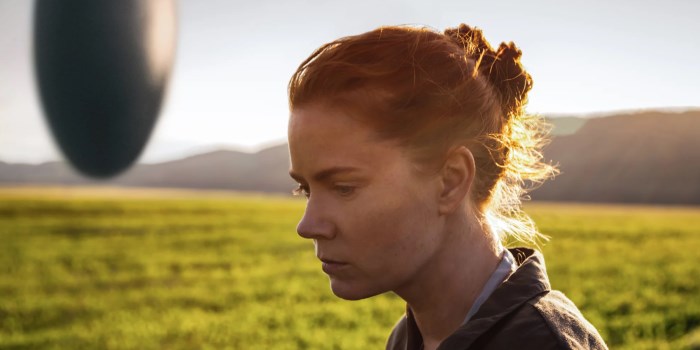
In Arrival, a linguist, a physicist and a colonel walk into an alien spaceship. No joke. Just brilliance.
Words, and how we use them, matter. When we’re talking about science fiction, ‘arrival’ has a specific, imposing reputation. When we’re talking about pop music, the connotations differ.
Director Denis Villeneuve’s Arrival isn’t a musical based on that ABBA album, tragically. But to say he’s simply telling the same old tale of intergalactic invasion isn’t entirely true either.
The name suggests a destination; the conclusion of a journey. It’s also, somehow, a beginning. Does that make it a loop?
Anyway, you get the gist. All this meaning, from a measly seven-letter word. Think of how these interpretations must change in each culture. (In Portugal, Arrival is called O Primeiro Encontro, or, The First Date—and that kinda fits too, though for different, somewhat spoilery reasons.)
This complexity of language is precisely what encourages Col. Weber (Forest Whitaker) to reach out to Dr. Louise Banks (Amy Adams), an accomplished linguist, when the aliens land.
In vertically-erect ships that resemble halved olive pits they come, parking in twelve locations across the Earth. Every eighteen hours, the ships open and our planet’s representatives can hover up into its rectangular meeting room, where a glass pane divides bipeds from the seven-legged ‘heptapods’.
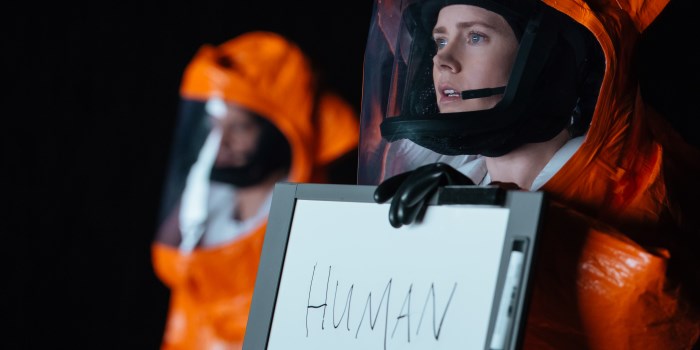
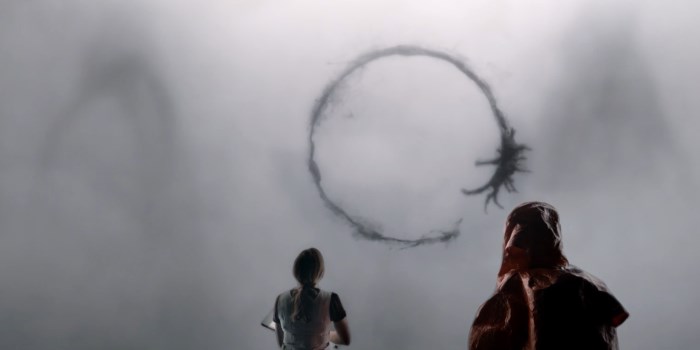
Banks, joined by theoretical physicist Ian Donnelly (Jeremy Renner), has the job of figuring out what their purpose is on Earth. Before that, she has to find a common mode of communication. She holds a blackboard that reads “Human” and puts her hand on her heart. The visitors, use their spindly limbs to conjure a circular cloud-sentence from the ether in response. Sorry, can you repeat that?
News reports remind us that the world is chucking a fit over this first contact, but we never leave the military compound where Banks and Donnelly work steadily to explain their guests’ intentions. Progress is promising, until the heptapods say ‘weapon’—maybe—in their alien cursive. Do they actually mean ‘tool’? Are they asking for one, or planning to use one against us? Before answers come, China and Russia begin plotting military action against their floating olive invaders.
That abridged synopsis is how you sell Arrival to audiences seeking a sci-fi thriller, and those viewers won’t be disappointed. Villeneuve, after all, is our leading dread-and-vomit-inducing filmmaker. As proven in Incendies, Prisoners and especially Sicario, he is equipped to ratchet up tension in a traditional, crowd-pleasing manner, even when wandering into darker, weirder and less explicable thematic territory. (Enemy might be his most anxious-making movie, but that’s more of a crowd-displeaser.)
But just as the title summons different responses, the feature itself activates multiple pleasure centres, beyond simply those sated by two hours of entertaining distraction.
Villeneuve isn’t solely seeking to make us vomit in panic here. He guides a haunted Adams, wrestling with devastating memories, and an amiable Renner to deeply humanistic performances. They offer this B-movie premise not just legitimacy; they elevate it to the level of phenomenon.
To put it bluntly, Arrival is miraculous. Adapted by Eric Heisserer from a short story by Ted Chiang (“Story of Your Life”, a twist on Kurt Vonnegut’s Slaughterhouse Five), the picture tenderly explores the meaning (and miscommunication) of language, between Earthlings above all.
It also reminds us how the language of cinema should tell stories too. Cinematographer Bradford Young relies on recurring visual motifs (of panes of glass and rectangles), while composer Jóhann Jóhannsson uses the looped vocals from Theatre of Voices to augment his hypnotic, droning score.
To say how these elements and Villeneuve’s other choices inform our reading would shatter Arrival’s mystery and give away the final reveal. I won’t be the one to ruin that experience for you. But I will say, as the title materialised with the closing credits, it carried more weight than when it started. A beautiful arrival to an ending, and a beginning.
4.5/5
In cinemas November 10. Rated M for mature themes and coarse language.
Photo: FilmNation.
Topics
Ref: ce177c88-ab02-4018-be70-a6b2002d35a4




Comments & Feedback
Share your opinion
Emoji cheatsheet Formatting Comment guidelines