Movie Review: 20th Century Women
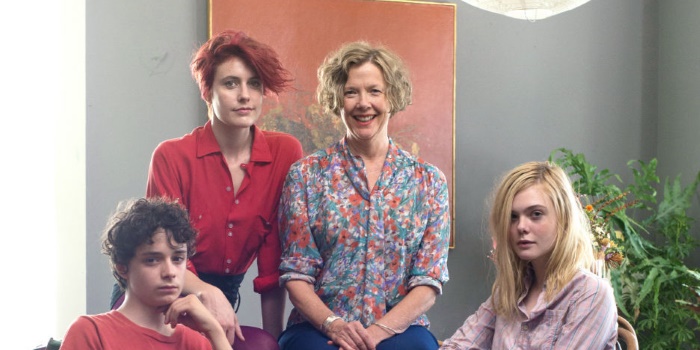
How many women does it take to screw in a fifteen-year-old boy’s metaphorical lightbulb?
(This is not a dirty joke. You can only blame yourself for making it so.)
The answer? Just three: His mother, his crush, and a post-punk photographer with a streak of rebellion and red hair who can play him the music of Siouxsie and the Banshees and Talking Heads.
According to 20th Century Women, it takes a village to raise a teenager. Or maybe it’s a commune.
In the film, single mother Dorothea Fields (Annette Bening) calls upon the fellow lodgers in her refurbished Santa Barbara boarding house to help her son, Jamie (Lucas Jade Zumann), come of age, circa 1979.
She can’t deny that she understands her burgeoning, pubescent boy—and the age she lives in—less and less each day, and his abandoning father isn’t likely to come pick up the slack. So, it’s over to Dorothea’s hipper, ill-equipped roommates for some improvised man-making!
(Writer-director Mike Mills apparently drew from his own life for this semi-autobiographical tale, inspired by his own devoted and enigmatic mother. His last flick, Beginners, also semi-autobiographical, was based on his vacant father’s late-in-life emergence as a vibrant gay man. Mills’ aunts and uncles must be getting nervous, or at least putting together contracts for their life rights, with generous back-end deals.)
Early bonding efforts by Dorothea's sensitive, live-in carpenter William (Billy Crudup) fall flat. Instead, the burden of Jamie’s rearing falls upon Abbie (Greta Gerwig), the bleached-redhead wrestling with her own maternal issues, and his sexually-experienced friend Julie (Elle Fanning), who doesn’t officially live with the Fields but sneaks into Jamie’s room each night, just to sleep, frustrating him endlessly.
Together, with plenty of mistakes made along the way, they work to make one another whole and human, albeit replete with quirks, because this is still a film about Californian co-parenting after all.
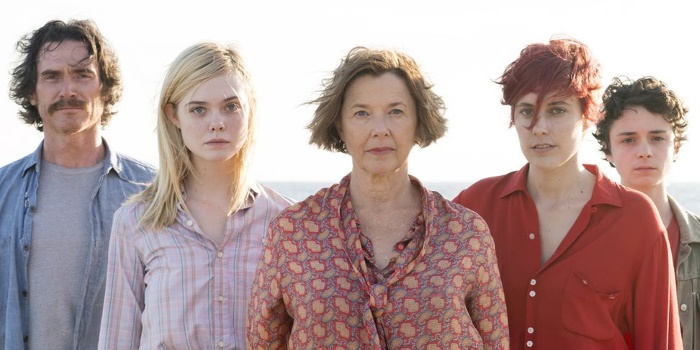
In 20th Century Women, Mills conflates the concept of “mother” with “sister” and “would-be lover”, which, erm, is certainly a complicated approach to maternal relationships. (Freud, meanwhile, would be loving this. And so soon after Alien: Covenant! It’s a great time at the movies for Oedipus-heads.)
However, this isn’t some cinematic, psychosexual torture chamber for young men who accidentally take their mums to see it on a casual Sunday outing. (She loves Annette Bening! I didn’t realise!) Mills is a contemporary of Wes Anderson and Miranda July (his wife, the visual artist who gifted us with the ultimate romantic emoji—pooping back and forth, forever—in her first feature, and who can surely expect her own semi-autobiographical tribute from Mills next). Like them, he gives his movies a mild, melancholic edge, but they are precisely composed and picture book-esque. They don’t include any ominous storm clouds that can’t be abated by a suitable soundtrack selection.
Sometimes, his threadbare plots feel so airy, you think they’d lift off into the clouds, if they weren’t anchored by some wonderfully grounded performances. Bening, in particular, makes Dorothea’s contradictions feel like a warm collage. Of course, the project's three female characters still came from a singular male’s pen and perspective. At least Mills lets Dorothea and Jamie narrate the picture in tandem. Bening, Gerwig and Fanning breathe additional life into parts that may have simply seemed like manic pixie dream mums.
‘Quirky’ can often be a dirty word, though it does apply somewhat here. Yet, thanks to its five main performers, 20th Century Women feels whole and human. It was only raised quirky.
4/5
In cinemas now. Rated M for sexual references, coarse language, drug use and nudity.
Photo: A24
Topics
Ref: 23de409c-aa46-46e4-b0a9-a782008df629

Most Popular



Comments & Feedback
Share your opinion
Emoji cheatsheet Formatting Comment guidelines
:)