Marc Fennell on the World’s Hottest Chilli and Why "It Burns"
Marc Fennell describes the chillis in new podcast It Burns as a form of torture. So, why did he keep eating them?
Stolen recipes. Long-lasting feuds. Death threats.
You're forgiven for thinking I'm describing a new season of Underbelly or The Sopranos.
Instead, the subject of today's conversation is actually chillis and the journey Marc Fennell (from SBS's The Feed) had to take to in order to uncover the dark side of chilli-head subculture in his new Audible Original podcast, It Burns.
Chilli-heads are, of course, people who are passionate about chillis and subject their mouths (and bodies, for that matter) to some of the hottest chillis found on earth.
However, Marc told Student Edge that he realised quite early on in the making of the podcast that it was a much bigger story than just a quest for finding hot chillis.
"When you're talking to people who are making something that is so hot, it's not fun anymore, it’s almost a form of torture," Marc tells Student Edge.
"You have to ask yourself why are people putting themselves through that."
Chillis are measured by something called the Scoville scale; a chilli ruler, if you will. The higher the number, the hotter the chilli. To put it in perspective, a jalapeño rates between 2,500 and 5,000 Scoville Heat Units, similar to Tabasco sauce. In comparison, the chillis at the core of It Burns (like the Carolina Reaper) reach into the millions.
"They are hundreds of thousands of times hotter than the average chilli and they kinda just ruin you for the rest of the day," Marc confesses.
And that's exactly what happened to him one day in South Carolina while he was recording the podcast.
"They wouldn't even tell me what [chilli] it was, they were just like 'Here, try this!'" Marc recalls.
And he did what any self-described chilli lover would do: "I tried it."

"I ended up pulling over on the side of a freeway, had to go into a strip mall sort-of thing, and I went into a juice bar and just poured a heap of juice [into my mouth].
"Everyone's thinking, 'Why is this brown, sweaty man drinking all this juice?' [but] I was in so much pain."
He remembers the only thing he could to ease the pain was to just let it pass.
"There's nothing you can do."
While most of us can't comprehend the feeling of eating a chilli that hot, we've all experienced a lesser version of Marc's story. A dare, an accident, a few stray chilli seeds hidden in your bánh mì. It's a feeling caused by one main culprit: Capsaicin.
Without getting too deep into the science, the 'burn' is essentially your body's reaction to that foreign chemical. It tricks your brain into thinking that a physically hot substance has entered your mouth and this is why we tend to sweat, feel a burning sensation and, potentially, even suffer a stomach ache.
It seems rational that humans would eventually build up a tolerance against these sorts of reactions. It's why certain cultures around the world embrace hotness while others prefer a more mild palette.
I asked Marc, who talks a big chilli game, if he's built up a tolerance for some of the more outrageous suspects on the scale.
"I tried one of the really hot ones again the other day," Marc admits.
"I was reminded all over again how atrocious these chillis are and I don't really want to go back to them unless I absolutely have to."
He's laughing, but it could easily be mistaken for crying too.
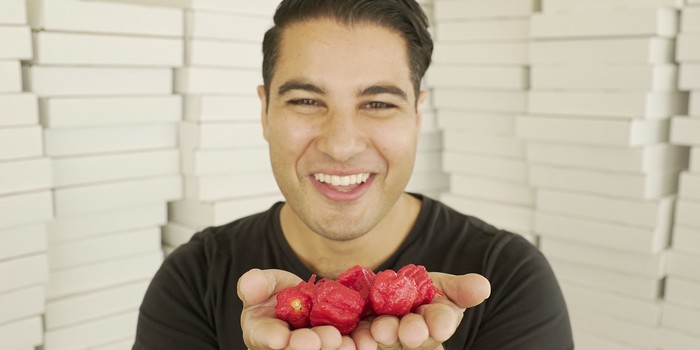
Bubbling beneath the surface, underneath the brow-sweating chilli burns and scorching belly aches is a story about humans and how they deal with pain.
"I'm a big fan of, what I call, the small doorway," Marc explains.
"Your small doorway is a quirky story about chillis and then it opens up into some very big ideas about people, history and culture."
It's certainly apparent from the get-go that It Burns is not just a podcast about this wild world and their zany activities; it's about real humans doing strange things in the name of pain and the excitement it can bring.
"I began to realise that the people in the series had complex and quite traumatised lives," Marc says.
"It became this story about pain and how people use physical pain to, in some cases, replace emotional pain."
And while Marc is definitely partial to a chilli or two on occasion (unlike the chilli-heads he spent weeks with while recording It Burns), he prefers the love and togetherness food can bring rather than the pain and terror.
"I will always love spicy food but it's important to think about it in context," Marc admits.
"What is it good for and what is it meant to do.
"I don't think food should be a thing that we compete over... or something that tears friendships apart.
"Food is at its great expression when it brings people together."
It Burns is available for free on Audible now until 15 June.
Header Image: Supplied