Let An Army Cap Quash Six Clichés About Life At The Royal Military College
This post is presented in collaboration with the Royal Military College.
For those considering a life in the Defence Force, certain intimidating images from cinema history may spring to mind.
There’s of course the drill sergeant from Full Metal Jacket, making life a living hell for his troops; there’s Bill Murray commandeering a tank in Stripes; there’s Demi Moore shaving her noggin in G.I. Jane; there’s Goldie Hawn, tear-strewn on the poster of Private Benjamin; and, most chilling of all, there’s Pauly Shore, handed a weapon, in 1994’s In the Army Now. (Not seen that last one? Phew.)
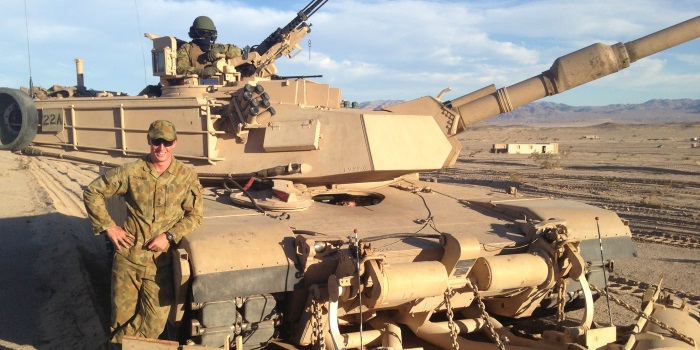
But Captain Geoff Rickards, 28, assures us the experience of training to become an Army Officer at Australia’s Royal Military College (RMC) in Duntroon is far removed from the kind of military training seen on the big screen. In fact, he enjoyed his time at RMC so much he’s now taking up a role as a Career Adviser to soldiers.
“To be honest, I feel like I’m giving back, so I can impart some experiences I’ve had, and help develop the future," he told Student Edge.
“I know it sounds really cliché,” he conceded, but Captain Rickards is for real. To prove it, he quashed six clichés about training to become an Army Officer and what life is like at the Royal Military College, beginning with this one:
1. It’s not like the movies.“People have an opinion that it’s very much like the movies; like Full Metal Jacket, et cetera,” he said.
2. You’re not going to be shouted at all day long.
“You have to be good enough, but it’s less of the ‘we will yell at you until you fail’ – in fact, it’s none of that – it’s ‘we will help you [get through training] if you are having issues’,” Captain Rickards explained, easing any concerns of Full Metal Jacket coming to life.
“Having been there myself, I know it’s very much an adult learning environment. It’s fast-paced but it’s achievable. That’s not to say it’s easy, but it’s definitely achievable.”
He adds, of those who don’t fulfil their training because of physical or academic reasons and get “back-classed” (basically: held back) 90 per cent graduate in the following six months.
3. You’re gonna have to put in the work.
Just because there’s no drill sergeant breathing down your neck every minute of the day doesn’t mean that RMC won’t push you beyond what you previously thought you were capable of.
“The physical and mental challenges were the hardest,” Captain Rickards remembers.
4. … But you still have free time.
“You get your weekends,” he assured us.
“You’ll finish class at six, most days, so every night is your own. Yes, you live on campus, but you have your own time after class, so long as you’re ready for the next one.”
Captain Rickards also told us about the camaraderie that comes with living on campus.
“We have leave periods like everyone else does," he said.
"I guess the difference is, you’re living on campus, so when you have free time, you’re hanging out with your mates.
“Even though it’s free time, you don’t see many people leave; they sort of hang out with one another, because you do become so close. Going through anything tough, you become a lot closer with the people you go through it with."
5. Class-work and fieldwork intermingle.
At the Royal Military College, a balance is struck between the classroom, where cadets can learn about military history and strategy, and the field, where class-work is put into practice.
“It’s different every day,” Captain Rickards recalled.
“I’d be in the classroom for maybe three hours a day and in-between that I’d have two hours where I’m doing some sort of physical activity, whether that be completing an obstacle course or something else.
“It’s not like your standard university of tertiary education where you’re just in a room all day. You might learn how to attack a hill [in class] but throughout that week and throughout the month following, you’ll do a certain amount of field work where you’ll actually get to practice what you've learnt.”
6. The classes are like nothing else.
Imagine “a big open area, the same size as half a football field” with 200 other cadets. That, Captain Rickards explains, is how classes work at the RMC, whether they're about ambush strategies or humanitarian aid.
Still, he calls it a “two-way” experience.
“You get instruction, but at all stages throughout, it was, ‘Any questions?’ Johnny would chuck his hand up. ‘Yeah sir, can you explain what that means?’ And [the lecturer would] go through it.’ It was very two-way, because they’re expecting you to do these things in two weeks, so you need to be able to understand it effectively.”
“It’s a very engaging way to learn,” he added, for those who have maybe felt an eyelid droop during high school or uni lectures.
“That’s the other thing about being a military officer; you have to be engaging and inspirational because you’re potentially getting people to put their bodies in harm’s way.”
The Royal Military College - Duntroon prepares you for a career in the Army as an Officer by promoting leadership and integrity, by inspiring high ideals and the pursuit of excellence, and by instilling a sense of duty, loyalty and service to the nation. Learn how you could become an Army Officer and graduate as a leader in just 18 months.
Photo: Supplied.
Topics
Ref: eb9ffcb9-8c0f-48c4-b201-a6660051407c



Comments & Feedback
Share your opinion
Emoji cheatsheet Formatting Comment guidelines