Human’s Best Friend: Assistance Animals Are Helping Those With Disabilities Gain Confidence and Companionship
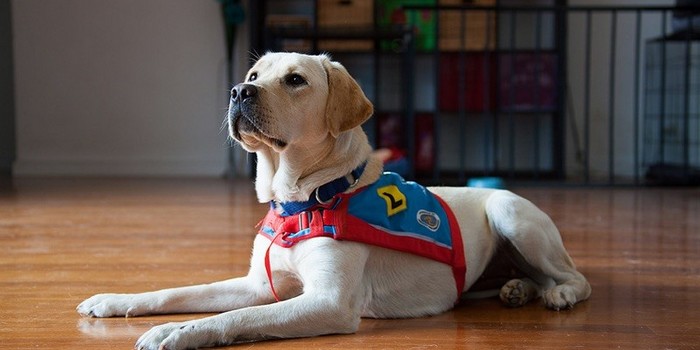
It’s an old adage that dogs are human’s best friend.
And yet, in the last decade, dogs have come to play more than just the role of best friend.
"Assistance animals are animals that live with people and help them perform daily activities," Dr. Pauleen Bennett from La Trobe University tells Student Edge. "By definition, they have to help [their owners] with concrete tasks."
These tasks can include fetching objects, opening doors and even putting clothes in the washing machine.
But most importantly, assistance animals are helping young people with physical disabilities as well as those with Autism Spectrum Disorder to gain confidence in public.
"If you walk down a street with a dog, people will stop and talk to you,” Dr. Bennett explains.
"You feel more like a person [having a dog with you], you meet more people."
While the role of assistance animals in society has only recently become more visible, the idea of animals—more specifically, dogs—helping humans with physical disabilities and mental disorders has persisted for centuries.
One of the first recorded instances of animals helping to relieve symptoms of patients in asylums can be traced back to London’s York Retreat. Opened in 1796, it was one of the first of its kind to offer its patients more humane treatments and allowed domestic animals to roam freely within the property.
"They thought people were mentally better when they were interacting with animals," Dr. Bennett explains.
But it was nearly another 140 years before guide dogs were trained to assist people with vision impairments.
"People [started to] realise that people could use dogs for other things as well," Dr. Bennett says; a moment that created the opening for an expansion of service animals.

Photo: Gruffpuppy
To differentiate, there is a diverse range of dogs that service humans for different purposes. Companion animals provide companionship; therapy dogs have defined goals for their patients but generally don’t have the same type of access as assistance animals. Then there are animal-assisted activities, which include having dogs with a less-structured plan who aim to lower stress levels. These are the type of dogs you might find in a school on exam day or in hospitals cheering up patients. Assistance animals help to assist their owners and have passed their Public Access test, meaning they can enter public spaces that would not usually permit other animals (think planes, shopping centres, train stations et cetera).
The problem, however, is while the current research seems to indicate assistance animals are beneficial to the recipients, its efficacy is largely unsubstantiated. Despite this, many who use assistance animals talk about having greater confidence levels in the home as well as when they’re in public spaces, allowing them to finally achieve a level of autonomy and independence that wasn’t possible prior.
"The fact that we don’t have evidence doesn’t mean that it doesn’t work, it just means that we don’t have evidence," Dr. Bennett admits. "I'm prepared to believe them until proven otherwise."
Dr. Bennett says the science behind assistance animals is tricky due to the inconsistency of methods and measurement techniques. She explains that, in scientific studies, a placebo is usually placed to measure the effectiveness of the treatment (in this case, assistance dogs). However, it's a bit trickier when you have dogs because there's no such thing as a placebo dog.
"We try to measure things like cortisol and oxytocin (human hormones) and we try to behavioural observations," Dr. Bennett explains. Ultimately, however, it's down to the feedback they're given by those receiving assistance from these animals. In those stories, academics and scientists can empirically see the value in having them around.

Photo: The Gehrmanns
The dogs are trained over a two-year period, Jane McKie from Assistance Dogs Australia explains. "They're all taught the same skills but then as it comes closer to the end of the training period, our trainers will identify what type of client that dog will be best for," McKie says. "Dogs are like humans, they have different personalities."
Assistance Dogs Australia is one of the many providers in Australia that provide assistance animals to clients around the country. The organisation started in 1996 when their founders were on a trip to the United States and saw a young girl who had an assistance dog. They overheard the young girl tell her mother: "'Mummy when I've got this dog with me, I can do anything.'"
McKie explains that there are a bunch of memorable stories of people whose lives have changed by assistance animals.
"We used to have a mother who used to have to lie on top [of her son] to stop his meltdown [due to his Autism Spectrum Disorder]," McKie recalls. "Now the dog does that instead. That's a massive help for them both."
McKie also mentions that some of the dogs use the 'visit' cue to go instantly to their owners and put their head in their lap for as long as necessary. "Just having that physical, warm heart beating beside you, it calms you down," McKie explains.

McKie also echoes Dr. Bennett's sentiments that assistance dogs operate as a social lubricant, among their many other roles, and help to give their recipients a newfound confidence in public.
But despite the dogs having Public Access—essentially a licence to enter public spaces that pets usually can't—it doesn't cancel out all forms of discrimination. An issue can sometimes occur in renting, where some tenants with assistance animals may not be chosen due to having an assistance animal. In some cases, tenants haven't disclosed they have an assistance animal and have been threatened with eviction.
"No landlord, legally, is able to say you can't rent the premises," McKie argues. In the event that they do, McKie says that legal action could be taken.
Another issue is accessibility. At present, the substantial cost and long waiting periods mean that many miss out on assistance animals.
It costs approximately $35,000 to train an assistance dog over a two-year period and, at this moment, the National Disability Insurance Scheme (NDIS) does not cover assistance animals. The costs of hearing and seeing assistance animals are covered under the NDIS, but due to the lack of rigorous scientific evidence, other assistance animals, like those that Assistance Dogs Australia provides, are not.
The burden of evidence falls on the provider to work with the NDIS recipient and their plan manager to offer validated evidence that an assistance animal provides reasonable and necessary support. Only then, will the scheme consider covering some of the associated costs.
The role of assistance animals in society, despite its long history, has only recently come under the spotlight. While this visibility has brought some criticisms to light, it's also created an awareness of some of the immense benefits of having assistance animals for young people. With any luck, this will finally lead to some substantial evidence so that many more can get the assistance they deserve.

Photo: Assistance Dogs Australia
Topics
Ref: 77d2eba9-9451-4680-a0f6-a7cc005792f3

Most Popular



Comments & Feedback
Share your opinion
Emoji cheatsheet Formatting Comment guidelines
They should have these for aged, disabled, pts sufferers and many other types of people who suffer from many varieties of setbacks.