How You Can Help Challenge Instances of Racism At School, Work and Home
Trigger warning: this article discusses racism, violence and death.
Racism against Asian Australians and Asian Americans is not exactly a new issue, but since the spread of the coronavirus pandemic, the number of hate crimes, violence, and racist behaviour towards people from Asian communities has significantly increased.
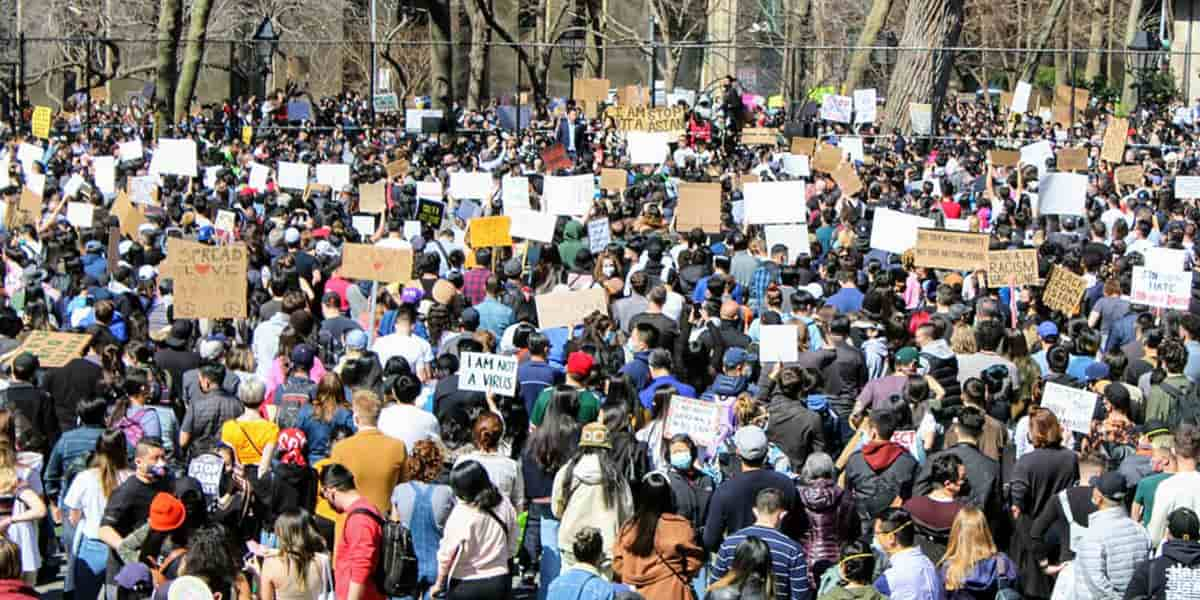
Similarly to the Black Lives Matter movement last year, many people are taking to the streets to protest all forms of racism. Since January, people across the US have been protesting the hate crimes and violence that Asian people have been experiencing for years.
On Sunday, a #StopAsianHate protest was held following a shooting in Atlanta that killed eight people and caused major outrage in the US both due to the attack and the police's response.
Proud to be ones in the March in Atlanta, GA #StopAsianHate pic.twitter.com/dB91gMU7oj
— Yanbing Wang, PhD (@YanbingWang3) March 20, 2021
So, let’s break down exactly what’s happened and what you can do to tackle instances of racism in your everyday life.
What happened in Atlanta?
On Tuesday 16 March, eight people—six of whom were of Asian descent—were shot to death in an attack by a 21-year-old man at three massage parlours in the city.
The man first targeted Young’s Asian Massage in Cherokee County at 5pm and then targeted Gold Spa and then Aromatherapy Spa across the street.
Since the incident, the attacker has been taken into custody and charged with eight counts of murder and one count of aggravated assault.
The victims of Young’s Asian Massage have since been identified by police. Their names were Delaina Ashley Yaun, Paul Andre Michels, Xiaojie Tan, Daoyou Feng.
I want to know their names, who and what they loved, the people they had waiting for them at home, everything they hoped for. I want to know the fabric of their days and the contexts of their lives.
— kat chow (@katchow) March 17, 2021
While the attacker has been taken into police custody and charged, the police have since sparked outrage with their public response to the attack.
At a press conference last Wednesday, Cherokee Country Sheriff’s Office spokesman Captain Jay Baker described that the attacker understood his actions and that he was just “at the end of his rope.”
“Yesterday was a really bad day for him, and this is what he did.”
it's a hate crime. so call it a hate crime.
— Karen Chee (@karencheee) March 17, 2021
Why have protests been happening?
While the attack in Atlanta is one of the first to gain global media attention, racist attacks and violence against Asian people (particularly Asian women) have been rampant in the past 12 months.
protect asian women, asian massage parlor employees, asian sex workers, asian nail techs, undocumented asian people, poor asian folks, asian people who don’t have security & networks and who can’t go to the police for protection. we have to protect us.
— mia sato (@MiaRSato) March 17, 2021
Since the World Health Organisation declared coronavirus as a global pandemic, assumptions about the origin of the virus from Wuhan, China have caused many people to lash out against Asian people in fear of catching COVID-19.
On top of that, politicians and public personalities like Donald Trump consistently referring to coronavirus as the ‘Chinese virus’ or the ‘Wuhan virus’ only further reinforced the stigma.
These kinds of violent attacks against Asian people and communities are not just an American issue. Earlier this month, a video of a teenage boy racially abusing staff at a café in Canberra surfaced online.
Furthermore, a survey conducted by the Asian Australian Alliance last year found that in just two months, there had been over 377 reports of racism, equivalent to 47 instances a week.
Women are also overwhelmingly more likely to get targeted by racist attacks, with 65 per cent of the Asian Australian Alliance survey respondents being women.
How can I challenge racism and discrimination?
So, what exactly can you do in your everyday life to challenge racism towards Asian communities?
Here are some ideas and resources.
Educate yourself.
To start with, do your best to educate yourself on what racism is and how you can personally avoid it.
According to the Australian Human Rights Commission, racism takes many forms and can include prejudice, discrimination, and hatred towards someone because of their skin colour, ethnicity, culture or even religion.
Racism isn’t always obvious either. It can also be reflected through someone’s attitudes, words, beliefs and actions, which can also include discrimination and appropriation.
Call it out.
There are ways that you can call out racism if you feel comfortable and safe enough to do so. You can find out more about ways to call out racism in your personal life here.
Check in with your peers.
Now is a good time to check in with your Asian Australian peers. Have a casual chat with your friends, family and work mates of Asian descent and see how they’re going.
Advocate for awareness.
If you want to make a difference in your school or workplace you can even go a step further and advocate for awareness and inclusion in your classroom.
Encourage your school to teach your peers about what constitutes racism and how to be accepting of everyone, no matter how different they are to you.
While it is clear that instances of racism and racially motivated hate crimes have increased since the beginning of the coronavirus pandemic, Asian Australians and Asian Americans have been facing harsh discrimination and racist behaviour for years, but their experiences are often minimised.
When you see racism happening, you have a moral responsibility to your fellow Americans to stand up and speak out.
— Tammy Duckworth (@SenDuckworth) March 21, 2021
Every individual can make a difference to #StopAsianHate. pic.twitter.com/sjo6IbxlPZ
#StopAsianHate.
Header Image: Twitter (@rachjuramirez)
Topics
Ref: f3efed7e-cb9c-43db-857e-acf30021b931





Comments & Feedback
Share your opinion
Emoji cheatsheet Formatting Comment guidelines