Five Unforgettable Stats About VIC Road Safety: P-Platers Most At Risk; Male Drivers More Likely To Die Than Females
This article is presented in collaboration with the Transport Accident Commission.
Earlier this year, we outlined what happens to the human body in a car crash.
With the help of science (yeah, science!) we learned why exactly our collar bones are often the first to break in a vehicular collision, what happens to our ribcages (spoiler alert: nothing good) and the circumstances in which our bowels rupture mid-crash, causing waste to spill everywhere.
Needless to say, it was shocking stuff, and though no one ever intends to get into a car accident, we figured the gory reality of it all might encourage additional safety on the roads.
The Transport Accident Commission now wants young people to help spread the message, through their Green Man Grants competition. The TAC is offering $50,000 in funding to anyone with a creative solution to encourage road safety, be it a short film, sculpture, app… whatever.
As if the prospect of $50,000 wasn't enough, the TAC is also giving away up to ten individual $5,000 cash prizes to the best submissions selected to pitch their big idea.
But why, you may be wondering, is road safety such a big deal? So glad you asked.
Below, you’ll find five further shocking (Victoria specific) stats about the dangers of driving. Hopefully they’ll remind you that tragedy on the roads affects everyone, especially young people, and that there are easy, important steps we can all take to stay alive.
The more friends you tell, the safer we’ll all be. So, here goes:
1. P-platers are the most at risk on the road.
The most dangerous time to be a driver is during your first six months on a probationary licence, the TAC has found. It’s not necessarily surprising, given that this is when a driver is at their least experienced. That doesn’t mean, however, there aren’t ways for P-platers to fight the statistics. Since 33 per cent of fatal crashes among first year P-drivers occurs between 10pm and 6am at night, you might be better off getting your folks to drive you to and from late evening events where you’ll know there’ll be drinking. Otherwise, find a responsible designated driver (or call an Uber). The numbers do not have to define you.
2. Around one in four drivers killed in Victoria over the last 10 years were between the ages of 18 and 25.
One in four: That’s 24 per cent of all Victorian driver fatalities from the past decade involving millennials, amounting to more than 350 young lives lost. When you consider the fact that this age group only makes up 13 per cent of licence holders within the state, that number seems especially alarming. And yet, it gets even more alarming…
3. In 2015, 67 per cent of young Victorian drivers were killed during "high alcohol times”.
Now, this doesn’t necessarily mean the drivers were over the legal blood-alcohol limit (which is 0.05, BTW). Rather, it just means 67 per cent of young drivers died on the road between the hours outlined below, courtesy of the TAC.
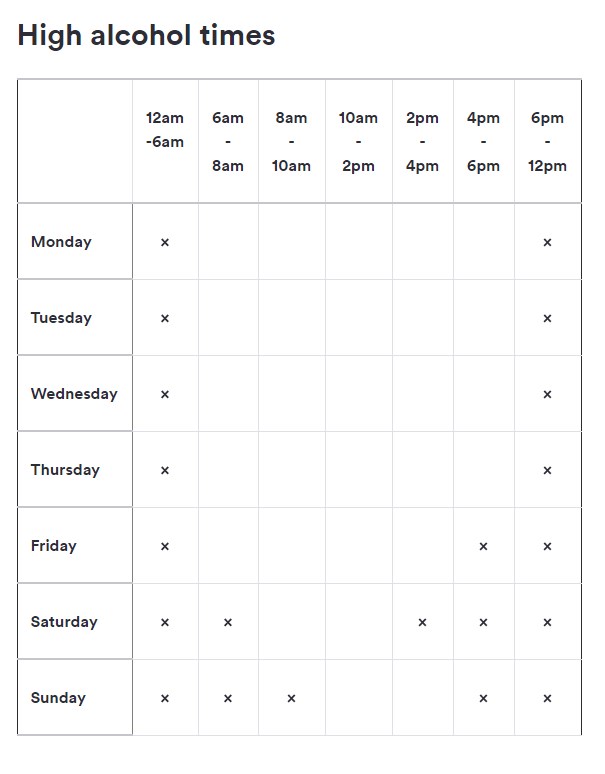
Even if the roads seem emptier late at night, you should always remain on high alert. You may be stone cold sober, but being aware of when others might be over the limit, and driving accordingly, could be the difference between life and death.
4. Males are more likely to be killed on the road than women.
In Victoria, more men are killed in car accidents than women, according to TAC data. The Victorian road toll reveals that an average of 194 men are killed every year (based on the past five years). In contrast, an average of 76 women are killed on the road, annually. Gents, if a friend is getting into their car after having a few too many, take the initiative to call them a cab and ensure they get home in one piece. (And despite the disparity, ladies should be doing the same for their friends too.)
5. In the last five years, 60 per cent of pedestrian deaths took place on roads signposted at 60km/h or lower.
It’s not just drivers at risk. Pedestrians can be fatally struck simply by stepping onto the road a split second too soon. Most astoundingly, 60 per cent of these deaths took place on Victorian roads few would classify as ‘dangerous’ or even ‘fast’, at 60km an hour or lower. A reminder to anyone driving at 60km/h: You may not be travelling at light speed, but your attention and your decisions could still put a life in peril.
If you want to contribute to the conversation and inspire road safety, enter TAC’s Green Man Grants comp here. Entries close October 6, 2016.
Photo: iStock.
Topics
Ref: 37720e60-76a5-4a89-946a-a68700951118





Comments & Feedback
Share your opinion
Emoji cheatsheet Formatting Comment guidelines