Explainer: Donald Trump’s Immigration Ban and What It Actually Means
Donald Trump has proven he can talk the talk, but it’s (terrifyingly) clear now that he will also walk the walk.
U.S. President Donald Trump has signed an executive order to temporarily ban refugees and travellers to the US from seven Muslim-majority countries: Syria, Iran, Iraq, Sudan, Libya, Somalia and Yemen.
The order, which was signed on Friday, will affect more than 134 million people. Trump said the action was taken in order to “[Protect] the nation from foreign terrorist entry into the United States”.
What is the ban and who will be affected?
Donald Trump’s immigration ban will put in place strict regulations on many potential immigrants, and suspends all refugee admissions for four months. “I’m establishing new vetting measures to keep radical Islamic terrorists out of the United States of America,” Trump said. “Don’t want them here.”
Under the ban, all immigration from countries with suspected terrorism concerns will be suspended for 90 days. Trump is insistent his decision will prevent militants from entering the country.
Trump’s decision also involves cutting the intake of refugees by half. Last year—under former President Barack Obama—the U.S. refugee limit was 110,000. Under Trump, this will be slashed to 50,000.
Many have been concerned about what this means for permanent residents and green card holders (having a green card means you have permission to live and work in the U.S. on a permanent basis, but can’t vote in elections). For people falling under those two categories, it appears they are still allowed to board flights to America, but will likely face extra screening tests or be detained on arrival.
Human rights groups have said green card holders trying to return from holidays, business trips or studies are being stopped in foreign airports. Green card holders who are outside the U.S. at the moment are being urged to meet with consular officials to obtain a waiver to return home.
This kid was detained at Dulles airport before finally being reunited with his mother. NOT OK. #TrumpBan #MuslimBan #NoBanNoWall pic.twitter.com/wQuSkD9YMM
— Savanna Davenport (@_vanna_d) January 29, 2017
Interestingly enough, it appears countries where Trump does business have not been hit by the new travel restrictions. The new order makes no mention whatsoever of Turkey, which has been at the centre of several terrorist attacks in recent months. It's understood Trump has licensed his name to two luxury towers in Istanbul, and a Turkish company also manufactures one line of Trump-branded home furnishings.
Saudi Arabia, Egypt, Afghanistan and Pakistan aren't included in the ban, despite commonly documented terrorist activity.
Why has this happened and what are the concerns?
Trump made clear during his campaign he would impose a ban on Muslims from entering the country. It was part of his election strategy, and it appears it paid off. Reporters have criticised Trump for using the ban to further entrench anti-Muslim and Islamophobic sentiments in the U.S.
Suad Abdul Khabeer, assistant professor of Anthropology and African American Studies at Purdue University, says Trump is creating a Muslim "bogeyman". In an article for Al Jazeera she writes: “The way anti-Muslim racism works is that Islam and Muslims are a bogeyman, hated and feared because of how they are “different”, i.e. by how they look and what they do.”
It has been reported by the New York Times absolutely zero terrorist attacks have been committed in the United States by anyone who has immigrated from the seven countries affected by the ban, within the past 15 years.
Civil rights groups have condemned Trump’s actions as harmful and discriminatory. “President Trump has cloaked what is a discriminatory ban against nationals of Muslim countries under the banner of national security,” said Greg Chen of the American Immigration Lawyers Association.
Others, including Chancellor of Germany Angela Merkel, have expressed concern over Trump’s willingness to ignore the Geneva refugee convention—of which the U.S. is a signatory. Under the Geneva convention, all signatory states are obliged to take in war refugees on humanitarian grounds.
What has been the reaction?
Donald Trump has defended the ban, despite public outcry and a weekend of confusion and outrage. “America has always been the land of the free and home of the brave,” said the President. “We will keep it free and keep it safe, as the media knows, but refuses to say.”
He has also criticised the way in which the ban has been labelled, saying: “To be clear, this is not a Muslim Ban, as the media is falsely reporting… This is not about religion—this is about terror and keeping our country safe.”
A number of European countries have condemned Trump’s decision, including Canada, France, Ireland and Sweden. Iran’s former minister, Javad Sarif, has said the ban will be recorded in history as “a great gift to extremists and their supporters… Collective discrimination aids terrorist recruitment by deepening faultlines exploited by extremist demagogues to swell their ranks.”
Meanwhile, Australia has shown support for the ban. Foreign Minister Julie Bishop says the Turnbull government will support Trump’s “strong immigration and border protection policies”. Bishop said the government is working to ensure Australians would continue to have access to the U.S.
“I am confident that the Australian government and the US government will continue to support each other in ensuring that we can implement our strong immigration and border protection policies,” expressed Bishop.
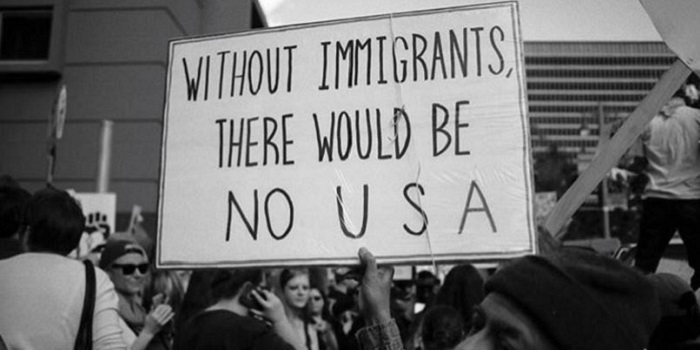
Protesters have gathered in solidarity at airports, and on the streets, to decry the ban.
DC showed up bigly today to protest #MuslimBan. People are organizing and motivated. There is hope. #RefugeesWelcome pic.twitter.com/8sewf4gZNQ
— The Resisterhood (@resisterhood) January 29, 2017
Are you planning on traveling to the United States?
Travel advice to the U.S. has been updated by the Department of Foreign Affairs and Trade. It notes that Australians who are dual citizens of Iran, Iraq, Sudan or Syria are no longer eligible to apply for electronic visa approvals for the U.S. or for the existing visa waiver available to Australian citizens.
Australians who have previously been issued an approval will now, likely, have them revoked. Waivers may be granted by the U.S. Homeland Security Secretary for travellers working for international organisations, state and territory governments, journalists on reporting trips, and Australians who have visited Iran or Iraq for legitimate business-related purposes.
Otherwise, Aussies who have visited any of those seven Muslim-majority nations within the past six years will no longer be allowed to apply for the mandatory security check required for entry to the U.S.
Photo: Twitter (@nikatarani)
Topics
Ref: abdf75d8-0fe5-4d14-b7bd-a70b00050f14




Comments & Feedback
Share your opinion
Emoji cheatsheet Formatting Comment guidelines