Be Sure To Step Outside Tonight Because A Rare Supermoon Will Be Gracing Our Skies
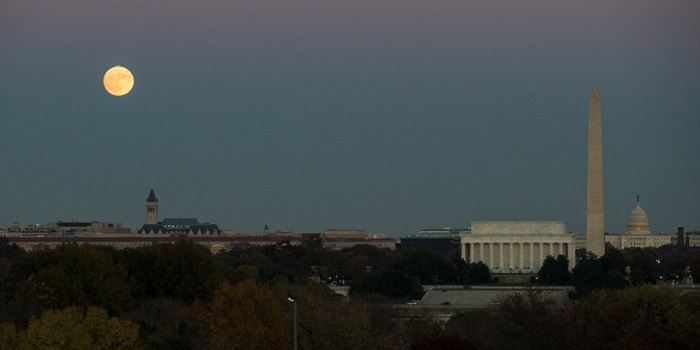
A supermoon occurs when the following criteria is satisfied: The moon must be in its glorious full phase, while simultaneously orbiting very close to Earth.
If you want to get technical, the scientific name for a supermoon is actually a "perigee moon," according to Gizmodo.
What makes these supermoon/perigee moons so unique is that they're up to 14 per cent bigger and 30 per cent brighter than regular ol' full moons.
The last time the moon was ever this close to Earth was in January 26, 1948. Like, before most of us were even born.
NASA reckons the November 14 moon could even be classified as an "extra-supermoon".
It said tonight's moon "is not only the closest full moon of 2016 but also the closest full moon to date in the 21st century." Woah.
In other parts of the world, people have already snapped some beaut pictures and videos.
Vice-president of the Astronomical Society of Victoria Perry Vlahos said skygazers should head to an east-facing beach, or to the top of a hill with uninterrupted views to the east.
"In Sydney, any of the beaches facing towards the east, like Manly or Bondi, would be good. In Melbourne, it would be a beach on the western side of Port Phillip Bay," he said.
If you can't escape the city, then just get to the top of the highest building you can. (Legally, of course).
Melbourne Planetarium astronomer Tanya Hill said Melbourne folk should head out between 7:40pm and 8:09pm to see the ellusive moon. If you're a Sydneysider, you have from 7:07pm to 7:36pm to get in on the action.
You won't require any fancy gear at all, so don't worry about telescopes and all that jazz. Well, apart from a camera, if you want to capture the special moment.
Rod Dickson, Senior forecaster at the Bureau of Meteorology, said cloud cover could obstruct the view although it didn't appear the skies would be "fully overcast".
Happy sky viewing!
Photo: Twitter (@NASA)

Most Popular



Comments & Feedback
Share your opinion
Emoji cheatsheet Formatting Comment guidelines
such a beautiful sight!
I saw it