Album Review: Kesha Finally Gets Her Voice Back on “Rainbow”
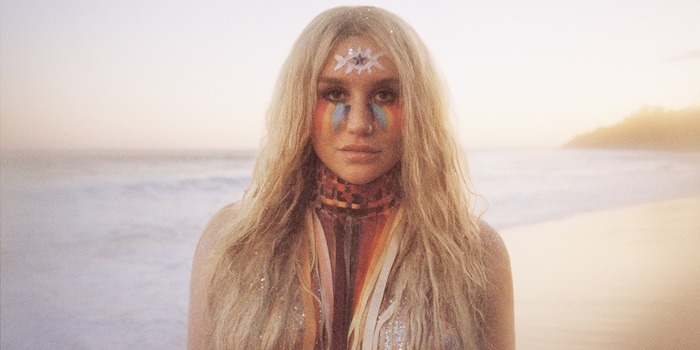
Everything is political, especially these days, and that now includes the music of Kesha. (2017 is weird.)
Having dropped the dollar symbol from her name, Kesha officially begins the Serious Artist stage of her career with Rainbow, a collection of pop songs that sat in purgatory while she engaged in an ugly legal battle with producer Dr. Luke (whom she accused of sexual assault; he was never charged), as well as some anthemic singles that herald her new reputation as a feminist hero.
Furthering 2017’s weirdness, it’s Kesha’s inspirational tunes that ring loudest and best.
Opening with the acoustic “Bastards”, Kesha re-introduces herself, and her impressive pipes, with the refrain, “Don’t let the bastards get you down,” immediately tying the album’s cause to that of The Handmaid’s Tale. (The clarity of the production reminds how Dr. Luke, aka Lukasz Gottwald, would often needlessly obscure Kesha’s voice with autotune; a symbolically disturbing realisation.)
It’s not known which songs Kesha had been sitting on since her last record’s release in 2012, and which ones were based on her recent struggles. I’d bet the Mark Ronson-esque “Woman” is of the more recent variety. Reportedly inspired by Donald Trump’s “grab them by the p****” comment, her clarion call even recruits the many-horned Dap Kings for musical support.
The Dap Kings' former bandleader, Sharon Jones, died in 2016 following a long illness; she blamed Donald Trump for bringing about the stroke that would eventually prove fatal. You can’t help but feel that Jones would have approved of the new Kesha. She wouldn’t be the only legend to offer a co-sign on Rainbow either: Dolly Parton joins her on the southern, “Lucy In the Sky With Diamonds”-evoking cover of “Old Flames (Can’t Hold a Candle to You)”.
No one will accuse “Woman” of subtlety, with its chorus-jumpstarting lyric, “I’m a motherf***ing woman”. Yet on the same song, you can hear Kesha break into a giggle and lose the melodic thread for a moment. We’ve heard her laugh menacingly on a track before, at the start of “Blow”; this time, it’s an organic tease that she’s finally sharing the music she wants, and is excited, to make. (Though, “Blow” still bangs.)
Show-stopping highlight “Praying”, produced by Ryan Lewis, is a direct address to her sexual attacker (even if he goes unnamed), pierced by her climactic scream. It paves the way for “Learn to Let Go”, a carefree slice of sunny, late-oughties pop, which, thanks to its sequencing, carries surprising weight, and makes Rainbow an inspiring survivor's story.
There are more highlights—the sparse, finger-snapping “Hymn”; the Ben Folds-penned piano ballad “Rainbow”; the malicious Johnny Cash inversion, “Hunt You Down”; the infectious throwaway ode, “Godzilla”—than lowlights, which is a first for a Kesha album.
Of the songs that most recall her previous singles, only “Boots”—a darker take on her Pitbull collaboration, “Timber”—could be charitably described as listenable. Her two partnerships with Eagles of Death Metal, “Let ‘Em Talk” and especially the bubble-gum chant “Boogie Feet”, are painfully grating, failing to recapture the giddy, nihilistic abandon of her early, usually-disregarded hits.
But the infrequency of missteps here is an achievement in itself. Pop albums are often a feat of curation; multiple producers and songwriters assembling to create radio-friendly hits in service of an artist’s brand. What becomes apparent on Rainbow is that either Kesha never really held the reins on her persona, or that she’s since grown out of it, emboldened by her personal turmoil and experiences. Kesha without the currency sign is a feminist icon and pop star I’d like to know better, and already feel like I do.
There is a tragic underside to Rainbow’s success, however: Kesha’s quest to be released from her contract with Dr. Luke fell on the deaf ears of the court, and, as the New York Times reports, her first album in five years remains a product of Dr. Luke’s Kemosabe Records. Not only is Gottwald entitled to Rainbow’s profits, she owes him two more records.
If you think it’s strange we’re considering Kesha as a Serious Artist in 2017, consider the fact that over the next few years, she may be further embedded in our minds as a model of resilience and protest. Stranger still, it seems she’s up to the task.
3.5/5
Rainbow is now available
Mild coarse language.
Photo: Sony
Topics
Ref: 0dcd8abd-72ed-4deb-8911-a7cf0054ac25






Comments & Feedback
Share your opinion
Emoji cheatsheet Formatting Comment guidelines