Change the Date? 60 Per Cent of Students Want to Keep Aus Day on 26 Jan
But the reasons behind the response might surprise you.
Last week, Triple J announced they would be moving their Hottest 100 countdown to the fourth weekend of January after mounting pressure by their listeners and some within the music industry.
Triple J decided that, for everyone to enjoy the countdown, they would need to change the date from Australia Day due to its negative association among the Indigenous community.
"There were a lot of different perspectives about 26 January, and different ways to approach Australia Day," Triple J wrote online.
"But when it came to the Hottest 100, it was clear most people want the Hottest 100 to be on its own day when everyone can celebrate together."
Since then, the announcement has been embroiled in controversy, from members of the government demanding Triple J change it back, to a slew of angry opinion pieces.
Imagine being a politician mad The Hottest 100 won't be on Australia Day when Australia Day has only been on Australia Day since the year Shawshank came out
— Wil Anderson (@Wil_Anderson) November 27, 2017
To settle the issue, Student Edge held a survey asking students what they thought of the changes to the Hottest 100, and what they thought about Australia Day being held on 26 January, generally.
We found that little more than a quarter (27 per cent) of the 845 students we asked were opposed to Triple J changing the date of their countdown, while 43.7 per cent were unsure or didn't believe the changes affected them.
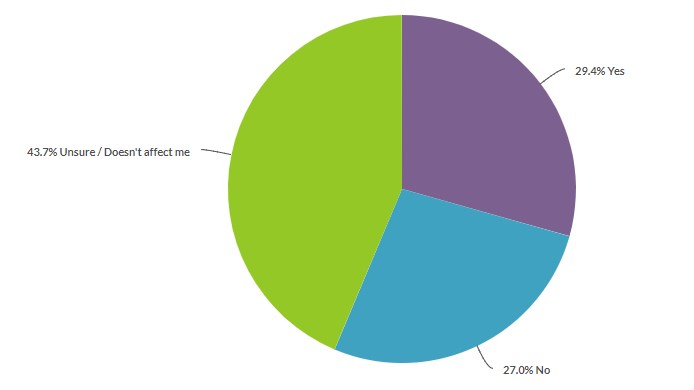
Of those who responded to the survey under the age of 18, 25.8 per cent were opposed, compared to 28 per cent of those aged over 18.
But when we asked if we should change the date of Australia Day, a different story emerged.
Almost 60 per cent were opposed to changing the date of the public holiday, while 28.2 per cent were for it.

Surprisingly, 10.8 per cent of students under 18 stated they were unsure or didn't believe it affected them, while 14.2 per cent of students over 18 admitted the same.
What is most interesting, perhaps, are the explanations for their responses.
In the pro-'Change the Date' camp, students explained it was important to be respectful and understand why changing the date mattered to Indigenous Australians.
"Australia Day should be a day that celebrates Australia's diversity and that brings everyone in Australia together despite their differences," one student wrote. "The current date of Australia Day is disrespectful and not inclusive of everyone."
Another explained that we shouldn't focus on the mildly inconvenient repercussions if the date was to be changed.
"I think it's important to listen to minority groups about issues that pertain to them rather than just dismissing it because we believe it could be mildly inconvenient to us," the respondent explained.
Australia is a country that is egalitarian, embraces the equality of individuals and compassion.
— Nakkiah Lui (@nakkiahlui) November 28, 2017
Changing the date of Australia Day so that it is inclusive of ALL Australians isnt a political act. It's Australian.
Wanting to keep it on a day that excludes many is UN-Australian.
When it came to the 'no' voters, things got a bit ambiguous.
Not all were against changing the date because of what it represented to them.
"I think changing the date is a band-aid solution," one student said. "It doesn't really address substantial issues of inequality which still exist."
Another explained that the date should remain, but the way we celebrate the day might need to be reconsidered:
"I think that the idea of Australia Day is based off good intentions but in respect of Indigenous Australians, maybe the way in which we approach it could be changed."
Another echoed these sentiments:
"You can't erase Australia's bad history so instead Australia Day could be used as an excuse to acknowledge and apologise for the horrendous invasion and past as well as celebrate the country for what it is today. Unfortunately changing the date will not fix what happened centuries ago by no one who is alive today."
What became clear with some responses was that there was a fundamental misunderstanding of history.
Some students claimed Australia Day has always been held on 26 January, and it should remain that way, while others explained that it was the day Captain Cook landed and that history cannot be rewritten.
Though 26 January, 1788 was the day members of the First Fleet allegedly held a small ceremony to celebrate their arrival, they had actually arrived in Port Botany a few days earlier. Captain Cook was nowhere near Australia during this week. He had first come to the area 18 years earlier.
It's another misconception that Australia Day was always held on 26 January.
1994 marked the first year all states and territories recognised Australia Day in unison with a public holiday; prior to that, it wasn't until the 1940s that all states adopted a common date and name.
What's most important about this whole discussion is better understanding the issues that remain at the forefront: What is Australia Day to our nation and, if it is meant for everyone, what are we doing to make sure that's the case?
To have your say in our surveys, join the Student Edge Surveys panel here.
Photo: iStock.com/candice84
Topics
Ref: a4a22005-08f4-43d5-8d2c-a83f0051f52c






Comments & Feedback
Share your opinion
Emoji cheatsheet Formatting Comment guidelines